VT4VT started collecting municipal grand lists to document what Vermont’s reassessment cycle is actually doing to property values and tax bills. The first concern was obvious: homeowners, farms, camps, rental properties and land were being reassessed, sometimes dramatically. But after reviewing New Haven, Colchester and now Stockbridge, another pattern is becoming impossible to ignore.
Utility infrastructure and major commercial property are also being reassessed upward, sometimes by millions or tens of millions of dollars. Those properties are different from a private home because the tax does not simply end with the company that owns the parcel. Businesses recover operating costs through the prices they charge, and regulated utilities recover approved costs through the rates paid by customers. In Vermont, property taxes are explicitly included among Green Mountain Power’s non-power costs under its regulatory structure.
That means a large increase in the property-tax bill on electric, gas, transmission or communications infrastructure can eventually become part of what Vermonters pay for electricity, natural gas, internet, telephone service and other products and services. The assessments themselves are now visible in the municipal records, and the size of some of the increases deserves far more attention than it has received.
Stockbridge Shows How Fast the Numbers Can Move
Stockbridge provides the clearest example so far because VT4VT now has the 2025 Grand List, the completed 2026 reassessment and the actual 2026 tax bills.
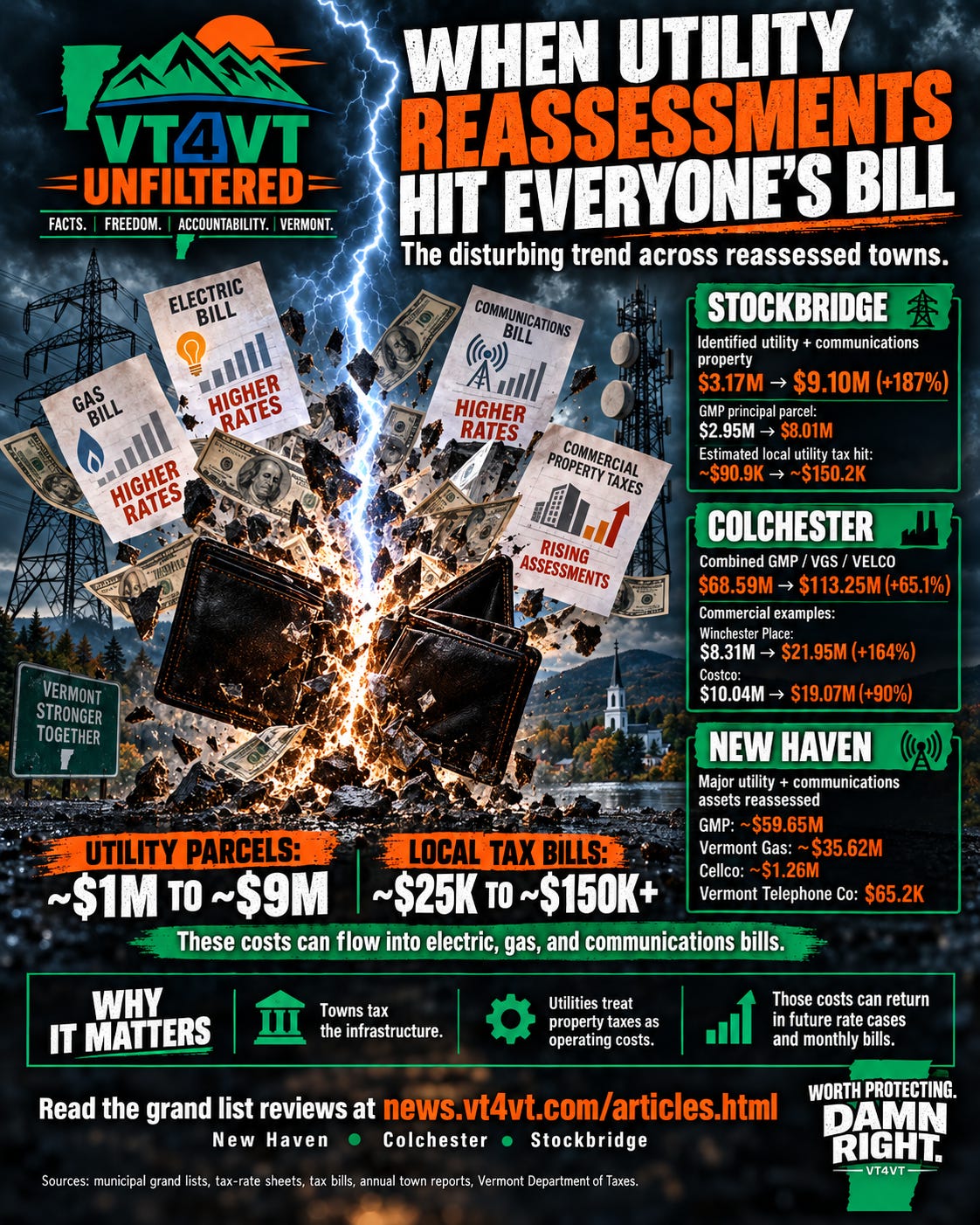
Green Mountain Power’s principal transmission-line parcel on Blackmer Boulevard was assessed at approximately $2.95 million in 2025. After reassessment, the same parcel was valued at $8.01 million, an increase of roughly 171 percent. The 2026 Stockbridge tax bill on that single property is $148,640.39, including approximately $92,565 in education property tax and $56,076 in municipal tax.
Using the prior assessment and Stockbridge’s 2025 non-homestead rate, that property was carrying a tax obligation in the neighborhood of $90,000 before reassessment. The new bill approaches $150,000. That is roughly $60,000 more in annual property taxes on one utility parcel, and there are additional GMP properties in the town.
The aggregate result is even more significant. VT4VT identified approximately $2.99 million of GMP property in Stockbridge in 2025 and approximately $8.09 million in 2026, an increase of roughly $5.1 million, or 171 percent. Vermont Trans Co’s fiber-optic and equipment property increased from $182,500 in 2025 to approximately $1.01 million in 2026, an increase of more than 450 percent. The 2025 Grand List identifies that property as fiber optics and equipment on Blackmer Boulevard.
Combined, the major GMP and Vermont Trans Co property VT4VT identified in Stockbridge moved from roughly $3.17 million to $9.10 million. That is an increase of approximately $5.93 million in assessed utility infrastructure in one small Vermont town.
Colchester Is the Same Story on a Much Larger Scale
Colchester produced a much larger utility footprint, and the increases were substantial across several companies.
VT4VT’s Colchester analysis found that aggregate Green Mountain Power property increased from approximately $37.91 million to $59.65 million, or 57.3 percent. Vermont Gas property increased from approximately $20.91 million to $35.62 million, or 70.3 percent, while VELCO increased from approximately $9.77 million to $17.99 million, or 84.2 percent.
Taken together, those three utility groups increased from approximately $68.59 million to $113.25 million. That is $44.67 million in additional assessed utility property, an increase of 65.1 percent.
The principal parcels show the scale clearly. GMP’s major Colchester property increased from approximately $29.98 million to $50.96 million. Vermont Gas’s principal property went from approximately $20.33 million to $34.44 million, and VELCO increased from approximately $9.77 million to $17.99 million.
These are not abstract percentages. A higher assessment multiplied by the applicable tax rate produces a higher property-tax obligation. Those property taxes become part of the expense of operating the infrastructure Vermonters depend on every day.
Commercial Property Is Being Hit Too
Colchester also demonstrates that the issue reaches far beyond regulated utilities.
Champlain Housing Trust’s Winchester Place property increased from approximately $8.31 million to $21.95 million, an increase of about 164 percent. Costco’s Lower Mountain View Drive property increased from approximately $10.04 million to $19.07 million, about 90 percent. Sunderland Farms properties experienced increases exceeding 150 percent in some cases.
A commercial property owner does not absorb an unlimited increase in expenses without consequences. Property taxes become part of the cost of operating the building or business. Those costs are reflected through rents, prices, fees, reduced margins, lower investment or other operating decisions.
The mechanism is even clearer with regulated utilities because Vermont’s regulatory system explicitly recognizes property taxes as a utility expense.
Green Mountain Power Already Has Tens of Millions in Municipal Taxes
Green Mountain Power’s own regulatory filings put the statewide issue into perspective.
Under its previous multi-year rate framework, GMP projected $37.203 million in municipal taxes for FY2024, $38.642 million for FY2025 and $40.136 million for FY2026. Those municipal taxes were listed as part of the company’s cost of service.
The Vermont Public Utility Commission describes property taxes as part of GMP’s fixed non-power costs, alongside infrastructure, operations and maintenance, financing costs and other expenses. Those are costs built into the regulatory structure used to determine how much revenue the utility needs to collect.
That is why the municipal grand lists matter outside the towns where the utility property sits. If property-tax obligations increase across dozens of reassessed communities, GMP’s statewide municipal-tax expense increases. Customers finance the utility’s approved revenue requirement through their electric rates.
A tax that appears locally to have been shifted onto the utility does not disappear. It enters the utility’s cost structure and is ultimately financed by the customers buying the service.
This Is Happening While Electric Rates Are Already Going Up
The timing makes the trend more important.
Green Mountain Power customers will see a 5.5 percent rate increase beginning October 1, 2026. GMP originally requested a 7.5 percent increase, and the Public Utility Commission approved 5.5 percent after reviewing the filing. GMP serves more than 275,000 Vermont customers.
Other Vermont electric utilities are also seeking substantial increases. The Public Utility Commission’s current docket includes Stowe Electric seeking 14.6 percent and Barton seeking 14.73 percent, while Jacksonville has requested 17.72 percent. Vermont Public has reported requests of roughly 30 percent in Swanton and about 15 percent in Hyde Park.
Those utilities have many expenses, and property tax is one of them. Fuel, transmission, storms, labor, healthcare, financing and infrastructure investment all contribute to utility costs, but adding sharply higher property taxes does not make electricity cheaper. It adds another expense that has to be paid.
This is the part of the reassessment discussion that has received almost no attention.
The Cost Can Leave One Town and Come Back on Everyone’s Bill
There is an obvious attraction for a municipality when a large utility parcel is reassessed upward. If a utility carries a larger portion of the town’s taxable Grand List, other properties may carry a smaller share than they otherwise would.
But Vermonters should follow the transaction all the way through.
Consider the Stockbridge GMP parcel. The assessed value went from roughly $3 million to $8 million, and its tax obligation moved from roughly $90,000 toward $150,000. Stockbridge gets the additional property-tax revenue from the utility, but GMP does not manufacture the money used to pay that bill. It earns its revenue from customers.
Now multiply the same process across GMP infrastructure in town after town.
Colchester alone added approximately $21.7 million to the assessed value of identified GMP property. Add Vermont Gas and VELCO and the three utilities gained roughly $44.7 million in assessed value in one municipality. Stockbridge added another roughly $5.9 million among the major utility properties VT4VT identified.
VT4VT has reviewed only a fraction of Vermont’s municipalities.
New Haven Was the Warning; Colchester and Stockbridge Strengthened the Pattern
The New Haven investigation was the first VT4VT Grand List case study that pushed the project to start looking beyond homeowners and toward utility infrastructure. The town’s reassessment produced major changes across its tax base and raised the question of what was happening to utility and communications property as Vermont’s reassessment cycle expanded.
Colchester then provided enough parcel-level information to aggregate GMP, Vermont Gas and VELCO values and measure the changes directly. Stockbridge has now added something Colchester did not initially give us: the actual post-reassessment tax bills showing what those new assessments mean in dollars.
That progression matters. We are no longer looking only at theoretical changes in assessed value. In Stockbridge, the bill exists.
This Could Become a Statewide Cost Shift
Approximately 40 Vermont municipalities have now completed townwide reassessments, and more are coming. If the utility increases VT4VT found in Colchester and Stockbridge appear across even a portion of those communities, the aggregate increase in taxable utility property could become very large.
The statewide investigation therefore needs to follow the same properties through every stage: old assessment, new assessment, old tax rate, new tax rate, old tax obligation, new tax obligation, and eventually the utility’s regulatory filings.
That is how Vermonters will be able to see the full transaction.
The town reassesses the utility property. The tax bill rises. The utility records a higher operating expense. The cost becomes part of the utility’s financial requirements, and customers finance those requirements through their rates.
The same basic economic reality applies to commercial property, although without the regulated-rate process. Higher taxes on a store, apartment complex, manufacturer, hotel or other business become part of the cost of providing whatever that business sells.
Vermont’s Reassessment Numbers Are In. We Need Your Help
The Grand Lists Are Showing Us Something Bigger
VT4VT began this project because Vermonters were reporting enormous reassessment increases on their homes. Those concerns remain real, but the public records are now showing that the effect reaches well beyond individual homeowners.
Utility infrastructure is being reassessed. Commercial property is being reassessed. Communications infrastructure is entering the taxable picture in ways that need additional examination. At the same time, electric rates are already rising and businesses across Vermont continue to face higher operating costs.
The disturbing trend is not simply that property assessments are going up.
It is that the reassessment may create costs that move throughout Vermont’s economy long after the municipal Grand List is finalized. A large increase on a utility parcel can eventually appear in an electric or gas bill hundreds of miles away. A large increase on commercial property becomes another expense embedded in rents, goods and services.
Those are still property taxes. Vermonters simply pay them through a different bill.
Read the VT4VT Grand List Investigations
The continuing Grand List and reassessment series is collected at VT4VT Grand List and Reassessment Articles. The published and developing case studies include New Haven, the first complete VT4VT public-record case study; Colchester, where the utility and commercial-property analysis became a major part of the investigation; and Stockbridge, VT4VT Town Reassessment Report VT4VT-FY2027-006/25/26-A, which now includes the completed reassessment and actual 2026 tax bills.
The Colchester report can be read directly at Colchester Reassessment — The Grand List. Stockbridge will join the report index as Report 006.
Sources
Town of Stockbridge, 2025 Billed Grand List.
Town of Stockbridge, 2026 Tax Bills, including Green Mountain Power transmission property.
VT4VT, Colchester Grand List methodology and utility aggregation, documenting GMP, Vermont Gas, VELCO and major commercial-property changes.
Vermont Public Utility Commission, Green Mountain Power Multi-Year Regulation Plan, identifying property taxes as part of non-power costs.
Green Mountain Power, Cost of Service Adjustment Detail, showing municipal-tax forecasts of $37.203 million in FY2024, $38.642 million in FY2025 and $40.136 million in FY2026.
Vermont Public and VTDigger, September 2026 GMP rate decision, documenting the approved 5.5 percent increase effective October 1.
Vermont Public Utility Commission, current 2026 electric rate proceedings, including Stowe, Barton and Jacksonville.
VT4VT is continuing to collect municipal Grand Lists, reassessment notices and tax bills so these costs can be measured town by town. The statewide Grand List database, reassessment survey and related research are available through VT4VT.com.
Worth Protecting. Damn Right.