During one of Vermont’s worst affordability periods in modern memory, the State moved forward with one of the most consequential property valuation changes in recent Vermont history.
The bill was H.480, later enacted as Act 68 of 2023. Its title was simple: An act relating to property valuation and reappraisals. But the consequences are not simple.
The Vermont Legislature’s own bill record identifies H.480 as a bill of the House Committee on Ways and Means, not as a bill sponsored by one individually named legislator. The same official bill page lists Roll Call Votes (0) and states that Governor Phil Scott approved the bill on June 14, 2023. (Vermont General Assembly)
That matters.
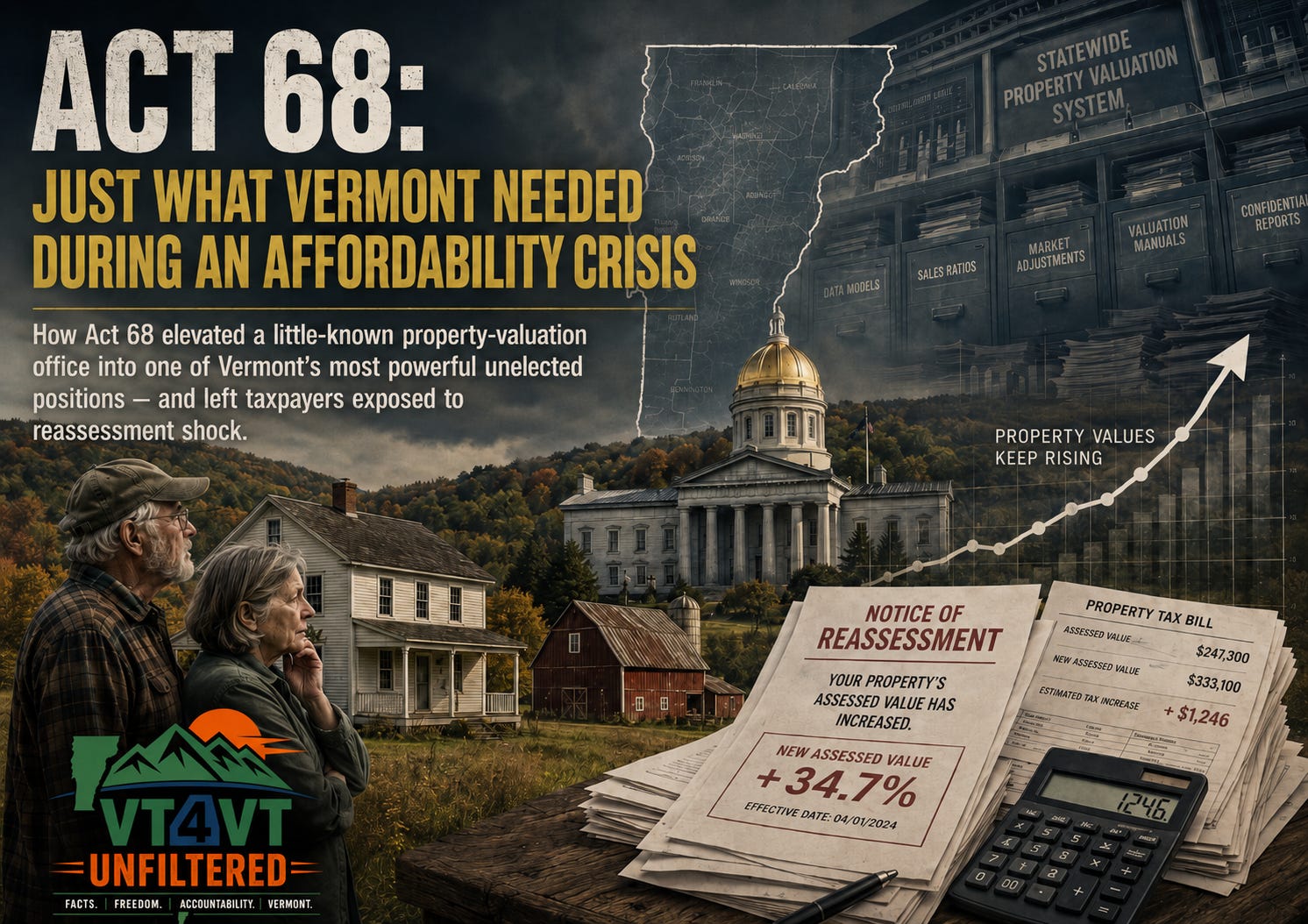
A law now affecting virtually every property owner in Vermont entered the public record through committee. The official bill page does not show a recorded floor roll-call vote identifying how each legislator voted. It moved through the committee process, passed the Legislature, and became law.
Now the reassessments are arriving.
The tax bills are next.
Vermont’s Affordability Backdrop
Act 68 did not arrive in an economic vacuum.
Vermont’s population is barely growing. The U.S. Census Bureau estimates Vermont’s July 1, 2025, population at 644,663, compared with a 2020 estimate of 643,077, a change of only 0.2%. Census data also show that 24.1% of Vermonters are age 65 or older, while only 17.0% are under 18.
At the same time, Vermont’s school system is serving fewer students. The 2024 Vermont State Education Profile Report says total Vermont public school enrollment declined from 88,343 students in 2003-04 to 82,828 students in 2022-23, a 6.2% decline. K-12 enrollment fell more sharply, declining 14.2% over the same period.
The rural economy has also changed. Vermont Public reported in 2025 that Vermont had 868 dairy farms a decade earlier and 439 at the time of reporting. The article states that most closures were of small- and medium-sized farms, while dairy still makes up two-thirds of Vermont’s total agricultural sales.
Manufacturing is not carrying the state the way it once did. Federal Reserve Economic Data, using U.S. Bureau of Labor Statistics data, listed Vermont manufacturing employment at 27,700 workers in May 2026. That is not an expanding industrial base capable of absorbing unlimited new household costs.
Housing costs moved in the other direction. Vermont’s 2025 housing data show that the price of homes sold increased 156% from 2001 to 2024, while household income increased 72% over the same period. That is the key affordability gap: home values rose more than twice as fast as household income.
The same housing report shows the recent shock more clearly. From 2021 to 2024, Vermont’s median primary home price increased from $259,900 to $340,000, a 31% increase. The income needed to afford the median-priced home increased from $68,394 to $110,000, a 61% increase.
Property taxes were already a major burden before Act 68 reassessments fully arrived. The Lincoln Institute of Land Policy reported that, in 2020, Vermont had the second-highest property tax burden in the nation as a percentage of personal income. It also noted that Vermont is one of only four states with no state-imposed limitation on property tax rates, levies, or assessments.
More recent reporting shows the pressure continuing. VTDigger reported that education property taxes had risen more than 40% in five years, according to the Tax Department, while student enrollment had dropped. The same report said Vermonters could see a nearly 12% property tax increase in 2026 based on early state estimates.
That is the backdrop.
Flat population. An aging state. Declining K-12 enrollment. Fewer dairy farms. A limited manufacturing base. Housing prices are growing faster than income. Property taxes already among the highest in the country.
Then Vermont chose to bring property values current against the COVID-era real estate market.
That may solve an assessment-uniformity problem.
It does not solve an affordability problem.
What Act 68 Did
Act 68 changed Vermont’s reappraisal system.
Current Vermont law requires each municipality to begin a full reappraisal no later than six years after the start of its most recent full reappraisal, unless a longer period is approved by the Director of Property Valuation and Review. The same statute gives the Director authority to order reappraisal when a municipality’s education grand list has a coefficient of dispersion greater than 20 or when the municipality has not reappraised on time. (Vermont General Assembly)
That statute also provides $8.50 per grand-list parcel per year for reappraisal and grand-list maintenance and allows the State to withhold education, transportation, and other funds if a municipality fails to submit or carry out an acceptable compliance plan. (Vermont General Assembly)
The State’s argument is straightforward: Vermont’s grand lists were outdated, inconsistent, and inequitable.
In its December 2024 report, the Vermont Department of Taxes said that Vermont’s property valuation system had long-standing structural problems that had been made worse in recent years. The report stated that municipalities were struggling to find reappraisal firms, small towns were often not financially viable for contractors, and many towns also struggled to find people willing to serve as listers and assessors.
The report said 135 municipalities were actively under reappraisal orders; 60 towns, or 24%, had not had a reappraisal in more than 15 years; the average last reappraisal year was 2016, and towns were already booking reappraisals into 2026–2029.
That is the State’s case.
Outdated grand lists can create unfairness between taxpayers. One property may be assessed close to market value while another similar property remains far below market value. In that narrow assessment sense, regular reappraisal can correct inequity.
But that is not the whole story.
The State Fixed Assessment Equity. It Did Not Fix Affordability.
The Department of Taxes framed the problem as an administrative and valuation problem.
The December 2024 report recommended:
multi-town assessment districts;
full-time paid assessment district staff;
assessment district staff replacing current municipal elected listers and/or appraisers;
standardized reappraisal contracting;
assessment district appeal boards instead of Boards of Civil Authority;
either a State valuation appeals board or professionalized PVR hearing officers;
changing the grand-list assessment date from April 1 to January 1;
statewide CAMA data standards;
Improved parcel data.
That is not a minor technical adjustment. It is a blueprint for restructuring Vermont’s property valuation system.
The missing piece is taxpayer protection.
The Department’s report recommends new assessment districts, regional professional staff, standardized contracts, appeal reform, data modernization, and a more centralized valuation structure. It does not recommend a targeted protection plan for the Vermonters most exposed to reassessment shock: elderly homeowners, retired residents, veterans, fixed-income households, low-income property owners, long-term residents, farmers, or people living in economically distressed rural towns.
It does not recommend an assessment cap. It does not recommend a tax-bill phase-in for sudden increases. It does not recommend special protections for towns with weak commercial tax bases, limited employment, declining school enrollment, or depressed local economies.
Existing Vermont programs still matter. Homestead classification, income-based property tax credits, Current Use, and certain exemptions may reduce the burden for some taxpayers. But those programs are not the same thing as Act 68 reassessment-shock protection.
That is the gap.
Vermont built a system to correct paper values. It did not build a system to protect the people forced to live under those new numbers.
The Accountability Gap: Act 68 and Vermont’s Expanding Valuation Bureaucracy
Act 68 also exposes a larger Vermont bureaucracy issue.
Vermont has roughly 645,000 people. Census data show Vermont’s population has barely changed since 2020, while nearly a quarter of the state is now age 65 or older. Yet the administrative structure governing those taxpayers keeps becoming more centralized, more technical, and more insulated from direct voter control.
Property valuation is now one of the clearest examples.
Act 68 did not create the Director of Property Valuation and Review. That office already existed. What Act 68 did was create the conditions that made the position one of the most consequential unelected offices in Vermont government.
The Director is not elected by Vermont voters. Under Vermont law, the Director is an exempt employee appointed by the Commissioner of Taxes, with the concurrence of the Secretary of Administration. The Division itself sits inside the Department of Taxes, within the Agency of Administration.
That is indirect accountability, not direct accountability.
The Director does not set school budgets, approve municipal spending, vote on local tax rates, or mail individual tax bills. But the office sits directly over the machinery that determines when towns must reappraise, whether towns comply, whether a longer reappraisal cycle will be approved, what training requirements assessors and listers must meet, and how reappraisal rules are administered.
That is not direct taxing power in the ordinary sense. The Legislature creates the education-finance system. Local voters approve school and municipal budgets. Municipalities issue the tax bills. But the valuation system is the foundation underneath all of it. Change the grand list, and you change the base on which the tax burden is distributed.
That is power.
Act 68 did not itself create assessment districts, replace Boards of Civil Authority, or complete a statewide takeover of local assessing. Those changes remain recommendations in the Department of Taxes’ 2024 Act 68 report. But Act 68 did more than require towns to reappraise every six years. It created the statutory reporting process that led directly to the State’s broader restructuring plan.
That report recommends moving Vermont from a town-by-town valuation structure toward multi-town assessment districts, regional assessment staff, State involvement in reappraisal contracting and oversight, standardized contract terms, and valuation appeals heard by assessment district boards instead of local Boards of Civil Authority.
That is the direction of travel. The State’s argument is efficiency, consistency, and valuation equity. The taxpayer’s question is accountability. When an assessment doubles, the homeowner cannot vote out an assessment district. When paper wealth rises but income does not, the system has no clear answer for the person expected to pay the bill.
Vermont is not simply updating old grand lists. It is building a more centralized property-valuation apparatus with enormous influence over household finances. The State’s own report says Vermont’s grand list contains approximately 340,000 active parcels, is valued at around $120 billion, raises over $1.4 billion for education, and raises over $600 million for municipal services.
A system with that much power over household finances should not move faster toward centralization than it moves toward taxpayer protection.
Paper Wealth Is Not Income
The core problem is simple: paper wealth is not income. A home can double in assessed value without the owner becoming wealthier. A retired couple may see their house double on the grand list, but their Social Security check does not double with it. A veteran may own land that increased in assessed value, but that does not mean disability compensation increased. A farmer may own acreage that looks valuable in a database, but that does not mean the land produces enough income to carry the tax bill.
For many long-term Vermonters, nothing changed except the number assigned to their property. They did not sell. They did not cash out. They did not buy during the COVID housing boom. They did not bring out-of-state purchasing power into the market. Someone else sold. Someone else paid the inflated price. Someone else reset the comparable sales data. The longtime owner stayed put.
Then the assessment arrived.
What VT4VT Is Seeing
VT4VT’s reassessment survey and public-record review are documenting the household-level impact.
Preliminary survey responses have shown assessment increases near or above 100% in multiple towns, with some reported increases far higher. Examples submitted through the survey include:
Winhall: $220,000 to $975,000;
Holland: $84,000 to $274,000;
Cambridge: $190,000 to $590,000;
Lyndon: $347,000 to $847,000;
Barre City: $155,000 to $300,000.
These are survey-reported figures and must be separated from verified municipal grand-list records until confirmed town by town. But they show why Vermonters are alarmed.
Public records from towns such as New Haven already show the broader pattern: grand lists rising sharply, individual assessments rising dramatically, and tax bills becoming the next major question.
This is not just about whether an assessor followed the model.
This is about whether the model makes sense when market value and ability to pay are separated.
What Vermonters Are Saying Online
Public records tell one part of the Act 68 reassessment story.
Public comments are telling another.
Over the last 60 days, VT4VT reviewed comments and engagement from TikTok videos, VT4VT Facebook posts, Rural Vermont Rising discussions, and related Facebook comment threads. These comments do not prove statewide tax outcomes by themselves. They are not grand lists. They are not tax bills. They are not municipal records.
They are field reports.
VT4VT is treating them as a public concern, not final proof. The next step is verification through grand lists, tax bills, town records, appeal outcomes, and published state education tax rates.
But the pattern is hard to ignore.
TikTok: Views, Shares, Saves, and Public Reaction
TikTok has provided the clearest engagement data so far.
From the TikTok analytics reviewed by VT4VT, videos with available statistics generated at least 23,000 views, hundreds of comments, more than 300 shares, more than 200 saves, and more than 300 new followers. The strongest-performing videos were not general political messages. They were videos about Act 68, reassessments, property taxes, and the VT4VT reassessment survey.
The strongest TikTok video reviewed generated more than 7,400 views, 557 likes, 129 comments, 176 shares, 97 saves, and 183 new followers. Another Act 68 video generated more than 4,300 views, 245 likes, 100 comments, 68 shares, 34 saves, and 56 new followers. A survey-launch video generated more than 4,300 views, 182 likes, 59 comments, 50 shares, 32 saves, and 39 new followers.
That matters because shares and saves usually indicate more than casual scrolling. People were not just reacting. They were preserving the information, passing it along, and using the comment sections to compare what was happening in their own towns.
TikTok commenters reported concerns from Randolph, Colchester, Hinesburg, St. Albans, Barre, Westmore, Springfield, and other Vermont communities. One Randolph commenter reported a home value increasing from about $116,000 to $281,000, with taxes rising from about $2,500 to almost $6,000. A Hinesburg commenter said property taxes had roughly doubled. A St. Albans commenter questioned whether a home assessed at $300,000 could actually sell for that amount. Another commenter raised concerns about a grandmother on a fixed income.
TikTok also produced repeated appeal-related comments. One commenter said they filed and were denied. Another said they went to town hall expecting a fight, objected to the assessment, and were surprised when the objection was accepted. Others asked what homeowners are supposed to do when their assessments double.
The TikTok comments also show the same confusion appearing across Vermont: some people understand that tax rates may fall after a townwide reassessment, while others are focused on the final bill they may actually have to pay.
Both concerns can be true at the same time.
A reassessment by itself does not automatically increase the total amount of taxes a town collects. But a reassessment can change who pays what share of the tax burden. If one property increases faster than the town average, that property may carry a larger share. If school spending rises, municipal spending rises, state education tax rates remain high, or CLA timing does not fully match the new grand list, final bills may still increase.
That is why VT4VT is collecting both numbers: assessment changes and actual tax bills.
Facebook: Longer Comments, More Detailed Concerns
Facebook comments are less useful for clean analytics because full view, save, and share data were not available in the material reviewed. But Facebook produced longer comments and more detailed explanations from property owners, residents, and people familiar with local assessment processes.
Across Rural Vermont Rising, VT4VT posts, and related Facebook discussions, Vermonters reported sharp assessment increases, confusion about tax-rate offsets, concern about education property taxes, and fear that paper increases in property value may turn into real bills they cannot afford.
Commenters reported properties doubling in assessed value. One person stated that a property went from about $250,000 to $500,000. Another described an unchanged property going from roughly $140,000 to $280,000. A Colchester commenter reported that a mobile home assessment increased from about $50,000 to $162,000 after a land-tax issue involving mobile home co-ops.
Other Facebook comments described larger rural and camp-property increases. One commenter said a Morgan camp or cottage increased from about $235,000 to $550,000, with taxes rising by roughly $3,000 and reaching more than $8,000 per year. Another commenter reported that properties in Morgan and North Troy doubled or tripled in value after recent reassessments, with one tax bill increasing by about $2,000.
Farm and working-land concerns also appeared repeatedly. One farm owner reported an assessment moving from about $56,000 to $300,000, with an expectation that it could exceed $500,000 after house updates were completed. The owner’s concern was not that the land had no value. The concern was that reassessment converted an unrealized paper value into a potential tax burden, even though farm income had not increased with the assessment.
Several Facebook commenters reported tax bill increases directly. One person said their taxes doubled after reassessment. Another reported a 30 percent tax increase after a townwide reassessment. Others stated that taxes had already doubled over several years and could rise again after the new assessment cycle.
Appeals and grievance concerns also appeared. One commenter with experience as a broker, appraiser, and former board of listers member stated that he reduced his assessment by $130,000 after appeal, while noting that many property owners never appeal. Another commenter said a flood-damaged and unlivable home increased in assessed value and had to be contested.
The Facebook comments also show a more technical public debate. Some commenters argued that if assessments rise, tax rates should fall. Others warned that Vermont’s statewide education property tax system makes the result more complicated than a simple municipal tax-rate adjustment.
That confusion is one of the most important findings.
Many Vermonters understand that a town budget is supposed to be spread across the grand list. But many are also trying to understand how local budgets, school budgets, state education tax rates, CLA adjustments, homestead status, non-homestead property, current use, property tax credits, and grievance outcomes all interact after reassessment.
That is not a simple public communication problem. It is a structural problem.
If ordinary property owners cannot reasonably predict whether a reassessment will raise, lower, or redistribute their tax burden, then Vermont has a transparency problem.
The Pattern Across Platforms
TikTok showed scale.
Facebook showed details.
Together, the comments show a public that is worried, confused, and actively trying to understand what Act 68 reassessments mean for real households.
The strongest concern is not merely that assessed values are rising. The strongest concern is that Vermont is moving properties toward market value without enough visible protection for people whose income did not rise with the market.
A homeowner’s assessment can double on paper without that homeowner’s income doubling in real life.
A retiree’s pension does not rise because nearby homes sold for more.
A farmer does not earn more because the surrounding rural land has become more desirable.
A camp owner, landlord, renter, small business, or longtime resident may still face higher costs even if the tax mechanics are more complicated than a simple assessment increase.
The public-record question is now straightforward:
Are lower tax rates fully offsetting higher reassessments?
Or are some Vermont homeowners, farmers, retirees, camp owners, landlords, renters, and small businesses seeing real tax increases despite the theory that reassessment should fairly redistribute the burden?
VT4VT will continue collecting survey responses, grand lists, tax bills, municipal records, and public comments to separate anecdotes from verified trends.
Vermonters who have received reassessment notices or tax bills should complete the anonymous Vermont Reassessment Survey and submit municipal grand lists or links to public records where available.
Direct Correspondence
One Vermont correspondent who has been reviewing reassessment data raised a separate concern about how land itself is being valued.
The concern centers on the use of curvilinear land valuation formulas. In plain English, these formulas generally reduce the per-acre value as parcel size increases. That may make sense in some cases, but the concern is that the formula may be applied without enough adjustment for zoning, actual use, wetlands, steep slopes, access, road frontage, and other parcel-specific limitations.
The correspondent argued that some land appears to be valued by a broad formula rather than by its actual usable condition. In that view, a parcel with wetlands, steep terrain, or limited development potential should not be treated the same as open, usable land with good road access.
This is not yet a public-record conclusion. It is a field report from a Vermonter reviewing the data. But it creates a testable question for VT4VT:
Are Vermont’s new land assessments applying broad acreage formulas in a way that fails to account for zoning, use, wetlands, slope, access, and other real-world limitations?
That question can be tested through grand lists, land schedules, reappraisal documents, zoning maps, wetlands maps, parcel records, and grievance outcomes.
Another Vermont homeowner described the long-term pressure property taxes can place on retirees and people who spent their lives trying to own their homes outright.
The homeowner said he and his wife made sacrifices early in life to pay off their mortgage faster, believing that once the house was paid for, retirement would become easier. Instead, he said their property taxes eventually exceeded what their mortgage payment had been.
He described moving from Charlotte to Addison in search of lower property taxes, only to feel that later statewide education tax changes erased much of the relief they had hoped to find.
His concern is not only about reassessment. It is about the larger question of whether Vermonters who worked, saved, built, paid off their homes, and retired here can afford to remain here.
That point is central to the FY2027 property tax cycle. A reassessment may show a higher paper value for a home, but paper value does not create retirement income. For fixed-income homeowners, veterans, disabled residents, farmers, and long-term property owners, the real issue is not what the property might sell for. The issue is whether they can afford to keep living there.
VT4VT is treating this as citizen correspondence, not a public-record conclusion. But it identifies a question that can and should be tested with public records: how much have property taxes increased over time for long-term homeowners, and how does that compare with mortgage costs, retirement income, and the ability to remain in Vermont?
A former Vermont assessor who contacted VT4VT described the current reassessment cycle as the result of several problems colliding at once.
In his view, many towns waited too long to reappraise. Some had not completed full reappraisals in close to 15 years. Others relied on the state to tell them when a reappraisal was required instead of watching their Common Level of Appraisal and Coefficient of Dispersion numbers closely and planning.
That matters because when a town falls behind, the correction can be sudden.
The former assessor said the COVID-era real estate market made the problem worse. Buyers from higher-priced areas moved into rural markets, sometimes buying properties online, entering bidding wars, and paying prices that did not reflect local wages, pensions, or long-term affordability. Those sales then became part of the data used to evaluate town assessments.
He also raised a data-quality issue. Some towns, he said, have incomplete or outdated property records. In towns without strong building-permit requirements, renovated houses, additions, teardowns, and rebuilt properties may not always be captured accurately in the grand list. If the underlying property data is wrong, then the reassessment model may be wrong too.
He also pointed to short-term rentals. In his experience, properties used as Airbnb-type rentals can sell for more than otherwise similar properties because they are income-producing assets. That creates another question for VT4VT to test: are short-term rental sales affecting nearby residential assessments, and are towns identifying those properties consistently?
This correspondence is not a public record. It is a
practitioner background from someone who has worked inside Vermont’s property-assessment system. But it identifies several testable questions:
Did towns that delayed reappraisal experience larger assessment jumps?
Did COVID-era sales distort local valuation models?
Are towns with incomplete permit or property-record systems producing less reliable grand lists?
Are short-term rental properties being identified and valued consistently?
And most importantly, does Vermont have enough protection for retirees, fixed-income homeowners, veterans, disabled residents, farmers, and long-term property owners when a delayed reassessment suddenly catches up all at once?
A Randolph Center resident who contacted VT4VT described the issue more broadly than reassessment alone.
Her concern is that property taxes keep rising year after year, while many Vermonters feel they have little control over the largest part of the bill. She pointed specifically to Vermont’s school property-tax system and the requirement that towns send education property-tax revenue to the state, even as local governments still have to manage roads, infrastructure, services, and uncollected taxes.
She also raised the example of Florida, where major homestead property-tax changes have been proposed for primary residences. Florida’s debate is not identical to Vermont’s system, but it shows that other states are openly discussing much larger forms of homeowner protection than Vermont currently offers.
For VT4VT, the importance of this correspondence is not whether Florida’s model is the right answer for Vermont. The importance is that Vermonters are now asking why this state has not had a serious public debate about stronger protections for homeowners, retirees, fixed-income residents, veterans, disabled residents, farmers, and long-term property owners.
This is citizen correspondence, not a public-record conclusion. But it identifies a recurring theme: many Vermonters do not see the current property-tax system as merely expensive. They see it as structurally out of control.
The COVID Market Became the Tax Base
The State’s assessment theory is built around current market value. On paper, that sounds neutral. In practice, it is not. Vermont’s COVID-era real estate market was not normal. Prices were pushed upward by remote work, low housing inventory, second-home demand, housing scarcity, and buyers with far more purchasing power than many residents.
Those sales became evidence. That evidence influenced assessments. Those assessments now shape the property-tax burden.
But many rural Vermonters did not do anything to create that new value. They did not build a new house, subdivide their land, install luxury improvements, or suddenly receive better wages, better roads, stronger schools, more jobs, or better access to services. Their homes and land became more valuable on paper as the surrounding market changed.
That is not the same as becoming wealthy.
The Rural Vermont Problem
Rural Vermont has many properties that do not fit clean spreadsheet assumptions:
old homes needing major work;
landlocked parcels;
undevelopable acreage;
wetland-heavy land;
steep land;
Current Use land;
family land;
old farms;
seasonal camps;
properties with limited road access;
properties in towns with little commercial activity;
Homes owned by people with fixed or modest income.
A spreadsheet may identify a higher market value.
A tax bill demands cash.
That is the difference between assessment equity and affordability equity.
Act 68 focused on the first.
Vermonters are now living with the second.
What the State Recommended — and What It Did Not
The December 2024 Department of Taxes report repeatedly discusses equity, consistency, standardization, professionalization, appeal reform, contractor capacity, parcel data, and assessment administration.
Those are real issues.
But they are system issues.
The missing protection is taxpayer protection.
A serious property tax reform should have asked:
What happens to elderly homeowners?
What happens to retired Vermonters?
What happens to veterans?
What happens to farmers?
What happens to long-term residents?
What happens to people in towns with few jobs and weak commercial tax bases?
What happens to families whose land is valuable only because someone else with more money bought nearby property?
What happens when a reassessment doubles the value of a property, but the owner’s income remains the same?
Act 68 did not answer those questions.
The 2024 report did not solve them.
Now, Vermont homeowners are being forced to answer them one tax bill at a time.
VT4VT’s Position
Public records show why the State wanted reappraisal reform.
VT4VT does not dispute that outdated grand lists can create unfairness.
But the State’s solution treated Vermont’s affordability crisis as if it were separate from the property valuation system.
It is not.
An accurate assessment can still result in an unaffordable tax bill.
A fairer grand list can still force an elderly person out of a home.
A professionalized valuation system can still punish rural landowners whose only “wealth” is land they never intended to sell.
That is the central issue.
Vermont did not need a reassessment system that simply converted COVID-era market distortion into taxable paper wealth.
Vermont needed taxpayer protections.
It still does.
What VT4VT Is Calling For
VT4VT is calling for a full public review of Act 68 and its consequences.
That review should include:
town-by-town grand-list comparisons;
pre- and post-reappraisal assessment changes;
actual tax-bill comparisons;
education tax-rate impacts;
municipal tax-rate impacts;
impacts on fixed-income homeowners;
impacts on veterans;
impacts on elderly and retired residents;
impacts on farmers and long-term rural landowners;
impacts on economically distressed towns;
whether reassessment shifted the burden onto lower-income or rural property owners;
Whether appeal rights remain meaningful after centralization.
Vermont should also consider targeted protections, including reassessment caps, tax-increase phase-ins, fixed-income protections, veteran protections, senior protections, farm protections, and long-term resident protections.
Those are policy recommendations, not public-record findings.
The public-record finding is simpler:
Act 68 changed Vermont’s reappraisal system. The State’s own 2024 report recommends even broader restructuring. But the public record does not show a comparable protection plan for Vermonters least able to absorb sudden assessment shock.
That is the story.
Help Build the Record
VT4VT is collecting reassessment notices, tax bills, grand lists, and public records from every Vermont municipality.
The goal is simple: document what is happening before the story gets buried under explanations, averages, and statewide talking points.
Complete the anonymous Vermont Reassessment Survey.
Submit your town’s grand list.
Visit VT4VT.com.
Worth Protecting.
Damn Right.
Source List
1. Act 68 / Reappraisal Law
Vermont Legislature — H.480 / Act 68 Bill Status Page
Use for bill history, legislative path, committee record, and status.
https://legislature.vermont.gov/bill/status/2024/H.480
Vermont Legislature — Act 68 as Enacted
Use for the final legal text of Act 68 of 2023.
https://legislature.vermont.gov/Documents/2024/Docs/ACTS/ACT068/ACT068%20As%20Enacted.pdf
Vermont Legislature — Act 68 Summary
Use for plain-language statutory summary.
https://legislature.vermont.gov/Documents/2024/Docs/ACTS/ACT068/ACT068%20Act%20Summary.pdf
Vermont Statutes — 32 V.S.A. § 4041a, Reappraisal
Use for current statutory reappraisal requirements.
https://legislature.vermont.gov/statutes/section/32/129/04041a
Vermont Statutes — 3 V.S.A. § 2289, Division of Property Valuation and Review
Use for PVR authority and structure.
https://legislature.vermont.gov/statutes/section/03/045/02289
Vermont Statutes — 32 V.S.A. § 3411, Powers of the Division of Property Valuation and Review
Use for PVR authority over appraisal, equalization, and related functions.
https://legislature.vermont.gov/statutes/section/32/121/03411
Vermont Department of Taxes — Final Report Pursuant to Act 68 of 2023: Statewide Reappraisals and Property Data, submitted December 16, 2024
Use the State’s own explanation of the reappraisal backlog, six-year cycle, assessment districts, appeal reform, property-data modernization, and administrative recommendations. The report states that Act 68 created a six-year cycle, repealed CLA-based reappraisal orders, retained COD as a trigger, and phased in training/certification requirements.
https://legislature.vermont.gov/assets/Legislative-Reports/RP-1348-2.pdf
2. Statewide Education Property Tax System
Vermont Statutes — 16 V.S.A. § 4025, Education Fund
Use the fact that statewide education property tax revenue is paid into the Education Fund (Vermont General Assembly)
https://legislature.vermont.gov/statutes/section/16/133/04025
Vermont Statutes — 32 V.S.A. § 5401, Education Property Tax Definitions
Use for definitions including homestead, nonhomestead, equalized education property value, and related terms. (Vermont General Assembly)
https://legislature.vermont.gov/statutes/section/32/135/05401
Vermont Statutes — 32 V.S.A. § 5402, Education Property Tax Liability
Use for statewide education tax structure, homestead/nonhomestead rates, municipal billing, and the separate education-tax itemization requirement. (Vermont General Assembly)
https://legislature.vermont.gov/statutes/section/32/135/05402
Vermont Statutes — 32 V.S.A. § 5402b, Commissioner’s Education Tax Rate Letter / Calculations
Use for the Commissioner’s annual education tax rate calculations and assumptions.
https://legislature.vermont.gov/statutes/section/32/135/05402b
Vermont Statutes — 32 V.S.A. § 5405, Equalization Study / CLA
Use for common level of appraisal, equalization process, and explanation requirements on property tax bills. (Vermont General Assembly)
https://legislature.vermont.gov/statutes/section/32/135/05405
Vermont Joint Fiscal Office — Education Tax Rate Letters and Assumptions
Use for Commissioner tax letters, yield assumptions, statewide education tax-rate estimates, and annual education finance context. (Vermont Legislative Joint Fiscal Office)
https://ljfo.vermont.gov/subjects/education/education-tax-rate-letters
Vermont Department of Taxes — Education Property Tax Rates
Use the homestead and non-homestead education tax rates used in calculator work and town-level comparisons.
https://tax.vermont.gov/ed-rates
3. Appeals, Grievances, and Taxpayer Process
Vermont Statutes — 32 V.S.A. § 4404, Appeals from Listers to Board of Civil Authority
Use for current local appeal process and BCA role.
https://legislature.vermont.gov/statutes/section/32/131/04404
Vermont Statutes — Chapter 131, Property Tax Appeals
Use a broader appeals structure.
https://legislature.vermont.gov/statutes/chapter/32/131
Vermont Department of Taxes Act 68 Report — Valuation Appeal Structure Section
Use the State recommendation to move valuation appeals away from BCAs and toward assessment district boards or professionalized state-level hearing structures.
https://legislature.vermont.gov/assets/Legislative-Reports/RP-1348-2.pdf
4. Existing Taxpayer Relief / Protection Mechanisms
Vermont Statutes — 32 V.S.A. § 6061, Property Tax Credit Definitions
Use for definitions related to property tax credits. (Vermont General Assembly)
https://legislature.vermont.gov/statutes/section/32/154/06061
Vermont Statutes — 32 V.S.A. § 6066, Computation of Property Tax Credit
Use Vermont’s existing income-sensitive property tax credit structure. (Vermont General Assembly)
https://legislature.vermont.gov/statutes/section/32/154/06066
Vermont Statutes — 32 V.S.A. § 6067, Credit Limitations
Use for limitations on property tax credits. (Vermont General Assembly)
https://legislature.vermont.gov/statutes/section/32/154/06067
Vermont Department of Taxes — Property Tax Credit / Homestead Resources
Use for practical homeowner guidance, homestead declaration, and property tax credit explanation.
https://tax.vermont.gov/property-owners/property-tax-credit
Vermont Statutes — 32 V.S.A. § 3756, Current Use / Use Value Appraisal Qualification
Use for Current Use eligibility and the distinction between fair-market-value taxation and productive-use valuation. (Vermont General Assembly)
https://legislature.vermont.gov/statutes/section/32/124/03756
Vermont Legislature — Overview of Vermont’s Current Use Program
Use for a plain-language explanation of Current Use and how use-value calculations work. (Vermont General Assembly)
https://legislature.vermont.gov/Documents/2026/Workgroups/House%20Ways%20and%20Means/Current%20Use/W~Ezra%20Holben~Overview%20of%20Vermont%27s%20Current%20Use%20Program~1-21-2025.pdf
5. Assessment Administration / PVR / Equalization
Vermont Department of Taxes — Listers and Assessors Resources
Use for PVR manuals, lister guidance, equalization materials, reappraisal resources, and assessment administration.
https://tax.vermont.gov/tags/listers-and-assessors
Vermont Department of Taxes — Equalization Study / Sales Validation Materials
Use for CLA, COD, equalization study, sales validation, and reappraisal methodology context.
https://tax.vermont.gov/document/equalization-study-sales-validation-training-2026
https://tax.vermont.gov/document/2025-equalization-study-results
Vermont Department of Taxes Act 68 Report — Reappraisal System / Assessment District Recommendations
Use the State’s recommendation to create multi-town assessment districts, full-time assessment district staff, standardized contracts, state oversight, and data modernization.
https://legislature.vermont.gov/assets/Legislative-Reports/RP-1348-2.pdf
6. Brigham / Act 60 / Education Finance Background
Brigham v. State, 166 Vt. 246 (1997)
Use for constitutional background on education finance and the equal educational opportunity doctrine. (Vermont General Assembly)
https://legislature.vermont.gov/Documents/2024/WorkGroups/House%20Education/Future%20of%20Public%20Education/Evaluating%20the%20Education%20Fund/W~Beth%20St.%20James~Brigham%20v.%20State%2C%20166%20Vt.%20246%20%281997%29~2-16-2024.pdf
Act 60 Background Testimony / Education Finance Reform
Use for historical context on Vermont’s shift to statewide education property tax equalization after Brigham. (Vermont General Assembly)
https://legislature.vermont.gov/Documents/2018/WorkGroups/House%20Ways%20and%20Means/Bills/H.911/Related%20Testimony%20on%20Education%20Finance%20Reform%20-%202018/W~Paul%20Cillo~Act%2060%20Testimony~1-16-2018.pdf
7. Vermont Demographics / Affordability Context
U.S. Census Bureau — QuickFacts: Vermont
Use for Vermont population, age 65+ share, population growth/change, and demographic context. The current QuickFacts page lists Vermont’s July 1, 2025, population estimate at 644,663 and persons aged 65+ at 24.1%. (Census.gov)
https://www.census.gov/quickfacts/fact/table/VT/PST045225
Federal Reserve Economic Data — Resident Population in Vermont
Use for the annual Vermont population trend. (FRED)
https://fred.stlouisfed.org/series/VTPOP
Federal Reserve Economic Data — FHFA All-Transactions House Price Index for Vermont
Use for long-term Vermont home-price trend and post-COVID market context. (FRED)
https://fred.stlouisfed.org/series/VTSTHPI
Federal Housing Finance Agency — House Price Index Datasets
Use for official house price index source data. (FHFA.gov)
https://www.fhfa.gov/data/hpi/datasets
Vermont Housing Finance Agency — Vermont Housing Needs Assessment 2025–2029
Use for housing shortage, affordability, inventory pressure, and COVID-era housing-market context. (Vermont Housing Finance Agency)
https://vhfa.org/sites/default/files/publications/VT-HNA-2025.pdf
HousingData.org / Vermont Housing Finance Agency
Use for town, county, and statewide housing-market data. (HousingData)
https://housingdata.org
8. Florida Comparison / Homeowner Protection Debate
Florida Governor’s Office — Save Our Homes from Excessive Property Taxes Proposal
Use for the Florida comparison showing that another state is publicly debating expanded homestead property-tax relief and a pathway toward broader elimination. (Florida Governor’s Office)
https://www.flgov.com/eog/news/press/2026/governor-ron-desantis-announces-special-session-property-tax-relief-unveils-save
Florida Senate — Property Tax Cut / HJR 1-F Release
Use for legislative action on the Florida proposal, including the proposed expanded homestead exemption. (The Florida Senate)
https://www.flsenate.gov/PublishedContent/Offices/President/6_2_26_Senate_Passes_Historic_Property_Tax_Cut_for_Florida_Homeowners.pdf
Ballotpedia — Florida Amendment 3, Homestead Tax Exemptions, Property Assessments, and Spending Restrictions Amendment (2026)
Use only as a secondary tracker for ballot language and status. (Ballotpedia)
https://ballotpedia.org/Florida_Amendment_3%2C_Homestead_Tax_Exemptions%2C_Property_Assessments%2C_and_Spending_Restrictions_Amendment_%282026%29
9. VT4VT Social Media / Citizen-Reported Field Data
VT4VT TikTok Comment and Analytics Archive
Use for TikTok analytics, view counts, comments, shares, saves, new followers, and assessment/tax concern comments. Treat as citizen-reported field data, not verified public records. The archive includes comments about appeal denials, survey verification, reported assessment increases, reported tax-bill increases, and video analytics.
VT4VT / Rural Vermont Rising Facebook Comment Archive
Use for Facebook-reported assessment changes, tax concerns, town examples, appeal concerns, and public debate over whether rates fall after reassessment. Treat as citizen-reported field data, not verified public records. The archive includes Colchester mobile-home co-op concerns, Pawlet reassessment comments, tax-rate offset arguments, and requests for Ripton and other town records.
VT4VT Vermont Reassessment Survey
Use for anonymous, self-reported assessment and tax-bill data. Treat as survey data used to identify patterns and towns for public-record verification.
U.S. Census Bureau, QuickFacts: Vermonthttps://www.census.gov/quickfacts/fact/table/VT/PST045224
Vermont Agency of Education / State Education Profile Report, 2024 Vermont State Education Profile Reporthttps://hsdvt.com/uploads/SchoolBoard/AOE-Listen-and-Learn-State-Education-Profile-Report-8.30.2024.pdf
Vermont Public, Vermont has lost more than 400 dairies in the past decadehttps://www.vermontpublic.org/show/vermont-edition/2025-04-21/new-commisoned-study-shows-americans-consuming-more-dairy-vermont-is-in-the-forefront
Federal Reserve Bank of St. Louis / U.S. Bureau of Labor Statistics, All Employees: Manufacturing in Vermont (VTMFG)https://fred.stlouisfed.org/series/VTMFG
Vermont Housing Finance Agency, State of Vermont Housing Needs / Vermont Housing Datahttps://vhfa.org/sites/default/files/documents/StateOfVTHousingNeeds.pdf
Lincoln Institute of Land Policy, Significant Features of the Property Tax: Vermonthttps://www.lincolninst.edu/app/uploads/legacy-files/vt_october_2023.pdf
VTDigger, Nearly 12% property tax increase projected for next yearhttps://vtdigger.org/2025/12/01/nearly-12-property-tax-increase-projected-for-next-year/
https://survey.vt4vt.com
VT4VT 2026 Vermont Grand List Survey
Use for collecting municipal grand lists or links to public records.
https://survey.vt4vt.com/2026-vermont-grand-list-survey/
VT4VT Property Tax Calculator
Use for estimated property-tax impacts based on available published rate inputs. State clearly that it is an estimate and that final bills may differ.
https://VT4VT.com
VT4VT Substack
Use for prior VT4VT research, article archive, calculator launch article, Act 68 concern article, and public-facing project documentation.

10. Facebook Source Notes
Rural Vermont Rising Group Page
Use only to identify the public discussion venue.
https://www.facebook.com/groups/vermontact181
VT4VT Contributor Activity in Rural Vermont Rising
Use for VT4VT contributor posts and public discussion threads.
https://www.facebook.com/groups/1542855450348397/user/61590559716607
Mark Aldrich Contributor Activity in Rural Vermont Rising
Use for Mark Aldrich’s posts and public discussion threads.
https://www.facebook.com/groups/1542855450348397/user/528802059
Source note for article:
VT4VT reviewed public comments from Mark Aldrich’s property-tax and reassessment posts in Rural Vermont Rising, comments from VT4VT contributor posts in the same group, and VT4VT public Facebook discussions after the VT4VT page and reassessment survey were created. These comments are treated like anonymous VT4VT Reassessment Survey responses: citizen-reported field data used to identify patterns, affected towns, taxpayer concerns, and claims for later verification against grand lists, reassessment notices, tax bills, and official records.
11. Town-Level Public Records to Add as They Are Verified
Municipal Grand Lists
Use for verified assessment changes.
Priority towns already discussed or flagged: New Haven, Addison, Vernon, Lincoln, Barre City, Colchester, Hinesburg, Randolph, St. Albans, Pawlet, Morgan, North Troy, Essex Junction, Essex, Underhill, Marshfield, Calais, Cambridge, Danville, Royalton, Dover, Holland, Winhall, Lyndon, Bethel, Weathersfield, Ripton.
Municipal Tax Rate Pages
Use for municipal/local rate comparison after reappraisal.
Final Tax Bills Voluntarily Submitted by Property Owners
Use for actual tax-bill comparison. Redact names, addresses, SPANs, parcel numbers, and personal identifiers unless the owner gives explicit written permission.
Reassessment Notices Voluntarily Submitted by Property Owners
Use for pre-bill assessment comparison. Redact identifying information.
Appeal / Grievance Records
Use for appeal success rates, reductions, denials, and process analysis where records are public or voluntarily submitted.
12. Final Article Source Note
Sources include Act 68 of 2023, Vermont statutes, the Vermont Department of Taxes’ December 2024 Act 68 report, Vermont Legislature bill records, education property tax statutes, property tax credit statutes, Current Use statutes, municipal grand lists where available, VT4VT survey responses, and public comments collected from TikTok, VT4VT Facebook posts, Rural Vermont Rising discussions, and related Facebook comment threads. Social media comments and survey responses are treated as self-reported field reports unless independently verified through public records, tax bills, grand lists, reassessment notices, or municipal documents.