VT4VT Needs Vermont’s Grand Lists
Before getting into the Colchester numbers, VT4VT needs help from Vermonters.
We are collecting municipal Grand Lists from 2024 through 2027 to document what is happening during Vermont’s statewide reassessment cycle.
These records are not always available on municipal websites. Finding and downloading them town by town can take anywhere from 15 minutes to several hours.
Contact your town clerk, assessor, or listers and request the Grand Lists. Excel or CSV files are preferable when available.
Send the files, or links to them, to:
You can also complete the anonymous Vermont Reassessment Survey and find our property-tax research at:
VT4VT.com
The growing database allows VT4VT to move beyond individual reassessment notices and compare what actually happened to entire municipal Grand Lists, individual properties, tax rates and ultimately property-tax bills.
Colchester is now one of the municipalities where we can make that comparison using official town records, including the 2026 As-Billed Grand List provided directly by Colchester Town Assessor Robert Vickery on September 1, 2026.
Colchester’s Grand List More Than Doubled tax rate decreased and the taxes went…
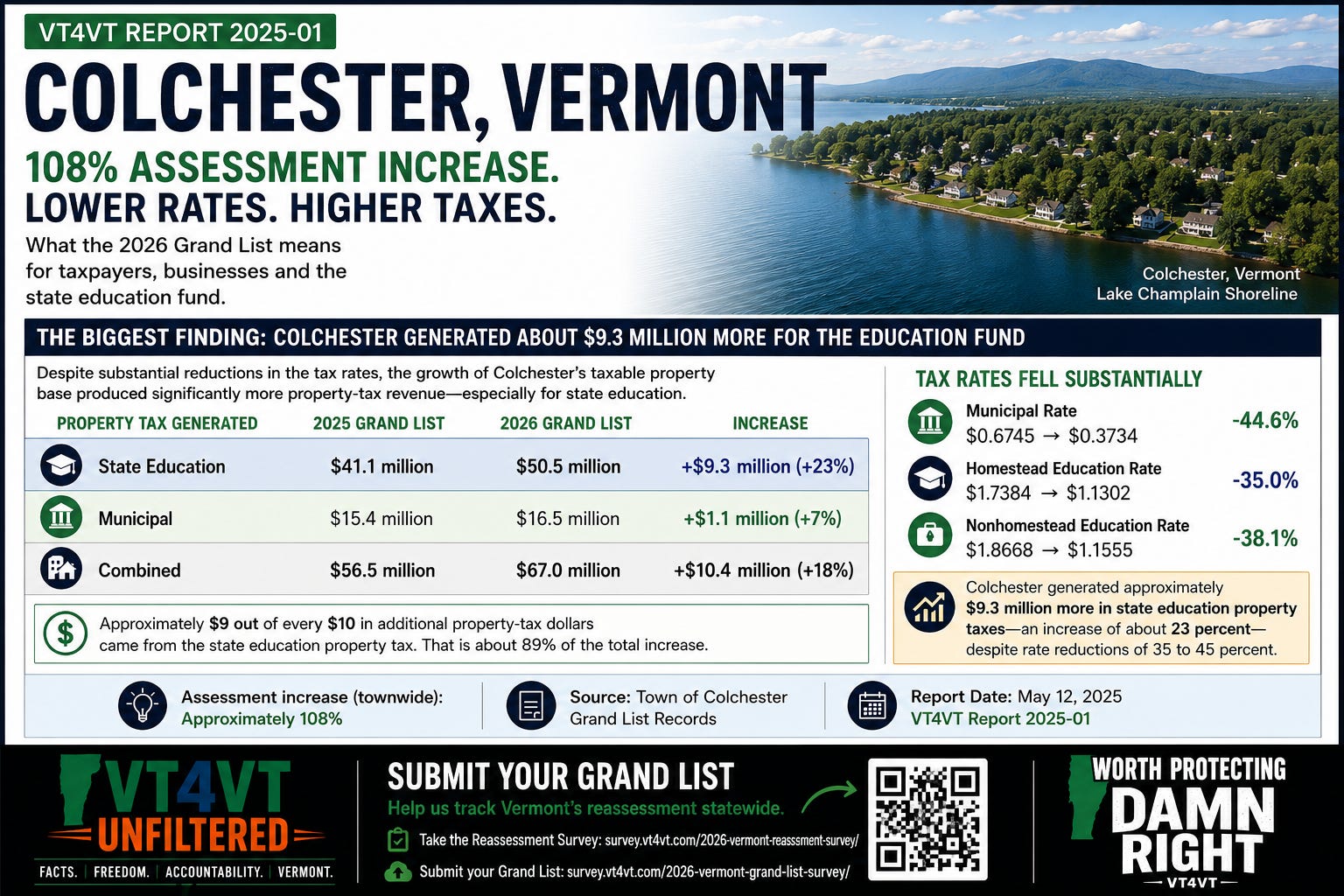
Colchester’s 2025 Grand List reported approximately $2.299 billion in real-property value. Following the town-wide reassessment, the 2026 records report approximately $4.774 billion.
That represents an increase of approximately $2.475 billion, or 107.7 percent.
An increase in assessed value does not, by itself, establish a property-tax increase. Vermont property taxes are calculated by applying municipal and education tax rates to taxable value, and those rates can change substantially following reassessment.
That happened in Colchester.
The municipal tax rate fell from $0.6745 per $100 of taxable value to $0.3734. The homestead education rate fell from $1.7384 to $1.1302, while the nonhomestead education rate fell from $1.8668 to $1.1555.
Colchester Property Tax Rates
Municipal Rate
2025 Grand List: $0.6745
2026 Grand List: $0.3734
Change: -44.6%
Homestead Education Rate
2025 Grand List: $1.7384
2026 Grand List: $1.1302
Change: -35.0%
Nonhomestead Education Rate
2025 Grand List: $1.8668
2026 Grand List: $1.1555
Change: -38.1%
Every major property-tax rate fell substantially following Colchester’s reassessment. The municipal rate declined approximately 45 percent, the homestead education rate approximately 35 percent, and the nonhomestead education rate approximately 38 percent.
But the declining rates tell only part of the story. Colchester’s property values increased enough that, despite these lower rates, the amount generated by the property-tax system increased substantially—particularly on the state education side.
Those reductions are substantial, but the assessed property base grew faster than the rates declined. That is why neither the percentage increase in an assessment nor the percentage decrease in a tax rate tells the entire story.
The important question is what happened when the new values and new rates were applied together.
The Biggest Finding: Colchester Generated About $9.3 Million More for the Education Fund
The dramatic increase in Colchester property values was accompanied by substantial reductions in the tax rates, but those reductions did not offset the growth of the taxable property base.
The 2025 Grand List generated approximately $41.1 million in state education property taxes. Using the 2026 taxable property base and the new education tax rates, that figure increased to approximately $50.5 million.
That is approximately $9.3 million more in state education property taxes from Colchester alone—an increase of about 23 percent in a single tax cycle.
Municipal property taxes increased much less. The comparable calculation rises from approximately $15.4 million to $16.5 million, an increase of approximately $1.1 million, or 7 percent.
State Education Property Tax
2025: $41.1 million
2026: $50.5 million
*Increase: +$9.3 million (+23%)
Municipal Property Tax
2025: $15.4 million
2026: $16.5 million
*Increase: +$1.1 million (+7%)
Combined Property Tax
2025: $56.5 million
2026: $67.0 million
*Increase: +$10.4 million (+18%)
The distinction matters because the overwhelming majority of the additional property tax generated from Colchester’s property base did not result from the increase in the municipal levy. Approximately $9 out of every $10 of the additional dollars in this comparison are attributable to the state education property tax.
This is one of the clearest findings in the Colchester records. The municipal rate fell by approximately 45 percent, the homestead education rate fell by approximately 35 percent and the nonhomestead education rate fell by approximately 38 percent. Nevertheless, the growth of the taxable property base was large enough that Colchester generated substantially more property-tax revenue.
For Colchester taxpayers, that distinction is important. A reassessment is often explained by saying that when property values rise, tax rates fall. Colchester demonstrates why that explanation cannot end there. The rates did fall—substantially—but the amount of property tax generated still increased.
The next question is where that additional burden landed. That requires looking beyond the townwide totals and examining individual properties, property classes and the changes occurring among residential, commercial and utility property.
Some Properties Increased Far More Than Others
Among businesses, utilities and other public-facing organizations, VT4VT found several properties with multimillion-dollar assessment increases.
Green Mountain Power — principal utility property
Prior assessment: $29,982,100
2026 assessment: $50,958,800
Change: +70.0%
Vermont Gas Systems — principal utility property
Prior assessment: $20,332,000
2026 assessment: $34,441,900
Change: +69.4%
Champlain Housing Trust — Winchester Place
Prior assessment: $8,314,700
2026 assessment: $21,952,800
Change: +164.0%
Costco — Lower Mountain View Drive
Prior assessment: $10,035,800
2026 assessment: $19,067,900
Change: +90.0%
Vermont Electric Power Co. — utility property
Prior assessment: $9,767,800
2026 assessment: $17,992,500
Change: +84.2%
Sunderland Farms Community LLC — Dylan Avenue
Prior assessment: $4,165,500
2026 assessment: $11,145,200
Change: +167.6%
Sunderland Farms Community LLC — Shea Drive
Prior assessment: $3,935,400
2026 assessment: $10,069,400
Change: +155.9%
Crystal Clear Hospitality LLC — Lower Mountain View Drive
Prior assessment: $12,084,000
2026 assessment: $18,000,000
Change: +49.0%
The Colchester records also contain properties whose assessments declined substantially. For privately owned properties and family trusts, VT4VT identifies the property by its physical location rather than publishing the owner’s name.
15 Mariner Heights
Prior assessment: $1,387,600
2026 assessment: $1,111,300
Change: -19.9%
1583 Brae Loch Road
Prior assessment: $1,224,125
2026 assessment: $989,891
Change: -19.1%
Marble Island Road / Cave Island*
Prior assessment: $234,400
2026 assessment: $104,600
Change: -55.4%
East Lakeshore Drive*
Prior assessment: $190,800
2026 assessment: $117,400
Change: -38.5%
1165 Middle Road
Prior assessment: $1,061,000
2026 assessment: $1,004,600
Change: -5.3%
48 Unit 100 Hegeman Avenue
Prior assessment: $153,000
2026 assessment: $114,600
Change: -25.1%
54 Leclair Drive
Prior assessment: $675,200
2026 assessment: $638,300
Change: -5.5%
48 Unit 200 Hegeman Avenue
Prior assessment: $135,000
2026 assessment: $98,600
Change: -27.0%
*The municipal records do not provide an unambiguous numbered physical street address for these parcels. VT4VT therefore uses the property location appearing in the municipal record rather than substituting the private owner’s mailing address.
These decreases are important because they demonstrate how unevenly reassessment can redistribute taxable value. While Colchester’s overall real-property value increased approximately 108 percent, individual properties did not move uniformly with the townwide total. Some properties increased dramatically, while others actually declined in assessed value.
This is precisely why the underlying Grand List matters. A townwide average cannot tell a property owner what happened to his or her particular share of the tax base.
The Utility Assessments Caught Our Attention
The utility properties deserve separate attention because the increases are substantial and because similar changes have begun appearing in Grand Lists VT4VT is examining elsewhere in Vermont.
Looking beyond the principal utility parcels and combining the identified Colchester properties belonging to each company, Green Mountain Power increased from approximately $37.91 million to $59.65 million, an increase of 57.3 percent.
Vermont Gas Systems increased from approximately $20.91 million to $35.62 million, an increase of 70.3 percent.
Vermont Electric Power Company, or VELCO, increased from approximately $9.77 million to $17.99 million, an increase of 84.2 percent.
Combined Utility Assessment
Prior assessment: $68.59 million
2026 assessment: $113.25 million
Increase in assessed value: $44.67 million
Percentage increase: 65.1 percent
Together, the identified Colchester assessments for these three utilities increased by approximately $44.67 million in a single Grand List cycle.
The assessment increases do not automatically mean their property taxes increased by the same percentages. These properties are generally subject to the nonhomestead education rate, and both the nonhomestead education rate and municipal rate declined substantially.
That distinction is particularly important here. The combined municipal and nonhomestead rate fell from approximately $2.5413 per $100 of taxable value to $1.5289. A utility’s assessment therefore had to increase substantially just to produce approximately the same combined property-tax liability under the new rate structure.
The actual before-and-after utility tax liability must be calculated using both the old and new assessments and the applicable tax rates rather than simply applying the new tax rate to the assessment increase.
The assessment increases do not automatically mean their property taxes increased by the same percentages. These properties are generally subject to the nonhomestead education rate, and both the nonhomestead education rate and municipal rate declined substantially.
That distinction is particularly important here. The combined municipal and nonhomestead rate fell from approximately $2.5413 per $100 to $1.5289. A utility assessment therefore had to increase substantially just to produce approximately the same combined tax under the new rate structure.
The actual before-and-after utility tax liability must be calculated using both the old and new assessments and the applicable rates rather than simply multiplying the assessment increase by the new rate.
Colchester Had Already Raised Concerns About Utility Valuation
There is an important piece of history behind the numbers.
In June 2025, the Town of Colchester reported that Vermont had taken over the valuation of utilities for municipal services and state education taxation. According to the Town, utility value in Colchester had decreased by $4,925,800 during the first year of the new system.
The Town said that reduction eliminated approximately 34 percent of the growth in Colchester property value that year, contributing to a higher municipal tax rate than the Town had estimated.
That makes what appears in the following Grand List particularly interesting.
Instead of another reduction, the identified assessments for Green Mountain Power, Vermont Gas and VELCO increased substantially in the 2026 records.
This does not by itself explain why the valuations changed, but it gives us a documented before-and-after sequence worth investigating: Colchester reported a nearly $5 million decline in utility value after the State took over valuation, followed by significant increases in several major utility assessments appearing in the next Grand List.
Vermont Also Changed How Communications Property Is Taxed
At the same time, Vermont changed the law governing communications property.
Act 145 of 2024 changed Vermont’s communications-tax structure. Effective July 1, 2026 and applicable to Grand Lists lodged on or after April 1, 2026, 32 V.S.A. § 3602b requires communications property to be set in the Grand List as real estate. For nonmunicipal communications providers, the property is taxed at appraisal value.
The statute encompasses communications infrastructure including wires, cables, conduits, pipes, antennas, poles and wireless communications towers.
Colchester’s 2026 records contain approximately $11.05 million in property classified in the telecommunications category, associated with companies including Comcast, Verizon Wireless, AT&T Mobility, T-Mobile, Fidium Fiber and other communications providers.
That does not mean $11.05 million of previously untaxed property suddenly appeared.
Colchester’s prior records already show communications equipment under other classifications. Comcast, for example, had approximately $2.005 million in equipment/personal property, while Champlain Broadband had approximately $77,500.
The important change is the statutory treatment of communications property. Measuring its actual tax impact requires identifying what was taxable under the previous system and comparing it with what entered the Grand List under the new law.
VT4VT is now looking for that change in other municipalities.
Does the Cost Stop With the Utility?
Utility property taxation raises another question because regulated utilities operate differently from ordinary property owners.
Property taxes are an operating expense for a utility. Vermont regulatory records demonstrate that those expenses can be incorporated into the cost-of-service calculations used in setting regulated rates.
Vermont Gas provides a particularly clear example. In a previous Public Utility Commission proceeding, the company projected that its property-tax expense would increase approximately $633,000, or 11.7 percent, because of changes in state tax law. That property-tax expense was considered through the company’s regulatory process.
Green Mountain Power’s regulatory filings similarly include municipal property taxes in its cost-of-service calculations.
GMP filed for an FY2027 base-rate increase during 2026 and subsequently submitted updated cost-of-service information. The timing is important. The original rate request preceded completion of Colchester’s 2026 tax cycle, so the Colchester reassessment cannot simply be identified as the cause of GMP’s requested increase.
Utilities also do not necessarily wait until every municipality has issued a final tax bill before preparing a rate filing. Property-tax expenses can be forecast using available valuation information, previous tax bills and expected tax rates, with actual expenses addressed later through the applicable regulatory process.
This creates the possibility of a regulatory lag.
A significant change in utility property taxes appearing during the 2026 municipal tax cycle may not immediately appear as an identifiable change on a customer’s electric or natural-gas bill.
The more important statewide question is therefore not how much more GMP, Vermont Gas or VELCO was assessed in one municipality. It is how much their total Vermont property-tax expense changes after reassessments and the new communications-property rules work their way through Grand Lists across the state.
If those expenses increase, the subsequent utility filings will tell us whether and how the companies seek to recover them from ratepayers.
We do not yet have enough evidence to quantify that impact.
Colchester Is Part of a Larger Investigation
The utility issue first caught VT4VT’s attention while examining other municipal records, including New Haven. Colchester provides another case where the underlying Grand List allows us to investigate the issue rather than speculate about it.
We now need both reassessed and non-reassessed municipalities.
If utility assessments increased substantially only in towns undergoing reappraisal, that tells us one thing. If the same utility assessments changed substantially in towns that did not reassess, state valuation practices or statutory changes may be playing a larger role.
The communications-property changes under Act 145 create another variable that must be separated from ordinary reassessment.
Answering those questions requires following the public records from beginning to end. VT4VT is comparing municipal Grand Lists and published tax rates with actual tax bills and subsequent utility rate filings. As more municipalities complete reassessments, those records should allow us to determine whether the utility assessment changes found in Colchester and New Haven are isolated cases or part of a broader statewide shift, and eventually whether increased property-tax costs are reflected in the rates Vermonters pay for electricity, natural gas, telecommunications and other services.
Help Us Obtain the Grand Lists
VT4VT is collecting municipal Grand Lists from 2024, 2025, 2026 and 2027.
Contact your town clerk, assessor or listers and request the Grand Lists, preferably in Excel or CSV format. If your municipality has the records available online, simply send us the link.
Grand Lists, reassessment notices and related public records can be sent to:
Vermonters can also complete the anonymous Vermont Reassessment Survey and follow the continuing investigation at:
VT4VT.com
The objective is to build a public-record database large enough to determine not merely whose assessments changed, but where Vermont’s property-tax burden is actually moving.
Sources
Town of Colchester — 2025 As-Billed Grand List. Official municipal Grand List used for prior-year property values and taxable Grand List totals.
Town of Colchester — 2026 As-Billed Grand List. Provided directly by Colchester Town Assessor Robert Vickery on September 1, 2026.
Town of Colchester — 2026 Abstract Grand List. Used as an additional comparison of post-reassessment property values.
Town of Colchester — Property Taxes. Published municipal, homestead education and nonhomestead education tax rates.
https://colchestervt.gov/329/Property-Taxes
Town of Colchester — June 30, 2025 Town News. Town explanation of the FY2026 municipal tax rate and the $4,925,800 decrease in state-determined utility valuation.
https://colchestervt.gov/Archive.aspx?ADID=975
Vermont Legislature — Act 145 of 2024, H.657. An act relating to modernization of Vermont’s communications taxes and fees.
https://legislature.vermont.gov/bill/status/2024/H.657
Act 145 of 2024 — As Enacted.
https://legislature.vermont.gov/Documents/2024/Docs/ACTS/ACT145/ACT145%20As%20Enacted.pdf
32 V.S.A. § 3602a — Electric utility property.
https://legislature.vermont.gov/statutes/section/32/123/03602a
32 V.S.A. § 3602b — Communications property.
https://legislature.vermont.gov/statutes/section/32/123/03602b
Vermont Department of Taxes — Listers and Assessors.
https://tax.vermont.gov/tags/listers-and-assessors
Vermont Public Utility Commission — Green Mountain Power FY2027 rate proceeding, Case 26-0096-TF.
https://epuc.vermont.gov/?q=node%2F64%2F209089
Green Mountain Power — Rate & Regulation Plan Filings.
https://greenmountainpower.com/regulatory/rate-regulation-plan-filings/
Vermont Gas Systems — Public Utility Commission Order concerning annual base rates and property-tax expense.
VELCO — Rates, Tariffs & Business Practices.
https://www.velco.com/rates-tariffs-business-practices
VT4VT — Colchester Grand List Analysis. Parcel-level comparison of prior and 2026 municipal records.
VT4VT.com
Worth Protecting.
Damn Right.