Executive Summary
Proposal 3 is not on the ballot because Vermont lacks labor protections. Vermont already has extensive collective-bargaining law, and federal law already protects organizing and bargaining rights for much of the private-sector workforce. The amendment reached voters after passing the Senate 29–0 in 2025 and the House 125–15, with support from every senator who cast a vote and from a bipartisan House majority. On the surface, that record could suggest a broad consensus around a simple workers’ rights measure. The harder question is why existing labor protections were not considered enough, and why organized labor wanted those protections moved into the Vermont Constitution.
The answer begins with what Proposal 3 is actually designed to prevent. Vermont organized labor has said openly that the amendment would constitutionally protect the current state of Vermont labor law and stop any future attempt to make Vermont a right-to-work state. Pay close attention to the phrase “Right to work” it does not mean a legal right to a job. In simple terms it mean you have a right to work in a union shop without getting harassed or fired because you do not want to join the union or pay the dues, its that simple. Right to work mean you can still have a job and not be or pay for a union in a union shop.
In labor law, “right to work” does not mean a right to a job. The phrase has become politically charged, often treated by organized labor almost as anti-union language, but its legal meaning is straightforward: a worker in a unionized workplace cannot be required to join or financially support the union as a condition of keeping that job. Vermont is not a right-to-work state. Under current law, and where federal law allows it, a private-sector worker covered by a lawful union-security agreement may refuse full union membership but can still be required to pay the legally permitted representational dues or fees. If that worker refuses to pay, the union can seek that worker’s discharge. That is one of the practical consequences that sits beneath the more abstract constitutional language.
That is also why Proposal 3 can be understood as something more than a general worker-protection measure. The labor organizations that sponsored, supported, and promoted the amendment were not responding to a vacuum in Vermont law. Collective-bargaining protections already exist. What those organizations wanted was permanence. Labor testified heavily in favor of Proposal 3, participated prominently in the legislative process, and continues to campaign for its adoption. Several of the same organizations are active political players in Vermont and contribute heavily in support of Democratic and labor-aligned candidates. That does not by itself invalidate the amendment, but it does help explain the institutional interest behind it. Proposal 3 protects the legal framework under which unions maintain membership, collect representational dues, and preserve bargaining strength.
The research helps explain why organized labor views that protection as so important. Studies on right-to-work laws do not show that unions disappear, but they do show that unions weaken. A 2022 National Bureau of Economic Research paper found that right-to-work laws reduced unionization and lowered wages in the states studied. That gives unions a direct incentive to block any future move in that direction. In that sense, Proposal 3 functions not only as a workers’ rights amendment, but also as an organized-labor preservation measure. Existing Vermont law already protects the worker’s right to organize. Proposal 3 chiefly protects the durability of the union framework itself.
That does not end the analysis, because the business side of the equation is more mixed. There is very little direct long-term research on the economic effects of constitutional labor amendments themselves, in part because the closest modern comparison, Illinois’ Workers’ Rights Amendment, is still recent. The stronger body of research comes from right-to-work laws. That evidence cuts in different directions. The same line of research that finds weaker unions and lower wages also includes studies finding stronger firm investment, higher employment growth in some sectors, higher profitability for labor-intensive firms, and increased venture-capital investment after right-to-work adoption. The most supportable conclusion is not that Proposal 3 guarantees a single economic outcome, but that it would lock Vermont into a more union-protective legal structure and permanently remove a policy option that some research associates with stronger business investment and weaker union power.
For voters, that is the real issue. Proposal 3 is not primarily about creating rights Vermont workers do not already have. It is about taking important parts of Vermont’s existing labor framework and placing them beyond the ordinary reach of future Legislatures. Supporters see that as necessary protection against future anti-union legislation. Critics see it as a constitutional amendment designed to preserve union power, protect union financing, and prevent future lawmakers from adopting a right-to-work policy even if the political will exists. However it is framed, the amendment’s central effect is the same: it would make Vermont’s current labor model far harder to change.
Continue reading the research below
If you are not a subscriber please join, get the articles early, and help grow the base. We do not plan to have a paid subscriber service.
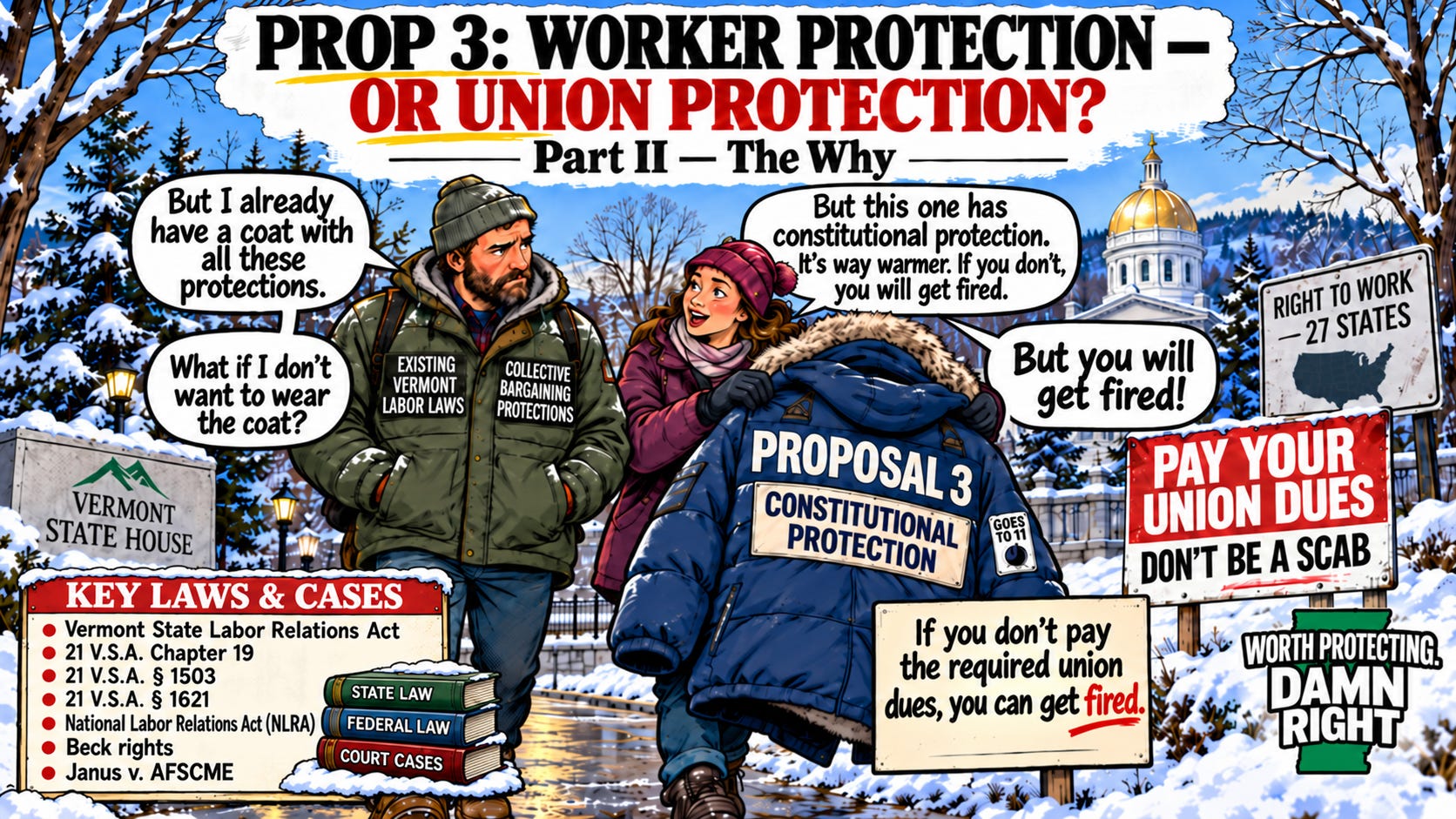
How Did We Get Here — and Why?
Part I documented how Proposal 3 reached the 2026 ballot: who introduced it, which labor organizations participated in the legislative process, how it moved through two separately elected Legislatures, and how lawmakers voted before and after the 2024 election.
Part II asks the harder question. Why? Vermont already has extensive collective-bargaining protections in state law, while federal law governs much of the private-sector workforce. Why did organized labor and legislative supporters conclude that those protections were not enough and that collective bargaining needed to be placed in the Vermont Constitution?
The answer begins with a phrase many people misunderstand: right to work.
What “Right to Work” Actually Means
“Right to work” does not mean that a person has a legal right to a job. In labor law, it means an employee in a unionized workplace cannot be required to join the union or pay union dues or fees as a condition of keeping that job.
Federal law generally allows an employer and union to negotiate a union-security agreement. Under such an agreement, workers in a bargaining unit may be required to begin paying union dues or fees after the applicable waiting period. A worker who objects to full union membership may exercise rights recognized in Communications Workers of America v. Beck, remain a nonmember and avoid paying the portion of dues used for activities unrelated to collective bargaining and representation. The worker may still be required to pay the portion associated with the union’s representational work. The National Labor Relations Board says 27 states have right-to-work laws prohibiting union-security agreements. National Labor Relations Board
The practical consequence is significant. A private-sector employee covered by a lawful union-security agreement can refuse full union membership and still be required to pay the legally permitted representational dues or fees. If the employee refuses to pay after receiving the required notice and opportunity to become current, the union can cause the employer to discharge that employee. Job performance does not have to be the issue. The NLRB expressly states that a union may cause an employer to discharge a worker for failure to pay periodic dues or initiation fees under a lawful union-security agreement, while prohibiting discharge for other reasons such as disagreement with the union or opposition to its activities. National Labor Relations Board
That distinction matters in Vermont because Vermont is not a right-to-work state. Proposal 3 would not create union-security agreements in every workplace; those arrangements are already permitted where applicable. What Proposal 3 would do is prevent a future Vermont Legislature from adopting the kind of right-to-work law now used in 27 states.
Why Right to Work Matters So Much to Organized Labor
The stakes for organized labor go well beyond terminology. The Vermont AFL-CIO says openly that Proposal 3 would “constitutionally protect the current state of labor law in Vermont” and stop any future attempt to make Vermont a right-to-work state. That is not an interpretation imposed by opponents; it is one of organized labor’s stated reasons for supporting the amendment. Vermont State Labor Council, AFL-CIO
Right-to-work laws do not abolish unions, but research indicates that they can materially weaken union membership and organizing. A 2022 National Bureau of Economic Research study examined five states that adopted right-to-work laws between 2011 and 2017 and found that unionization fell by about four percentage points within five years of adoption. The same research found declining wages, with the largest effects concentrated in industries that had relatively high unionization before the laws changed. National Bureau of Economic Research
That gives organized labor a direct institutional interest in Proposal 3. Constitutionalizing Vermont’s current labor framework would protect collective-bargaining rights, as supporters emphasize, but it would also protect the legal environment under which unions maintain membership, receive representational dues and organize additional workplaces. The amendment can therefore be examined both as a workers’ rights proposal and as an organized-labor preservation measure. The first description comes directly from supporters; the second is an analytical conclusion drawn from the amendment’s language, labor’s stated objective of blocking future right-to-work legislation and the documented relationship between right-to-work laws and unionization rates. Vermont State Labor Council, AFL-CIO
That distinction is important because Proposal 3 is not an ordinary labor bill. If it were a statute, a future Legislature could revisit it through the normal legislative process. As a constitutional amendment, it would deliberately make portions of Vermont labor policy more difficult to change.
Vermont Already Protects Collective Bargaining
Vermont workers do not currently lack collective-bargaining rights. The Vermont State Labor Relations Act already gives covered employees the right to organize, form, join or assist labor organizations, bargain collectively through representatives of their own choosing and engage in concerted activities for mutual aid or protection. The same law recognizes a right to refrain from those activities, subject to the exception for agreements requiring membership in a labor organization as a condition of employment. Vermont Already Has Labor Law — A Lot of It
Collective bargaining in Vermont did not begin with Proposal 3. Vermont has built separate statutory labor systems for private employees, State employees, teachers and administrators, municipal employees and Judiciary employees over nearly 60 years.
1967 — Vermont State Labor Relations Act, 21 V.S.A. Chapter 19. Vermont’s core state labor-relations law protects covered employees’ rights to organize, join or assist labor organizations, bargain collectively and engage in concerted activity. It establishes bargaining units, exclusive representation, elections, unfair-labor-practice rules and collective-bargaining procedures.
1969 — State Employees Labor Relations Act, 3 V.S.A. Chapter 27. Vermont established a separate collective-bargaining system for State employees. The chapter governs representation, bargaining units, bargaining subjects, management rights, unfair labor practices and proceedings before the Vermont Labor Relations Board. Individual sections still carry the original 1969 enactment history. Vermont General Assembly
1969 — Labor Relations for Teachers and Administrators, 16 V.S.A. Chapter 57. Vermont created a separate bargaining framework for teachers and school administrators effective September 1, 1969. It provides for exclusive representation, negotiations over salary and economic employment conditions, written collective agreements, mediation and other dispute-resolution procedures. The statute requires the selected organization to represent all eligible employees without discrimination based on whether they belong to the organization. Vermont General Assembly
Labor Relations for Teachers and Administrators — Title 16, Chapter 57
1973 — Vermont Municipal Employee Relations Act, 21 V.S.A. Chapter 22. Vermont extended a separate statutory labor system to municipal employees. The purpose section expressly protects employees’ rights to organize, form or join employee organizations and bargain collectively while also recognizing the rights of municipal employers and the public. Vermont General Assembly
Vermont Municipal Employee Relations Act — Title 21, Chapter 22
1997 — Judiciary Employees Labor Relations Act, 3 V.S.A. Chapter 28. Vermont created another separate bargaining statute for Judiciary employees. Its stated purpose is to recognize Judiciary employees’ right to join a labor organization and be represented by that organization in collective bargaining over terms and conditions of employment. Vermont General Assembly
Judiciary Employees Labor Relations Act — Title 3, Chapter 28
Teachers also intersect with the Municipal Employee Relations Act for representation and unfair-labor-practice purposes, another indication that Vermont’s labor framework has been built incrementally rather than through one statute. That provision dates to 1975. Vermont General Assembly
Federal Collective-Bargaining Law Goes Back Even Further
The state laws sit on top of another substantial body of federal labor law.
1935 — National Labor Relations Act. The NLRA established the central federal framework protecting organizing and collective bargaining for covered private-sector employees and created the National Labor Relations Board.
1947 — Labor Management Relations Act, commonly called Taft-Hartley. Congress amended the NLRA, imposed additional restrictions and responsibilities on labor organizations, and expressly allowed states to enact right-to-work laws prohibiting compulsory union-security arrangements.
1959 — Labor-Management Reporting and Disclosure Act. Federal law established a bill of rights for union members and imposed financial-reporting, election and fiduciary requirements on many labor organizations.
1978 — Federal Service Labor-Management Relations Statute. Federal employees received a separate statutory labor-relations system under Title 5 governing representation, collective bargaining, grievances and unfair labor practices.
This does not mean every American worker is covered identically. Different statutes apply to different categories of employees, and federal and state jurisdiction can vary considerably. It does establish something important for the Proposal 3 debate: organized labor and collective bargaining are already governed by decades of Vermont and federal law.
What Proposal 3 Would Put in the Constitution
Proposal 3 would add a new Article 23 to Chapter I of the Vermont Constitution. The proposed language says employees have a right to organize or join a labor organization and bargain collectively through an exclusive representative over wages, hours, working conditions, economic welfare and workplace safety. It then states that no law may be adopted that “interferes with, negates, or diminishes” those collective-bargaining rights. Vermont General Assembly
The final clause is particularly important. The amendment would also prohibit Vermont from adopting a law that bars an agreement between an employer and a labor organization requiring membership in the labor organization as a condition of employment. Vermont General Assembly
That language directly addresses right-to-work policy. If voters adopt Proposal 3, a future Legislature could not simply decide that Vermont should join the 27 states that prohibit union-security agreements. The constitutional text itself would stand in the way.
The policy would no longer depend solely on what a future House, Senate and governor decided.
Why Supporters Wanted Permanence
The legislative record shows that permanence was not incidental to Proposal 3. It was one of the central objectives.
The Vermont AFL-CIO’s current explanation says Proposal 3 protects the existing state of labor law and prevents a future attempt to make Vermont a right-to-work state. During legislative consideration, organized-labor witnesses likewise argued for preserving bargaining protections against future political changes. Vermont State Labor Council, AFL-CIO
That concern has a national context. Right-to-work laws have been adopted in numerous states over decades, and other states have acted to restrict or restructure collective bargaining, particularly in the public sector. Organized labor’s response in Vermont was not simply to seek another statute supporting unions. It sought constitutional language that future legislators could not undo through ordinary legislation.
That is why Proposal 3 changes the playing field differently from an ordinary bill. Statutory protections can be repealed. Constitutional protections are intended to survive changes in political control.
What Changes for a Worker Who Does Not Want the Union
The effect is easiest to understand from the perspective of an employee in a private-sector bargaining unit who does not want to belong to the union.
Under federal law, that employee generally cannot be forced into full union membership. The employee can exercise Beck rights, remain a nonmember and avoid paying for union political or other nonrepresentational activity. But where a lawful union-security agreement exists, the employee may still be required to pay the portion associated with bargaining and representation. National Labor Relations Board
If that employee refuses to pay the required amount, federal law permits the union to seek discharge after the union has met its notice obligations and given the employee a reasonable opportunity to become current. The NLRB’s guidance is explicit that nonpayment of permitted dues or initiation fees is one of the limited circumstances in which a union may cause an employer to discharge a worker. National Labor Relations Board
That means a worker can be fully satisfactory in every ordinary performance measure and still lose the job because of nonpayment under a lawful union-security agreement. In a right-to-work state, that particular condition of employment is prohibited. Proposal 3 would prevent Vermont from adopting that policy in the future.
That is a larger question than whether unions should be allowed to organize. Vermont already answers that question in the affirmative.
The constitutional question is whether a future Legislature should retain the power to say that employment cannot depend on financially supporting the bargaining representative.
Public Employees Are Different
Public employees are governed by a separate federal constitutional rule.
In Janus v. AFSCME, the U.S. Supreme Court held in 2018 that states and public-sector unions cannot require nonconsenting public employees to pay agency fees. The Court concluded that compelling those payments violated nonmembers’ First Amendment rights. Legal Information Institute
Proposal 3 cannot overturn that ruling. The Vermont Constitution cannot remove rights guaranteed under the U.S. Constitution. Public employees therefore cannot be compelled to pay agency fees merely because they are represented by a union, regardless of whether Vermont adopts Proposal 3. Legal Information Institute
The union-security question is consequently most significant in the private sector and other circumstances where federal law still permits such agreements.
What Changes for Employers
Proposal 3 would not eliminate employers’ rights under labor law or automatically create unions in Vermont workplaces, but it could. Employers would continue to operate under federal and state rules governing organizing campaigns, bargaining units, representation elections and collective bargaining.
The more consequential change is constitutional. Employers and employees would no longer be able to seek a future Vermont right-to-work law through the ordinary legislative process. If Proposal 3 passes, the Constitution would protect the continued legality of union-security agreements where federal law allows them. Vermont General Assembly
That provides organized labor with something more durable than favorable legislation. It provides a constitutional baseline against which future Vermont labor laws would be judged.
The Incentive for Organized Labor
The amendment does not organize a workforce by itself, but the incentives surrounding organization matter.
Research indicates that right-to-work laws reduce unionization rates. The 2022 NBER analysis found a decline of approximately 1.7 percentage points in unionization when right-to-work laws took effect in the states studied, increasing to about four percentage points after five years. In industries with historically high unionization, the reductions were considerably larger. National Bureau of Economic Research
NBER’s summary describes one mechanism directly: because every worker covered by a collective-bargaining agreement receives the negotiated benefits, prohibiting required dues can create what economists call a free-rider problem that weakens union financing and the ability to organize workers. National Bureau of Economic Research
Constitutionally preventing Vermont from adopting right-to-work therefore protects an environment more favorable to union membership, financing and organizing than the alternative. It does not guarantee organizing success, but it removes a policy change that empirical research associates with declining unionization.
For organizations whose membership, bargaining strength and financial resources depend on maintaining represented workplaces, that is an important institutional protection.
The Supporters’ Argument
Supporters describe those same arrangements as a question of fairness.
Once a union is the exclusive bargaining representative, it negotiates the contract for the bargaining unit rather than only for employees who voluntarily become full union members. Supporters argue that workers receiving negotiated wages, benefits, grievance representation and other contract protections should contribute toward the cost of providing that representation.
From that perspective, union-security agreements prevent workers from receiving the economic benefits of representation while allowing others to pay the cost. Right-to-work laws weaken that arrangement by making financial support voluntary even though the union remains responsible for bargaining on behalf of the unit.
Proposal 3 supporters therefore view constitutional protection as a safeguard against future political majorities weakening a system they believe protects workers collectively.
The Opposing View
The opposing argument starts with the individual employee.
A worker may not want to join the union, may disagree with how the union operates or may simply decide that the cost of representation is not worth paying. Under a lawful private-sector union-security agreement, federal law protects that employee from being forced into full membership and from paying for nonrepresentational activity, but it does not necessarily protect the employee from being required to pay representational costs as a condition of continued employment. National Labor Relations Board
Right-to-work laws place the individual’s choice ahead of that collective financing arrangement. They prohibit unions and employers from making union payments a condition of keeping a job. Proposal 3 would prevent Vermont from choosing that policy later through an ordinary statute.
The disagreement therefore involves two competing definitions of fairness. Supporters focus on the obligation to contribute toward representation from which all bargaining-unit workers benefit. Opponents focus on whether an employee should ever have to financially support an organization the employee does not want to join in order to keep a job.
Proposal 3 would place Vermont’s answer to part of that dispute in the Constitution.
Constitutional Rights Also Mean Constitutional Litigation
The phrase “no law shall be adopted that interferes with, negates, or diminishes” collective-bargaining rights reaches beyond right-to-work legislation. It would become constitutional language that future laws could be measured against. Vermont General Assembly
That matters because constitutional language is ultimately interpreted by courts. Future disputes about the boundaries of bargaining rights, excluded classes of employees, bargaining procedures or other labor restrictions could raise constitutional questions rather than merely questions of statutory interpretation.
The Legislature could still regulate labor relations, but it would do so beneath a new constitutional ceiling.
The exact boundaries of that ceiling cannot be known in advance. They would develop through future statutes, administrative decisions and litigation.
Illinois Took a Similar Path
Vermont is not the first state to consider this approach. The Vermont AFL-CIO itself points to Illinois, which adopted a similar constitutional amendment in 2022. Illinois’ provision protects organizing and collective bargaining, prohibits laws that interfere with or diminish those rights and protects agreements requiring labor-organization membership as a condition of employment. Vermont State Labor Council, AFL-CIO
Illinois provides a useful legal comparison because its language is close to Vermont’s proposal. It provides less certainty about long-term economic effects because the amendment is relatively new.
What Illinois already demonstrates is the structural change involved: labor rights that previously depended substantially on statute can become constitutional claims.
The Economic Record Is More Complicated
The business record is less clear-cut than either side’s campaign language suggests. There is very little direct long-term research on the economic impact of constitutional labor amendments themselves, in part because the closest modern comparison, Illinois’ Workers’ Rights Amendment, was adopted only in 2022. The stronger evidence comes from research on right-to-work laws, which Proposal 3 is expressly designed to prevent. The Vermont State Labor Council, AFL-CIO says Proposal 3 would “constitutionally protect the current state of labor law in Vermont” and stop any future attempt to make Vermont a right-to-work state. That broader research cuts in different directions. Nicole Fortin, Thomas Lemieux, and Neil Lloyd’s 2022 National Bureau of Economic Research paper, Right-to-Work Laws, Unionization, and Wage Setting, found that right-to-work laws lower unionization rates and wages. A 2020 Journal of Financial Economics study by Sudheer Chava, András Danis, and Alex Hsu, The Economic Impact of Right-to-Work Laws: Evidence from Collective Bargaining Agreements and Corporate Policies, found that after right-to-work adoption, firms increased investment and employment and labor-intensive firms experienced higher profits, even as wages for unionized workers declined. A 2025 Journal of Banking & Finance study, Right-to-work laws and venture capital investment, found that adoption of right-to-work laws was associated with higher venture-capital investment. The most supportable conclusion, then, is not that Proposal 3 has a single predictable business effect, but that it would lock Vermont into a more union-protective legal framework and permanently remove a policy option that some research associates with stronger business investment and weaker union power.
Why We Got Here
Part I documented how Proposal 3 traveled through two Legislatures and four overwhelming votes before reaching Vermont voters. Part II provides a documented explanation for why organized labor wanted the additional protection of a constitutional amendment.
Vermont already protects collective bargaining through statute. Federal law provides another layer of protection for much of the private sector. Organized labor did not need Proposal 3 to create collective bargaining in Vermont.
What existing statutes cannot guarantee is permanence.
A future Legislature could change current Vermont labor law. It could reconsider union-security agreements. Without Proposal 3, it could choose to adopt a right-to-work law.
Proposal 3 is designed to prevent that.
The Vermont AFL-CIO says so directly. The amendment would protect the current state of Vermont labor law and stop future efforts to make Vermont right-to-work. Research shows why that matters institutionally: right-to-work laws tend to reduce unionization and weaken the financing structure under which unions organize and represent workers. Vermont State Labor Council, AFL-CIO
For supporters, that is protection of a fundamental workers’ right.
For critics, it is a permanent restriction on future legislative choice and on the ability of an individual worker to avoid financially supporting a union where a lawful union-security agreement exists.
Both descriptions flow from the same underlying change.
Proposal 3 would move a significant portion of Vermont labor policy out of ordinary statute and into the state Constitution.
That is what Vermont voters are being asked to decide.
Research Report
The controlling public record is the proposed constitutional text itself. Proposal 3 would add Article 23 to Chapter I of the Vermont Constitution, creating a constitutional right to organize or join a labor organization and bargain collectively. The text would prohibit laws that interfere with, negate or diminish that right and would expressly prohibit a law barring agreements requiring labor-organization membership as a condition of employment. The Legislature records Proposal 3 as having completed its legislative process and being delivered to the Secretary of State on June 3, 2026. Vermont General Assembly
Official Proposal 3 record:
https://legislature.vermont.gov/bill/status/2026/PR.3
Official Proposal 3 text:
https://legislature.vermont.gov/Documents/2024/Docs/BILLS/PR0003/PR0003%20As%20adopted%20by%20the%20Senate%20Official.pdf
Existing Vermont law already recognizes the rights to organize, join labor organizations, bargain collectively and refrain from those activities subject to lawful union-security arrangements. The State Labor Relations Act also expressly describes its purpose as protecting the legitimate rights of employees, employers, individual workers and the public. Vermont General Assembly
Vermont State Labor Relations Act:
https://legislature.vermont.gov/statutes/fullchapter/21/019
Vermont State Labor Council, AFL-CIO
Proposal 3: VT’s Workers Rights Amendment
https://vt.aflcio.org/proposal-3-vts-workers-rights-amendment
National Bureau of Economic Research
Nicole Fortin, Thomas Lemieux, Neil Lloyd, Right-to-Work Laws, Unionization, and Wage Setting
Working Paper No. 30098, June 2022
https://www.nber.org/papers/w30098
Journal of Financial Economics
Sudheer Chava, András Danis, Alex Hsu, The Economic Impact of Right-to-Work Laws: Evidence from Collective Bargaining Agreements and Corporate Policies
Vol. 137, Issue 2, August 2020, pp. 451–469
https://www.sciencedirect.com/science/article/pii/S0304405X20300386
Journal of Banking & Finance
Helena Sarkodie, Kwabena Boasiako, Michael O’Connor Keefe, Justin Nguyen, Bernard Tawiah, Right-to-work laws and venture capital investment
Vol. 172, March 2025, Article 107383
https://www.sciencedirect.com/science/article/pii/S0378426625000044
21 V.S.A. § 1503:
https://legislature.vermont.gov/statutes/section/21/019/01503
The National Labor Relations Board states that union-security agreements are generally permitted under federal law in states that have not prohibited them. Objecting employees may remain nonmembers and pay only the portion used for representation. The NLRB also states that 27 states prohibit union-security agreements through right-to-work laws. National Labor Relations Board
NLRB, Employer/Union Rights and Obligations:
https://www.nlrb.gov/about-nlrb/rights-we-protect/your-rights/employer-union-rights-and-obligations
The NLRB further states that a union may cause an employer to discharge an employee for failure to pay periodic dues or initiation fees under a lawful union-security agreement, while requiring notice, an opportunity to become current and notice of the employee’s Beck rights. National Labor Relations Board
NLRB, What’s the Law? — Unions:
https://www.nlrb.gov/about-nlrb/rights-we-protect/whats-law/unions
Public employees operate under a different constitutional rule. In Janus v. AFSCME, the U.S. Supreme Court held that nonconsenting public employees cannot be compelled to pay agency fees to public-sector unions. Proposal 3 cannot override that federal constitutional protection. Legal Information Institute
Janus v. AFSCME:
https://www.law.cornell.edu/supremecourt/text/16-1466
The Vermont State Labor Council, AFL-CIO states that Proposal 3 would protect existing Vermont labor law and prevent any future attempt to make Vermont a right-to-work state. Its page also identifies Illinois’ 2022 Workers’ Rights Amendment as a similar constitutional model. Vermont State Labor Council, AFL-CIO
Vermont AFL-CIO, Proposal 3:
https://vt.aflcio.org/proposal-3-vts-workers-rights-amendment
Research from the National Bureau of Economic Research found that right-to-work adoption in five states between 2011 and 2017 reduced unionization by approximately four percentage points after five years and was associated with lower wages. The research does not establish that unions disappear in right-to-work states, but it does provide evidence that right-to-work laws weaken unionization and union financing. National Bureau of Economic Research
NBER, Right-to-Work Laws, Unionization, and Wage Setting:
https://www.nber.org/papers/w30098
NBER summary:
https://www.nber.org/digest/202208/impacts-right-work-laws-unionization-and-wages
Part I of the VT4VT investigation documented the proposal’s sponsors, organized-labor participation, four legislative votes and the intervening 2024 election:
https://news.vt4vt.com/articles/proposal-3-does-labor-really-need/
VT4VT uses AI as a research, organizational and production tool. The underlying reporting is based on public records, court decisions, official agency guidance and published research. Readers are encouraged to review the primary sources directly and report any errors or additional records that should be incorporated.
VT4VT is independent. Public-record research, records requests, data analysis, hosting and production require time and resources. Readers who find this work useful can support the project and help expand Vermont’s independent public-policy record at VT4VT.com.
VT4VT Surveys This Week
Is Vermont Affordable?
Can Vermonters still afford to live here?
This anonymous survey looks at the real financial pressure facing Vermont households, including housing costs, taxes, utilities, everyday expenses, and whether people are considering leaving Vermont because of affordability.
Your responses help VT4VT document what Vermonters are experiencing and identify trends that deserve deeper public-record research.
Take the survey:
https://survey.vt4vt.com/s/003-leaving/
Property Tax Affordability Survey
This week’s survey
Is Vermont Affordable? Focus on Housing
Take last weeks the survey:
https://survey.vt4vt.com/s/004-property-tax-affordabiltiy/VT4VT.com
Worth Protecting.
Damn Right.
Help Build the VT4VT Database
VT4VT is building an independent statewide database documenting Vermont property taxes, reassessments, Grand Lists, legislation, housing policy and government decisions.
Complete the anonymous Vermont Reassessment Survey:
Vermont Reassessment SurveySubmit your municipality’s Grand List:
Submit a Grand ListVermonters can also help by sharing reassessment notices, final property-tax bills, municipal records and sourced research. Survey responses are used to identify statewide trends and are not presented as identifiable individual taxpayer records.
Read the complete investigation and VT4VT town reports at:
VT4VT Newsstand
VT4VT.com
Support Independent Vermont Research
VT4VT keeps these stories, public-record investigations and research available to Vermonters.
VT4VT is a program of Fort Aldrich Incorporated, a 501(c)(3) nonprofit organization. Support helps pay for public-record collection, data analysis, research and the tools being built to document Vermont property taxes and public policy.
Readers can support the work through a paid VT4VT Substack subscription or through the VT4VT donation option at VT4VT.com.
Checks or money orders may also be made payable to:
Fort Aldrich Incorporated
P.O. Box 302
Northfield, VT 05663Write VT4VT in the memo if you want the contribution directed to the VT4VT program.
Can’t donate? Submit records, Grand Lists, reassessment information or sourced research. Building the database is part of the work.
VT4VT — Social Media Channels
YouTube: youtube.com/@Vt4vermont
Facebook — Vermonters for Vermont: Facebook
Instagram: instagram.com/vt4vermont
TikTok: tiktok.com/@vt4vt
Substack: vt4vt.substack.com
Telegram: t.me/VT4Vermont
Bluesky: vt4vermont.bsky.social
Reddit: reddit.com/user/VTforVermont
Quora: Vermonters for Vermont / VT4VT
Threads: VT4VT / @vt4vermont
Truth Social: @Vt4vermont
Twitch: https://www.twitch.tv/vt4vermont
Main website: VT4VT.com
VT4VT News: news.vt4vt.com
