There is a difference between contributing to government and becoming an unlimited source of revenue for it. Vermont’s Constitution itself recognizes both sides: Article 9 says citizens must contribute toward the expense of protecting life, liberty and property, but it also says the purpose of a tax should provide more service to the community than leaving that money uncollected.
Property taxes make that argument personal because property value is not income. Vermont calculates property taxes from taxable property value and applicable municipal and education rates. An assessment can rise dramatically without adding a dollar to the owner’s paycheck, pension, farm income or bank account.
That is also why “the rate went down” does not settle the question. A lower rate applied to a larger taxable value can still produce a larger bill, and Vermont’s current education-tax calculation also incorporates the CLA and statewide adjustment. The number that ultimately matters to the owner is the amount actually due.
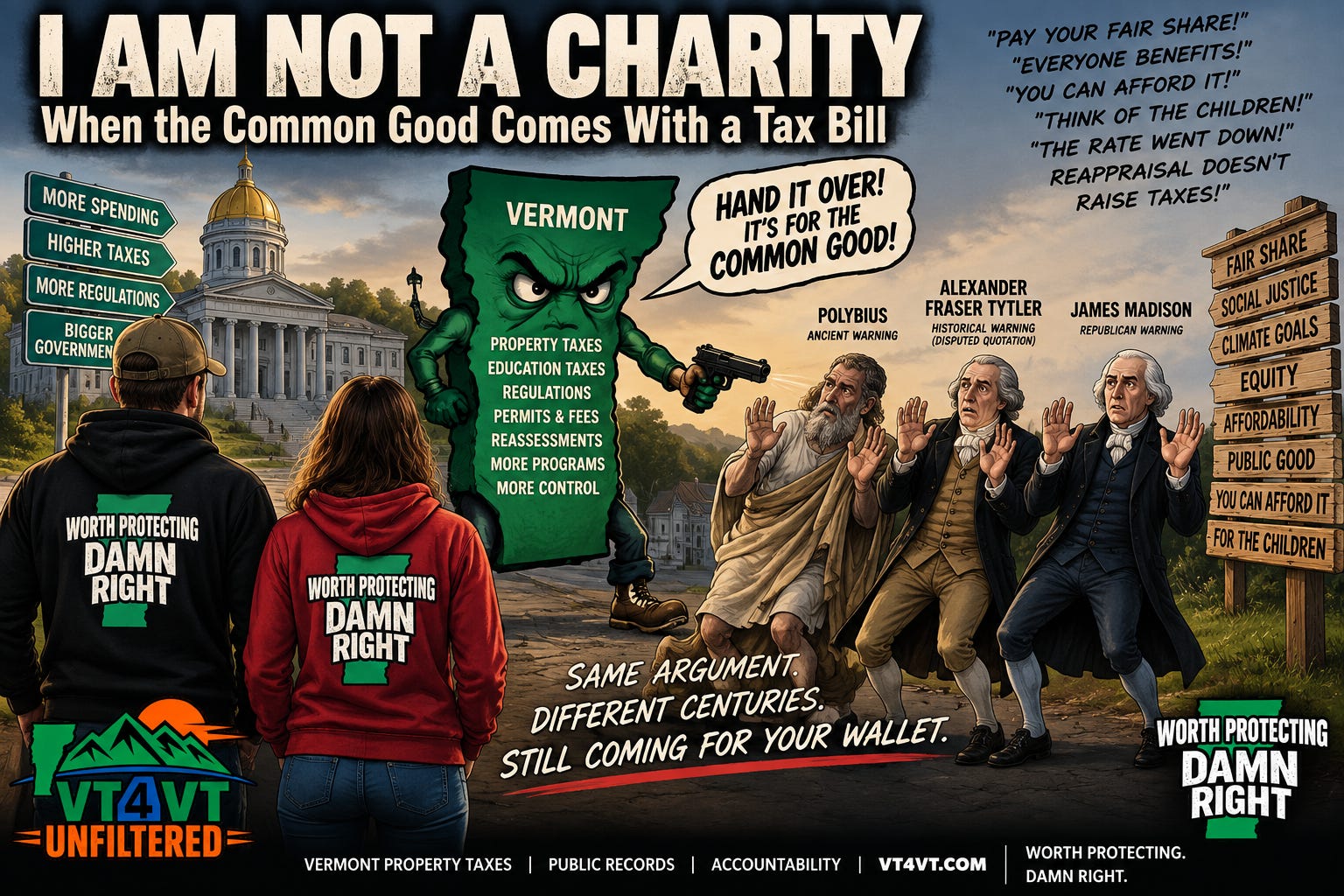
This argument is much older than Vermont. Polybius warned more than 2,000 years ago about political leaders cultivating an “appetite for gifts” and people becoming accustomed to living at the expense of others and depending upon their property. He was not writing about Vermont property taxes, but he identified the recurring political problem: benefits are easier to demand when somebody else bears the cost.
A similar warning is commonly attributed to Alexander Fraser Tytler, the 18th-century Scottish writer and judge: democracy survives only until voters discover they can vote themselves benefits from the public treasury. The quotation has not been found in Tytler’s writings, so VT4VT should identify it as commonly attributed to Tytler, but unverified. The attribution appears in American newspapers by at least 1946 and became widely known through a 1951 column.
James Madison supplied the American republican version of the warning. In Federalist No. 10, he wrote that unequal property interests naturally create political factions and specifically warned that taxation gives a dominant political group an opportunity to shift burdens onto a smaller group. His concern was not whether government could tax, but whether majority power could be exercised without sufficient regard for the property and rights of others.
That is where phrases such as “pay your fair share,” “everyone benefits,” “you can afford it,” “think of the children,” “the rate went down,” and “reappraisal doesn’t raise taxes” deserve scrutiny. Each may contain some truth, but none tells us whether the resulting burden is reasonable or whether the money is accomplishing the claimed public purpose.
The question is simpler: What are you taking, from whom, for what purpose, and where is the limit?
Government has legitimate expenses. The common good is real. Neither proposition means that ownership creates an unlimited obligation to finance every public priority placed before the taxpayer.
I am not a charity.
Sources
Vermont Constitution, Chapter I, Article 9 — Vermont General Assembly. Vermont Constitution
Vermont Department of Taxes — Your Vermont Property Tax Bill. Property Tax Bill
Vermont Department of Taxes — FY2027 Education Property Tax Rates. FY2027 Education Property Tax Rates
James Madison, Federalist No. 10, Founders Online, National Archives. Federalist No. 10
Polybius, The Histories, Book VI. Polybius, Book VI
Alexander Fraser Tytler attribution research. Tytler attribution history
Help Build the Record
VT4VT is documenting the FY2027 Vermont Property Tax Cycle using public records, municipal Grand Lists, reassessment notices, tax rates, final tax bills and anonymous survey data.
Complete the anonymous Vermont Reassessment Survey:
https://survey.vt4vt.com/2026-vermont-reassessment-survey/
Submit your municipality’s Grand List or provide a link to the public record:
https://survey.vt4vt.com/2026-vermont-grand-list-survey/
Reassessment notices, final property-tax bills and other public records help VT4VT compare individual experiences with the official municipal record.
Support the VT4VT Newsstand
VT4VT keeps its articles, public-record investigations, calculators and research available to the public. VT4VT is a program of Fort Aldrich Incorporated, a 501(c)(3) nonprofit organization.
Reader contributions support public-record acquisition, data storage, research, publishing and the tools used to analyze Vermont property taxes.
Contributions may also be mailed to:
Fort Aldrich Incorporated
P.O. Box 302
Northfield, VT 05663
Memo: VT4VT
Public records, Grand Lists, reassessment notices, tax bills and sourced research can also contribute directly to the project.
