As communities across Vermont move through the statewide reassessment cycle required under Act 68 of 2023, New Haven has emerged as another example of the scale of valuation changes many property owners are now experiencing.
According to New Haven grand list data, the town’s homestead grand list increased from approximately $208.3 million in 2024 to approximately $475.0 million in 2026, an increase of roughly 128 percent.
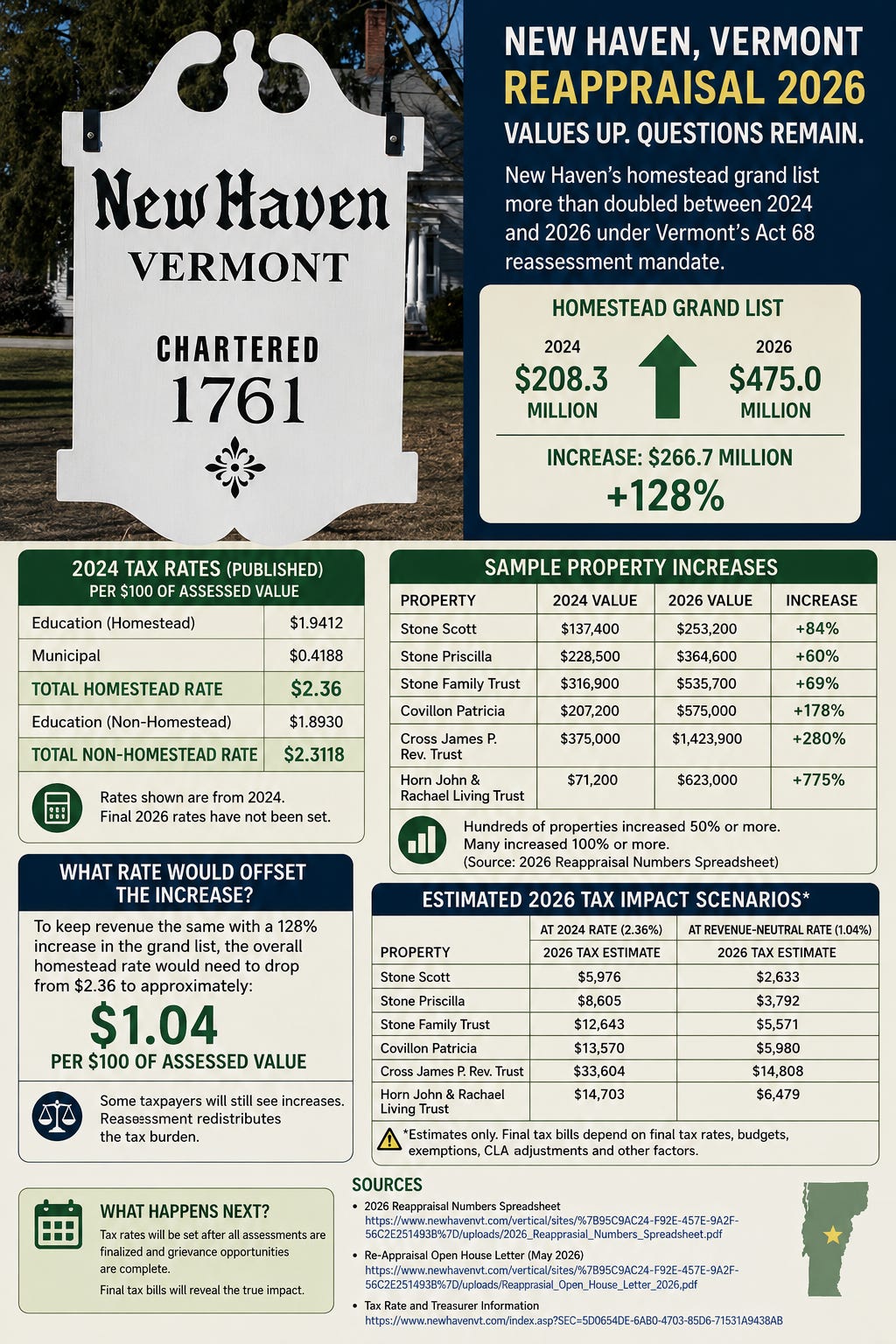
The reassessment data analyzed in this article comes directly from documents published by the Town of New Haven, including the official 2026 Reappraisal Numbers Spreadsheet and the town’s May 2026 Re-Appraisal Open House Letter. The town’s published tax information page was used to verify historical tax rates.
In practical terms, New Haven’s residential tax base more than doubled in just two years.
The reappraisal was not an isolated local initiative. It occurred as part of Vermont’s broader reassessment effort established under Act 68 of 2023, which requires municipalities to maintain assessments closer to current market values through regular reappraisals and valuation updates.
What the Town Told Residents
In a May 2026 letter to property owners, New Haven officials acknowledged concerns about the impact of the reappraisal process.
The town noted that the last townwide reappraisal was completed in 2013 and that significant changes in real estate values had occurred over the following thirteen years. Officials also stated that they could not determine the tax impact of the new assessments until all property values had been finalized and taxpayers had been given an opportunity to grieve their assessments.
The town further explained that tax rates would not be established until that process was complete.
That distinction is important.
Property assessments and property taxes are related, but they are not the same thing.
The Question Every Property Owner Is Asking
Will these higher assessments increase tax bills?
The answer depends on what happens to tax rates.
According to information published by the Town of New Haven, the 2024 tax rates were:
Education Tax (Homestead): 1.9412
Municipal Tax: 0.4188
Combined Homestead Rate: 2.36
If those rates remained unchanged, many property owners would see tax bills increase substantially because of the higher assessments.
However, reassessments generally result in lower tax rates because the overall tax base increases.
The critical question is whether those future rate reductions will be large enough to offset the dramatic increase in assessed values.
A Look at Individual Properties
While no single property tells the entire story, the town’s published reassessment spreadsheet provides examples of the magnitude of change.
Stone Scott
2025 Value: $137,400
2026 Value: $253,200
Increase: 84%
Stone Priscilla
2025 Value: $228,500
2026 Value: $364,600
Increase: 60%
Stone Family Trust
2025 Value: $316,900
2026 Value: $482,900
Increase: 52%
Covillon Patricia
2025 Value: $207,200
2026 Value: $575,000
Increase: 178%
Cross James P Revocable Trust
2025 Value: $375,000
2026 Value: $1,423,900
Increase: 280%
Horn John & Rachael Living Trust
2025 Value: $71,200
2026 Value: $623,000
Increase: 775%
These examples are not isolated.
The town’s reassessment spreadsheet contains hundreds of parcels showing increases of 50 percent or more, with many properties doubling and some increasing by several hundred percent.
Residential properties, farms, commercial properties, industrial properties, and large landholdings all appear throughout the reassessment records.
Why the Grand List Matters
The most important number is not any individual property.
It is the total value of the town.
When a town’s grand list increases from approximately $208 million to approximately $475 million, the overall tax base changes dramatically.
That change affects:
Education taxes
Municipal taxes
Tax burden distribution
State equalization calculations
Future tax rates
A reassessment does not simply change values on paper.
It changes how the tax burden is allocated among property owners.
Some taxpayers may ultimately see smaller increases than expected.
Some may see little change.
Others may see significant increases depending on how the new rates interact with the reassessed values.
Yes, but only as a scenario analysis.
We do not know the final 2026 education rate, municipal rate, CLA adjustments, or spending levels. Any estimate must be clearly labeled as hypothetical.
Using New Haven’s published 2024 homestead rate of 2.36%, we can estimate what tax bills would look like if rates did not change.
Property 2024 Value 2026 Value Est. 2024 Est. 2026
Tax @ 2.36% Tax @ 2.36%
Stone Scott $137,400 $253,200 $3,243 $5,976
Stone Priscilla $228,500 $364,600 $5,393 $8,605
Stone Family Trust $316,900 $535,700 $7,479 $12,643
Covillon Patricia $207,200 $575,000 $4,890 $13,570
Cross James P $375,000 $1,423,900 $8,850 $33,604
Revocable Trust
That illustrates why taxpayers are concerned.
However, rates almost certainly will not remain at 2.36%.
Revenue Neutral Estimate
The more interesting calculation is what rate would be required to offset the increase in the homestead grand list.
Homestead Grand List:
2024: $208.3 million
2026: $475.0 million
Increase factor:
$475.0M ÷ $208.3M = 2.28
If town and education spending remained identical, the effective rate would theoretically fall from:
2.36 → approximately 1.04
because:
2.36 ÷ 2.28 = 1.04
Using that revenue-neutral rate:
Property 2026 Value Tax @ 1.04%
Stone Scott $253,200 $2,633
Stone Priscilla $364,600 $3,792
Stone Family Trust $535,700 $5,571
Covillon Patricia $575,000 $5,980
Cross James P Revocable Trust $1,423,900 $14,808
Notice something important:
Even under a revenue-neutral scenario, taxpayers with increases much larger than the town average can still see substantial tax increases.
The VT4VT Story
This is the key point.
New Haven’s homestead grand list increased roughly 128%.
If every property increased by exactly 128%, taxes would mostly redistribute very little.
But the town’s own reassessment spreadsheet shows some properties increasing:
50%
80%
120%
200%
300%
700%+
While others increased far less. That means reassessment is not just about tax rates. It is about redistribution of the tax burden. The taxpayers who increased more than the town average will generally pay a larger share of the tax levy. The taxpayers who increased less than the town average will generally pay a smaller share. That is why the statement “reassessments don’t increase taxes” is incomplete.
The total levy may remain similar, but who pays it can change dramatically.
Important: The tax bill examples shown above are estimates for illustration purposes only. New Haven has not yet published final 2026 tax rates. Actual tax bills will depend on the final education tax rate, municipal tax rate, spending levels, exemptions, CLA adjustments, and other factors. The examples are intended to demonstrate the relationship between assessed value changes and potential tax impacts, not to predict final tax bills.
What Happens Next
New Haven officials correctly noted that the final tax impact cannot be determined until tax rates are established and tax bills are issued.
That is why VT4VT has repeatedly emphasized the importance of collecting both reassessment notices and actual tax bills.
The reassessments tell us what happened to property values.
The tax bills tell us what happened to taxpayers.
New Haven’s reassessment demonstrates the scale of change occurring under Vermont’s Act 68 reassessment mandate.
The values are now known.
The next question is whether the final tax rates will offset those increases—or whether homeowners, retirees, farmers, veterans, and long-time Vermont residents will ultimately pay substantially more.
The answer will come when the tax bills arrive.
Sources
Town of New Haven 2024 Billed Grand List.
Town of New Haven 2026 Grand List.
Town of New Haven, 2026 Reappraisal Numbers Spreadsheet.
Town of New Haven, Re-Appraisal Open House Letter, May 2026.
Town of New Haven Treasurer Tax Information Page.
Vermont Act 68 of 2023 (H.480).
Research Disclosure
Research assistance was provided using OpenAI ChatGPT. Primary source documents obtained from the Town of New Haven remain the authoritative source. Calculations, comparisons, and interpretations should be independently verified.Replace the source section with this version:
Sources
Town of New Haven, Vermont. 2026 Reappraisal Numbers Spreadsheet. Available at: 2026 Reappraisal Numbers Spreadsheet
Town of New Haven, Vermont. Re-Appraisal Open House Letter (May 2026). Available at: Re-Appraisal Open House Letter 2026
Town of New Haven, Vermont. Tax Rate and Treasurer Information. Available at: New Haven Tax Rate Information Page
Town of New Haven 2024 Billed Grand List.
Town of New Haven 2026 Grand List.
Vermont Act 68 of 2023 (H.480).
Research Disclosure
Research assistance was provided using OpenAI ChatGPT. Primary source documents obtained from the Town of New Haven remain the authoritative source. Calculations, comparisons, and interpretations should be independently verified.
Supporting Documents
Readers may review the original municipal documents directly:
VT4VT Report Information
Series: VT4VT Town Reassessment Report
Report ID: VT4VT-FY2027-001
Title: New Haven's Grand List Is Out, and the Numbers Are Hard to Ignore. Is This the Beginning of What's to Come?
Town: New Haven, Vermont
County: Addison County
Tax Year: FY2027
Version: 1.0
Status: Final
Original Publication: June 2026
Last Updated: June 2026
This report is part of VT4VT's ongoing statewide analysis of Vermont's Act 68 property reappraisals. Each municipality receives a permanent Report ID to support future updates, cross-references, and historical comparisons. Report IDs are assigned sequentially as analyses are completed and do not change with future revisions.
VT4VT – Worth Protecting. Damn Right.
Help Build the Statewide Dataset
VT4VT is collecting reassessment notices, grand lists, tax bills, and property tax information from communities across Vermont to better understand the real-world impact of Act 68 reassessments.
If you have received a reassessment notice, tax bill, or have access to your town’s grand list, please consider contributing to the project.
Vermont Reassessment Survey
Submit your reassessment information:
Survey:
Grand List Submission
Have access to your town’s grand list, abstract, tax rate documents, or reassessment notices?
Submit them here:
Grand List Submission:
The goal is simple: compare reassessment values, tax rates, and actual tax bills across all 247 Vermont cities and towns using primary source documents and taxpayer-reported data.