Part I — How We Got Here
On November 3, 2026, Vermont voters will decide whether to add a new collective-bargaining provision to the Vermont Constitution.
The measure is Proposal 3, formally identified by the Vermont General Assembly as PR.3 — Declaration of Rights; right to collectively bargain.
Its arrival on the 2026 ballot is the result of a process that began more than three years earlier. Proposal 3 originated in the Vermont Senate during the 2023–2024 General Assembly, entered the constitutional-amendment process while Democrats held commanding majorities in both legislative chambers, received extensive organized-labor participation during its committee consideration, passed the Senate and House by overwhelming margins, survived an intervening statewide election that substantially changed the political composition of the Legislature, and then passed overwhelmingly again.
The process did not require the approval of Governor Phil Scott. Vermont constitutional amendments do not move through the same signature-and-veto process as ordinary legislation.
The story of Proposal 3 therefore begins not with the 2026 ballot, but with the Legislature that first put the proposal in motion.
The Proposal Begins in 2023
Proposal 3 was formally introduced during the 2023–2024 General Assembly. The lead sponsor was Sen. Nader Hashim, a Democrat representing Windham County.
Hashim was joined by 19 additional Senate sponsors: Philip Baruth, Christopher Bray, Brian Campion, Alison Clarkson, Ann Cummings, Martine Gulick, Ruth Hardy, Wendy Harrison, Virginia Lyons, Mark MacDonald, Richard McCormack, Andrew Perchlik, Kesha Ram Hinsdale, Richard Sears Jr., Tanya Vyhovsky, Anne Watson, David Weeks, Rebecca White and Irene Wrenner. The official legislative record identifies the proposal as having been adopted by both chambers on April 30, 2024.
The sponsorship reflected the political balance of the Legislature in which Proposal 3 was born. The Senate entered the biennium with 22 Democrats, seven Republicans and one Progressive. In the House, official legislative records show party membership moving during the biennium between 104 and 105 Democrats, 37 and 38 Republicans, four and five Progressives, three independents, and, after a party change, one Libertarian.
Democrats therefore controlled both chambers by substantial margins when the constitutional-amendment process began.
The sponsorship itself was heavily Democratic and Progressive, although Republican Sen. David Weeks was also a sponsor. That distinction becomes important later because the floor votes ultimately became considerably broader than the sponsor list.
Organized Labor Arrived With the Proposal
The committee record shows organized labor visibly involved at the beginning of Proposal 3’s public legislative consideration.
On February 21, 2024, Sen. Hashim appeared before the Senate Committee on Economic Development, Housing and General Affairs as the proposal’s sponsor. The agenda placed him alongside a substantial group of organized-labor representatives.
Sean Stott appeared as Director of Government Affairs for the Laborers’ International Union of North America Midwest Region. Elena Bender appeared as Vice President of United Nurses and Professionals. Alan Raff appeared for a labor “Unity Table” identified on the official committee agenda with AFSCME, AFT, NEA, AFL-CIO, SEIU and the Teamsters. Aimee Towne appeared as President of the Vermont State Employees’ Association. Christopher Dube appeared as President of the Professional Fire Fighters of Vermont. Heather Riemer appeared as Executive Director of AFT Vermont. Larry Moquin appeared as a Laborers’ Local 668 field supervisor and vice president of the Vermont Building & Construction Trades. Kim Hokanson represented the North Atlantic States Regional Council of Carpenters. Retired union carpenter Jean Goodwin also appeared, as did David Mickenberg of Working Vermont.
The labor presence continued as the proposal moved through committee. On March 20, the Senate committee heard from University of Illinois labor-law professor Matthew Finkin, Vermont Labor Council AFL-CIO Executive Director Elizabeth Medina and David Mickenberg before voting on the proposal. The committee had held a separate discussion the previous day comparing labor amendments adopted in other states.
When Proposal 3 reached the House Committee on General and Housing, the same pattern continued. The House heard from Medina, AFT Vermont, LIUNA, VSEA, the Vermont Building & Construction Trades Council, carpenters, pipe trades and other union representatives. The committee record includes written testimony submitted on behalf of the Vermont Labor Council AFL-CIO and the Building and Construction Trades Council.
Organized labor was therefore involved not merely as an outside supporter after Proposal 3 had been developed. Labor representatives were present during the proposal’s early legislative consideration and remained involved through its movement from the Senate into the House.
That involvement also existed within a broader political structure. Several of the organizations participating in Proposal 3 routinely endorse candidates and participate in Vermont elections.
Vermont-NEA identifies itself as representing approximately 13,000 educators. In the 2024 general election, its statewide recommendations included Democratic presidential nominees Kamala Harris and Tim Walz, independent U.S. Sen. Bernie Sanders, Democratic U.S. Rep. Becca Balint, Democratic/Progressive gubernatorial nominee Esther Charlestin, Progressive/Democratic lieutenant-governor candidate David Zuckerman, Democratic Treasurer Mike Pieciak and Democratic/Progressive Auditor Doug Hoffer. Its legislative recommendations extended across House and Senate districts and included a number of candidates outside the Democratic Party as well.
VSEA likewise maintains an electoral program through its political operation. Its published 2024 general-election endorsements included Sanders, Charlestin, Zuckerman, Pieciak, Secretary of State Sarah Copeland Hanzas and Hoffer, followed by a large legislative endorsement slate. That slate included Democrats and Progressives as well as some Republicans, including Republican Sen. Randy Brock and Republican Sen. Brian Collamore.
The Vermont AFL-CIO’s political role is also explicit. In July 2026, while organizing its Labor-to-Labor campaign for Proposal 3, the organization announced endorsements for 50 candidates. Its statewide endorsements included Amanda Janoo for governor, Mike Pieciak for treasurer, Sarah Copeland Hanzas for secretary of state and Tim Ashe for auditor. Its legislative endorsements included numerous Democratic and Progressive candidates, including several senators who had voted for Proposal 3. The organization stated that affiliated unions had committed to recruiting volunteers for the Proposal 3 campaign while also working to elect endorsed candidates.
The political activity of those organizations does not establish why any individual legislator voted for Proposal 3. It does establish that several organizations closely involved in the amendment’s legislative development also maintain organized electoral programs designed to support candidates they view as aligned with labor priorities.
Vermont’s Constitution Requires Passing Two Legislatures
Proposal 3 could not reach the ballot simply because one Legislature supported it. Vermont uses an unusually deliberate constitutional-amendment process. Chapter II, Section 72 of the Vermont Constitution requires a proposal to begin in the Senate during a designated proposing period. The first Senate must approve it by a two-thirds vote. The House must then concur by a majority.
The proposed amendment then goes before the next biennial General Assembly. In that second Legislature, the constitutional threshold changes. The succeeding Senate needs only a majority, and the House again needs a majority. Only after the proposal survives that second Legislature can it be submitted to Vermont voters.
The process therefore places a statewide legislative election between the two legislative approvals. The Legislature that first proposes a constitutional amendment cannot complete the entire process by itself it must go to the second successive legislative body. The 2025-2026 session was changed dramatically, but it survived and passed across party lines.
The Governor Does Not Have a Veto
Proposal 3 never went to Gov. Phil Scott for approval because Vermont’s Constitution does not give the governor a veto over constitutional amendments.
An ordinary bill passes the Legislature and is then presented to the governor, who may sign it, veto it or allow it to become law without a signature under the circumstances prescribed by Vermont law.
A constitutional amendment follows Section 72 instead.
After the Legislature completes the required two-stage process, the governor’s role is associated with the public proclamations required before and after the statewide vote. That function is notice, not approval.
This explains why Scott could veto ordinary labor legislation but could not stop Proposal 3 with a veto. Whatever position a governor may hold on the proposal, the constitutional amendment proceeds from the General Assembly to Vermont voters once the requirements of Section 72 have been met.
The First Senate Vote: April 2, 2024
The first major constitutional hurdle came on April 2, 2024.
Because this was the proposing Legislature, Proposal 3 needed two-thirds of the entire Senate. With 30 seats, the practical threshold was 20 affirmative votes.
The Senate approved Proposal 3 29–0, with one senator absent. The vote exceeded the required constitutional threshold by nine votes.
The Legislature That Started the Process
2023–2024 Vermont Senate — April 2, 2024
22 Democrats
7 Republicans
1 Progressive
Yes — 29
Philip Baruth
Christopher Bray
Randy Brock
Brian Campion
Thomas Chittenden
Alison Clarkson
Brian Collamore
Ann Cummings
Martine Gulick
Ruth Hardy
Wendy Harrison
Nader Hashim
Russ Ingalls
Jane Kitchel
Virginia Lyons
Mark MacDonald
Richard McCormack
Robert Norris
Andrew Perchlik
Kesha Ram Hinsdale
Richard Sears Jr.
Bobby Starr
Tanya Vyhovsky
Anne Watson
David Weeks
Richard Westman
Rebecca White
Terry Williams
Irene Wrenner
No — 0
None.
Absent — 1
Dick Mazza
The first Senate vote was therefore unanimous among senators present.
That vote included Republicans as well as Democrats and the chamber’s Progressive member.
The First House Vote: April 26, 2024
Proposal 3 then moved to the Vermont House.
The House was even more heavily Democratic. Official House records show its membership shifted slightly during the biennium because of membership changes, ranging between:
104–105 Democrats
37–38 Republicans
4–5 Progressives
3 Independents
and 1 Libertarian after a party change.
On April 26, 2024, the House considered whether to adopt the constitutional proposal in concurrence. The official roll-call record shows 129 yes, eight no and 11 absent.
Affirmative: Andrews of Westford Andriano of Orwell Anthony of Barre City Arrison of Weathersfield Arsenault of Williston Austin of Colchester Bartholomew of Hartland Bartley of Fairfax Beck of St. Johnsbury Berbeco of Winooski Birong of Vergennes Black of Essex Bluemle of Burlington Bongartz of Manchester Bos-Lun of Westminster Boyden of Cambridge Brady of Williston Dolan of Waitsfield Donahue of Northfield Durfee of Shaftsbury Elder of Starksboro Emmons of Springfield Farlice-Rubio of Barnet Galfetti of Barre Town Garofano of Essex Goldman of Rockingham Goslant of Northfield Graham of Williamstown Graning of Jericho Gregoire of Fairfield Harrison of Chittenden Headrick of Burlington Holcombe of Norwich Hooper of Randolph McFaun of Barre Town McGill of Bridport * Mihaly of Calais Minier of South Burlington Morgan of Milton Morris of Springfield Morrissey of Bennington Mrowicki of Putney Nicoll of Ludlow Notte of Rutland City Noyes of Wolcott Nugent of South Burlington O’Brien of Tunbridge Page of Newport City Pajala of Londonderry Patt of Worcester Pouech of Hinesburg Brennan of Colchester Brown of Richmond Brownell of Pownal Burke of Brattleboro Burrows of West Windsor Campbell of St. Johnsbury Canfield of Fair Haven Carpenter of Hyde Park Carroll of Bennington Casey of Montpelier Chapin of East Montpelier Chase of Chester Chase of Colchester Chesnut-Tangerman of Middletown Springs Christie of Hartford Cina of Burlington Clifford of Rutland City Coffey of Guilford Cole of Hartford Conlon of Cornwall Corcoran of Bennington Cordes of Lincoln Demar of Enosburgh Demrow of Corinth Dickinson of St. Albans Town Dodge of Essex * Hooper of Burlington Houghton of Essex Junction Howard of Rutland City James of Manchester Jerome of Brandon Kornheiser of Brattleboro Krasnow of South Burlington * Labor of Morgan LaBounty of Lyndon Lalley of Shelburne LaLonde of South Burlington LaMont of Morristown Lanpher of Vergennes Laroche of Franklin Leavitt of Grand Isle Lipsky of Stowe Logan of Burlington * Long of Newfane * Maguire of Rutland City Marcotte of Coventry Masland of Thetford Mattos of Milton McCann of Montpelier McCarthy of St. Albans City McCoy of Poultney Priestley of Bradford Quimby of Lyndon Rice of Dorset Roberts of Halifax * Sammis of Castleton Satcowitz of Randolph Scheu of Middlebury Shaw of Pittsford Sheldon of Middlebury Sibilia of Dover Sims of Craftsbury Small of Winooski Squirrell of Underhill Stevens of Waterbury * Stone of Burlington Surprenant of Barnard Taylor of Milton Taylor of Colchester Templeman of Brownington Toleno of Brattleboro Toof of St. Albans Town Torre of Moretown Troiano of Stannard * Waters Evans of Charlotte White of Bethel Whitman of Bennington Williams of Barre City
Those who voted in the negative are: Burditt of West Rutland Hango of Berkshire * Higley of Lowell * Parsons of Newbury Peterson of Clarendon Smith of Derby
Those members absent with leave of the House and not voting are: Branagan of Georgia Brumsted of Shelburne Buss of Woodstock Dolan of Essex Junction Hyman of South Burlington Ode of Burlington Oliver of Sheldon Pearl of Danville Rachelson of Burlington Stebbins of Burlington Wood of Waterbury
The vote completed the first legislative stage required under Vermont’s constitutional-amendment process.
The first General Assembly had now approved Proposal 3 by 29–0 in the Senate and 129–8 in the House.
The 2024 Election Changed the Legislature
The November 2024 election substantially changed the political balance in Montpelier.
The Vermont House Clerk’s official post-election report described the turnover as unusually large. Fifty new representatives entered the 150-member House, equaling one-third of the chamber. Nine new senators entered the 30-member Senate, representing nearly one-third of that chamber.
The party shift was also substantial.
The House majority party fell from 105 members during the 2023–2024 biennium to 87 members for 2025–2026. The Senate majority party fell from 22 members to 16.
Official House membership statistics list the 2025–2026 House at 87 Democrats, 56 Republicans, with Progressive and independent membership changing from four Progressives and three independents to three Progressives and four independents after Rep. Troy Headrick changed his affiliation from Progressive to independent in January 2025.
The Senate entered the 2025 session with 16 Democrats, 13 Republicans and one Progressive.
Proposal 3 had therefore begun under a Senate with 22 Democrats and returned to a Senate with only 16. It had begun under a House with approximately 105 Democrats and returned to one with 87.
Proposal 3 nevertheless remained alive because it had already completed the constitutionally more difficult first stage.
The Threshold Changed in the Second Legislature
The second Legislature did not face the original two-thirds Senate requirement.
Under Section 72, once a proposed amendment survives the first General Assembly and the intervening election, the succeeding Senate and House need only majority approval.
Only 16 of the 30 Senate votes were required in 2025.
It did not matter.
The Second Senate Vote: March 20, 2025
On March 20, 2025, the newly elected Senate considered whether to concur in Proposal 3 and request House concurrence.
The official result was again 29 yes, zero no and one absent.
Across party lines every senator present voted in favor.
The political makeup of the chamber was substantially different from the one that had voted in 2024, but the numerical result was the same: 29 affirmative votes and no opposition.
The roster below identifies the 2025 vote by party. Current 2026 election status is noted where it can be established from the current general-election record. Vermont elects all 30 senators every two years. The November 2026 election therefore provides a direct opportunity to compare the legislators who voted on Proposal 3 with the names seeking another term. The official Secretary of State candidate page confirms that all 30 Senate seats are on the November 3 ballot.
Vermont Senate — March 20, 2025
Democrats — Yes
Philip Baruth — Chittenden Central. Still serving in the 2025–2026 Senate; not seeking reelection in 2026.
Seth Bongartz — Bennington. Still serving; 2026 general-election candidate.
Thomas Chittenden — Chittenden Southeast. Still serving; 2026 general-election candidate.
Alison Clarkson — Windsor. Still serving through the 2025–2026 term; not seeking reelection in 2026.
Ann Cummings — Washington. Still serving; 2026 general-election candidate.
Martine Gulick — Chittenden Central. Still serving; 2026 general-election candidate.
Ruth Hardy — Addison. Still serving; 2026 general-election candidate.
Wendy Harrison — Windham. Still serving; 2026 general-election candidate.
Nader Hashim — Windham. Still serving; 2026 general-election candidate.
Virginia “Ginny” Lyons — Chittenden Southeast. Still serving; 2026 general-election candidate.
Joe Major — Windsor. Still serving; 2026 general-election candidate.
Andrew Perchlik — Washington. Still serving; 2026 general-election candidate.
Rob Plunkett — Bennington. Still serving; 2026 general-election candidate.
Kesha Ram Hinsdale — Chittenden Southeast. Still serving; 2026 general-election candidate.
Anne Watson — Washington. Still serving; 2026 general-election candidate.
Rebecca “Becca” White — Windsor. Still serving; 2026 general-election candidate.
Progressive — Yes
Tanya Vyhovsky — Chittenden Central. Still serving; 2026 general-election candidate.
Republicans — Yes
Patrick Brennan — Grand Isle. Still serving; 2026 general-election candidate.
Randy Brock — Franklin. Still serving; 2026 general-election candidate.
Brian Collamore — Rutland. Still serving; 2026 general-election candidate.
Samuel Douglass — Orleans. Served in the 2025–2026 Senate.
Larry Hart Sr. — Orange. Served in the 2025–2026 Senate.
Steven Heffernan — Addison. Still serving; 2026 general-election candidate.
Russ Ingalls — Essex. Still serving; 2026 general-election candidate.
Chris Mattos — Chittenden North. Still serving through the term; not seeking reelection in 2026.
Robert Norris — Franklin. Still serving; 2026 general-election candidate.
David Weeks — Rutland. Still serving; 2026 general-election candidate.
Richard Westman — Lamoille. Still serving; 2026 general-election candidate.
Terry Williams — Rutland. Still serving; 2026 general-election candidate.
No — 0
None.
Absent — 1
Scott Beck — Republican, Caledonia. Still serving; 2026 general-election candidate.
Current Senate candidacies are reflected in the 2026 general-election candidate guides and official candidate system. Contemporary election records also identify Baruth and Clarkson as retiring and Mattos as not seeking another Senate term.
The significance of the vote lies in the numbers themselves. The second Senate needed 16 votes. Proposal 3 received 29.
The House Took the Final Legislative Vote
Proposal 3 then returned to the House Committee on General and Housing.
Organized labor again appeared in the committee record. Sean Stott of LIUNA, David Mickenberg of Working Vermont, Professional Fire Fighters of Vermont President Christopher Dube and Vermont-NEA General Counsel Rebecca McBroom were among those testifying during the 2025 consideration.
The full House voted on May 1, 2025.
The official roll call records 125 yes votes, 15 no votes and nine absent members.
The no votes came from Republican representatives, but Republicans did not vote as a unified bloc. A substantial group of Republican representatives joined Democrats, Progressives and independents in supporting Proposal 3.
The roster matters because these were the lawmakers who completed the legislative portion of the constitutional-amendment process.
Vermont House — May 1, 2025
Democrats — Yes
Angela Arsenault
Sarita Austin
John Bartholomew
Daisy Berbeco
Matt Birong
Doug Bishop
Alyssa Black
Tiff Bluemle
Michelle Bos-Lun
Lucy Boyden
Erin Brady
Jana Brown
Mollie Burke
Bridget Burkhardt
Elizabeth Burrows
Emily Carris-Duncan
Conor Casey
Ela Chapin
Kevin Christie
Esme Cole
Peter Conlon
Jonathan Cooper
Timothy Corcoran II
Mari Cordes
Wendy Critchlow
Leonora Dodge
Karen Dolan
Abbey Duke
David Durfee
Zon Eastes
Alice Emmons
Golrang “Rey” Garofano
Leslie Goldman
Ian Goodnow
Edye Graning
William “Will” Greer
Leanne Harple
Rebecca Holcombe
Jay Hooper
Lori Houghton
Mary Howard
Robert Hunter
Kathleen James
Charlie Kimbell
Bram Kleppner
Emilie Kornheiser
Emilie Krasnow
Kate Lalley
Martin LaLonde
Saudia LaMont
Emily Long
Jim Masland
Kate McCann
Jubilee McGill
Marc Mihaly
Brian Minier
Kristi Morris
Chris Morrow
Mike Mrowicki
Michael Nigro
Daniel Noyes
Kate Nugent
John O’Brien
Carol Ode
Herb Olson
Gayle Pezzo
Phil Pouech
Barbara Rachelson
Larry Satcowitz
Robin Scheu
Amy Sheldon
Trevor Squirrell
Thomas Stevens
Mary-Katherine Stone
Heather Surprenant
Shawn Sweeney
Dara Torre
Edward “Teddy” Waszazak
Chea Waters Evans
Candice White
Kirk White
Theresa Wood
David Yacovone
Progressives — Yes
Brian Cina
Kate Logan
Chloe Tomlinson
Independents — Yes
Anne Donahue
Troy Headrick
Jed Lipsky
Laura Sibilia
Republicans — Yes
Richard Bailey
Ashley Bartley
Michael Boutin
Carolyn Branagan
William Canfield
Thomas Charlton
V.L. Coffin
Allen “Penny” Demar
Eileen Dickinson
Deborah Dolgin
Martha “Marty” Feltus
Kenneth Goslant
James Gregoire
James Harrison
Mark Higley
John Kascenska
Chris Keyser
Wayne Laroche
Eric Maguire
Alicia Malay
Michael Marcotte
Francis “Topper” McFaun
Anthony “Tony” Micklus
Leland Morgan
Michael Morgan
Mary Morrissey
Thomas Oliver
Woodman Page
Sandra “Sandy” Pinsonault
Chris Pritchard
Beth Quimby
Brenda Steady
Chris Taylor
Casey Toof
Ken Wells
Republicans — No
David “Dave” Bosch
Thomas Burditt
Greg Burtt
Jim Casey
Joshua Dobrovich
Lisa Hango
Zachary Harvey
Christopher Howland
Larry Labor
Joe Luneau
Richard Nelson
Michael Southworth
Michael Tagliavia
Matthew Walker
Kevin Winter
Absent and Not Voting
R. Scott Campbell
Gina Galfetti
Robert Hooper
Patricia McCoy
Todd Nielsen
Rob North
Joseph Parsons
Debra Powers
Monique Priestley
The official House roll-call record confirms the 125–15 result.
A significant number of those representatives remain active candidates in 2026. Vermont Public’s 2026 legislative candidate guide identifies incumbents including Robin Scheu, Jubilee McGill, Timothy Corcoran, David Durfee, Robert Hunter, Jim Casey, Larry Satcowitz, Richard Nelson, Kevin Winter, William Canfield, Chris Pritchard, Kenneth Goslant, Candice White, Dara Torre, Michael Boutin, Kate McCann, Ela Chapin, Marc Mihaly and Theresa Wood among the candidates who sought another term this election cycle. The Secretary of State confirms that all 150 House seats are being elected again in November 2026.
The full 2026 general-election candidate roster is maintained by the Vermont Secretary of State and is updated as ballot qualifications change. For that reason, current-candidate status should be read as a snapshot of the 2026 election cycle rather than as part of the historical 2025 roll call itself.
Some Yes Votes Were Accompanied by Reservations
The 125 affirmative House votes did not mean every member who voted yes expressed the same view of every provision.
Several lawmakers placed explanations in the legislative record.
Rep. James Gregoire supported Proposal 3 while explaining that he believed both the right to join a union and the right not to join one deserved protection. His stated position reflected concern over compulsory membership while allowing the proposal to advance to voters.
Rep. Herb Olson also expressed concern about a potential conflict involving freedom of association while voting for the proposal.
Among those voting no, some lawmakers also placed their reasoning in the record. Rep. Joshua Dobrovich distinguished between supporting a worker’s right to organize and requiring union membership as a condition of employment. Rep. Lisa Hango similarly identified employee choice as a concern. Other opponents raised questions involving workforce recruitment or the scope of workers covered by the proposal.
Those arguments concern what Proposal 3 does and why it was sought. They belong principally to the next Part, II. In the legislative history, however, they show that the final 125–15 vote contained more varied reasoning than the raw number alone reveals.
Four Legislative Votes
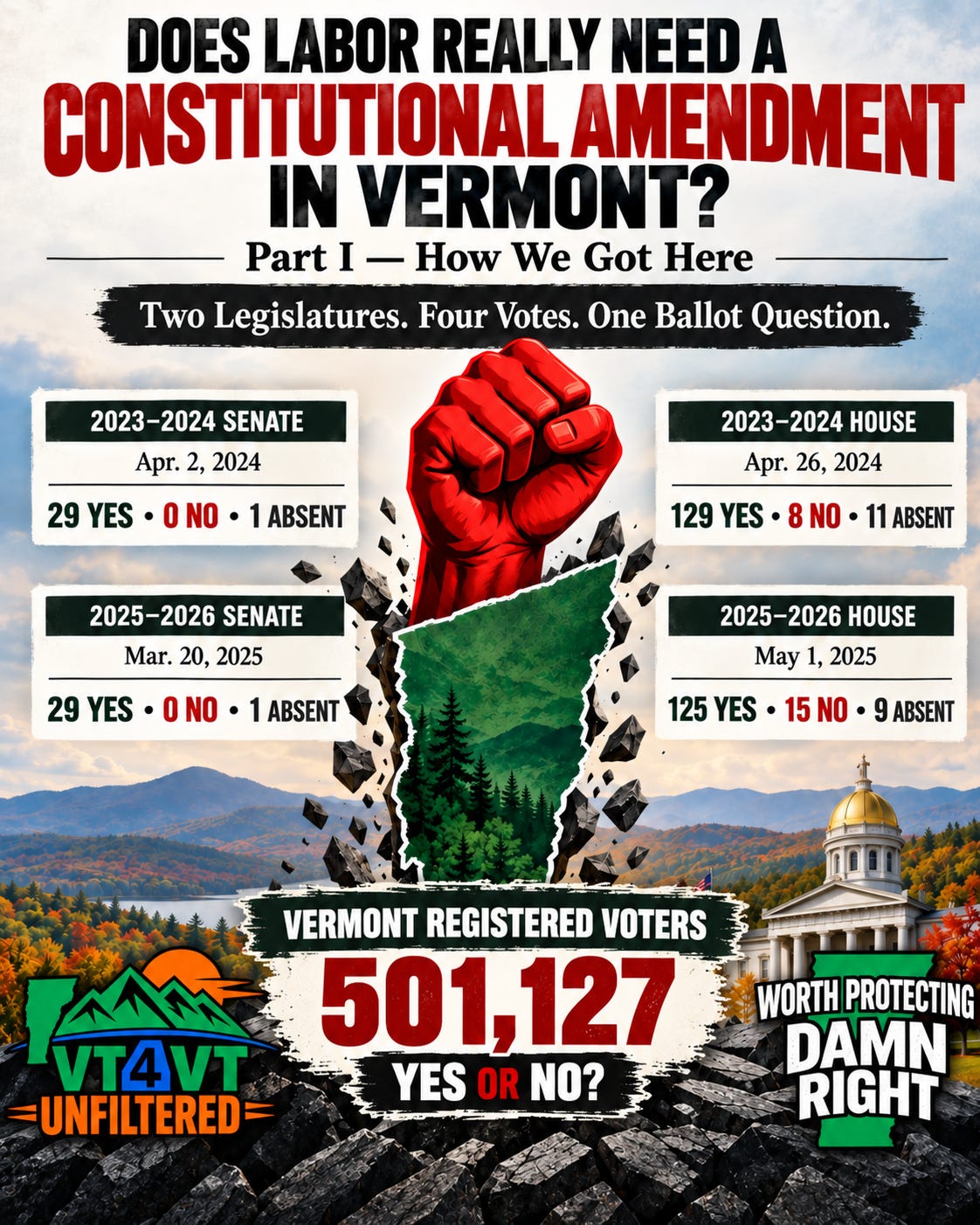
Across the two General Assemblies, Proposal 3 received 29 Senate votes and zero opposition in 2024; 129 House votes against eight in 2024; 29 Senate votes and zero opposition in 2025; and 125 House votes against 15 in 2025.
The first Senate vote was the constitutionally difficult one because it required two-thirds of the chamber.
The second Senate needed only a majority.
Proposal 3 exceeded both thresholds by wide margins.
The House likewise approved it overwhelmingly in both bienniums, although opposition increased from eight representatives during the first stage to 15 during the second.
The intervening election had significantly reduced Democratic strength in both chambers, yet Proposal 3 still received support from members of every party represented in the Senate and from Democrats, Progressives, independents and Republicans in the House.
That sequence is the political record of the amendment’s legislative passage.
The Political Balance Changed, but Proposal 3 Continued
The amendment began when Democrats held 22 of 30 Senate seats and approximately 105 of 150 House seats.
It returned after the electorate had reduced those numbers to 16 Democrats in the Senate and 87 Democrats in the House.
The second Legislature therefore looked materially different from the first.
Proposal 3 nevertheless passed the new Senate 29–0 and the new House 125–15.
The explanation lies partly in Vermont’s constitutional process and partly in the breadth of the legislative votes.
By the time voters changed the Legislature in November 2024, Proposal 3 had already completed the first constitutional stage. It did not have to start over. The succeeding Legislature faced the lower majority threshold prescribed by Section 72.
At the same time, the proposal did not depend on that lower threshold. It retained substantial bipartisan support.
The amendment originated under one legislative balance and completed the process under another.
If you support Proposal 3, there is a good chance your legislators already do as well.
If you oppose it, the roll calls are worth reading carefully. The names show exactly who voted to place the amendment before Vermont voters.
The Governor Was Never the Final Gatekeeper
After the second Legislature acted, Proposal 3 did not go to Gov. Scott for a signature. No veto or override for this amendment, you are responsible to approve this or deny it, your vote matters.
The official 2025–2026 legislative record shows the proposal proceeding under Section 72 toward the Secretary of State and the statewide election process.
A statute enacted by the Legislature remains subject to the normal legislative and executive process and can generally be amended by a future Legislature.
A constitutional amendment is different. The governor cannot veto its submission once the constitutional requirements have been fulfilled, and a later Legislature cannot simply repeal constitutional text through an ordinary bill.
That difference is the bridge between Part I and Part II.
How Proposal 3 Reached the Ballot
The public record provides a clear sequence.
Proposal 3 was introduced in the 2023–2024 Senate by Sen. Nader Hashim and 19 additional senators. Its sponsorship was overwhelmingly Democratic and Progressive, with Republican Sen. David Weeks also among the sponsors.
Organized labor was visibly involved when the proposal was publicly developed. Representatives of LIUNA, United Nurses and Professionals, VSEA, the Professional Fire Fighters of Vermont, AFT Vermont, the Vermont Building & Construction Trades, the Carpenters, Working Vermont and a Unity Table associated with AFSCME, AFT, NEA, AFL-CIO, SEIU and the Teamsters appeared during the proposal’s early committee consideration. The Vermont AFL-CIO subsequently remained involved as the proposal moved through the Legislature.
Several of those organizations also maintain established electoral programs and candidate-endorsement operations. Their published endorsements show substantial support for Democratic and Progressive candidates, along with selected independents and Republicans.
The first Senate approved Proposal 3 29–0.
The first House approved it 129–8.
Vermont then held the constitutionally required intervening election.
That election reduced Democratic legislative strength from 22 to 16 Senate members and from roughly 105 to 87 House members.
Proposal 3 then entered the newly elected General Assembly.
The second Senate needed only 16 votes. It received 29.
The second House approved the proposal 125–15.
The governor had no veto.
The amendment then moved to the voters.
That is how Proposal 3 reached the 2026 ballot.
The Question Part I Cannot Answer
The legislative record explains how Proposal 3 reached the ballot, but it does not explain why collective-bargaining protections already governed extensively by Vermont and federal law needed to become constitutional rights; why organized labor sought constitutional permanence instead of relying on statute; why the amendment restricts future laws that would “interfere with, negate, or diminish” those rights; or what its protections for labor-organization membership agreements could mean for employers, employees, union members, nonmembers, future Legislatures and Vermont’s business climate. Those are different questions.
They are the subject of Part II — Why We Got Here.
Methodology and Source Standard
This investigation relies first on public records maintained by the Vermont General Assembly and the Vermont Secretary of State. The legislative history, sponsor names, committee appearances, chamber composition and vote totals come from official Vermont legislative records. Current 2026 candidate information is checked against the Secretary of State’s election resources and contemporary statewide election guides where additional candidate-status detail is needed.
Union participation is identified from legislative committee agendas, witness records and written testimony. Political endorsements are taken from the organizations’ own published endorsement pages rather than attributed through third-party descriptions.
The article separates the documented legislative history from arguments concerning the merits of Proposal 3. The latter are reserved for Part II.
Primary public records include the Vermont General Assembly’s 2023–2024 PR.3 record, the April 26, 2024 House roll call, the March 20, 2025 Senate roll call, the May 1, 2025 House roll call, official House membership-by-party statistics, the House Clerk’s report on changes resulting from the 2024 general election, and the Vermont Secretary of State’s 2026 candidate records. Organizational records include Vermont-NEA’s 2024 candidate recommendations, VSEA’s 2024 general-election endorsements and the Vermont AFL-CIO’s 2026 endorsement and Proposal 3 campaign material.
Sources
The March 20, 2025 Senate vote was 29–0, with one senator absent, so every senator who actually voted supported Proposal 3. Vermont General Assembly
For the House, the May 1, 2025 vote was 125–15, with nine absent. The Legislature also publishes the full member-by-member roll call. Vermont General Assembly
For the first legislative round, the official 2023–2024 PR.3 record confirms the proposal and sponsors, while the April 26, 2024 House Journal contains the named House vote and legislators’ explanations of their votes. Vermont General Assembly
So for the article’s Sources section, I would use these four official records first:
Vermont General Assembly — PR.3, 2023–2024
PR.3 legislative record
Vermont House Journal — April 26, 2024
April 26, 2024 House Journal
Vermont Senate — Proposal 3 Roll Call, March 20, 2025
2025 Senate roll-call record
Vermont House — Proposal 3 Roll Call, May 1, 2025
2025 House roll-call record
VT4VT Surveys This Week
Is Vermont Affordable?
Can Vermonters still afford to live here?
This anonymous survey looks at the real financial pressure facing Vermont households, including housing costs, taxes, utilities, everyday expenses, and whether people are considering leaving Vermont because of affordability.
Your responses help VT4VT document what Vermonters are experiencing and identify trends that deserve deeper public-record research.
Take the survey:
https://survey.vt4vt.com/s/003-leaving/
Property Tax Affordability Survey
How are Vermont property taxes affecting your household?
This anonymous survey focuses specifically on property taxes, reassessments, rising property values, tax bills, and whether Vermont homeowners believe their current property-tax burden is sustainable.
The results will help VT4VT compare taxpayer experiences with municipal grand lists, tax rates, reassessment data, and other public records as we continue building the FY2027 Vermont Property Tax database.
Take the survey:
https://survey.vt4vt.com/s/004-property-tax-affordabiltiy/
VT4VT.com
Worth Protecting.
Damn Right.
Help Build the VT4VT Database
VT4VT is building an independent statewide database documenting Vermont property taxes, reassessments, Grand Lists, legislation, housing policy and government decisions.
Complete the anonymous Vermont Reassessment Survey:
Vermont Reassessment Survey
Submit your municipality’s Grand List:
Submit a Grand List
Vermonters can also help by sharing reassessment notices, final property-tax bills, municipal records and sourced research. Survey responses are used to identify statewide trends and are not presented as identifiable individual taxpayer records.
Read the complete investigation and VT4VT town reports at:
VT4VT Newsstand
VT4VT.com
Support Independent Vermont Research
VT4VT keeps these stories, public-record investigations and research available to Vermonters.
VT4VT is a program of Fort Aldrich Incorporated, a 501(c)(3) nonprofit organization. Support helps pay for public-record collection, data analysis, research and the tools being built to document Vermont property taxes and public policy.
Readers can support the work through a paid VT4VT Substack subscription or through the VT4VT donation option at VT4VT.com.
Checks or money orders may also be made payable to:
Fort Aldrich Incorporated
P.O. Box 302
Northfield, VT 05663
Write VT4VT in the memo if you want the contribution directed to the VT4VT program.
Can’t donate? Submit records, Grand Lists, reassessment information or sourced research. Building the database is part of the work.
YouTube: @Vt4vermont
Substack: VT4VT Substack
X: @vt4vermont
Instagram: @vt4vermont
TikTok: @vt4vt
