VT4VT Town Reassessment Report — STOCKBRIDGE,
Report ID: VT4VT-FY2027-006/25/26-A
Comparison: 2025 Billed Grand List → 2026 reassessed/billed values
Status: Completed reassessment reflected in 2026 tax bills.
Stockbridge’s Assessments Nearly Doubled. Its Tax Rates Fell. Its Property-Tax Levy Still Rose About 22%.
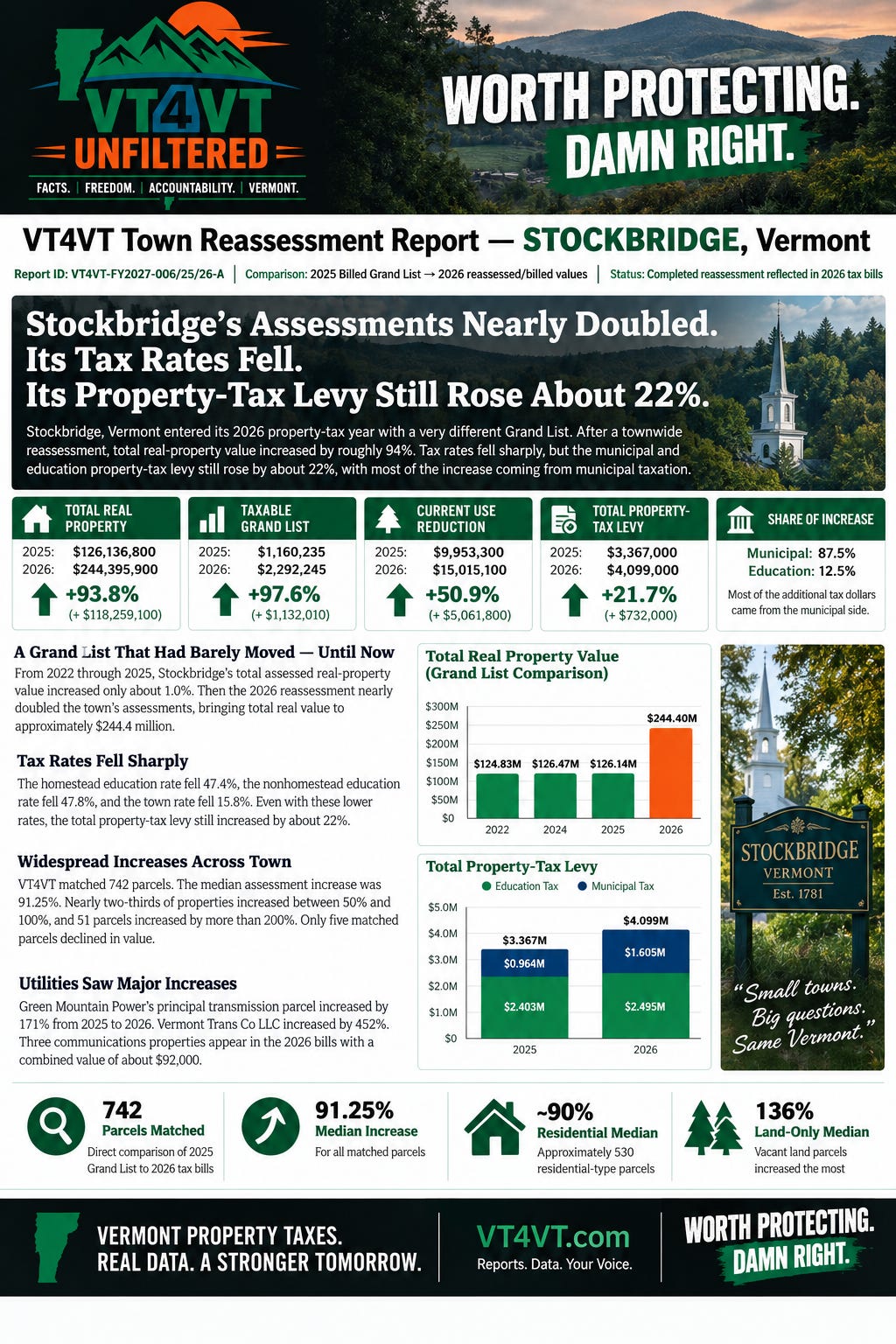
Stockbridge, Vermont entered its 2026 property-tax year with a very different Grand List from the one taxpayers had been living under.
The town’s 2025 Billed Grand List reported $126.14 million in total real-property value. The 2026 tax bills issued after the town’s reassessment contain approximately $244.40 million in assessed real property, an increase of roughly $118.26 million, or 93.8 percent. The signed 2026 tax-rate document reports an official Grand List of $2,292,245, nearly double the 2025 Grand List of $1,160,235.
That does not mean Stockbridge property taxes doubled. The education and municipal tax rates fell substantially after reassessment.
But the tax dollars did not fall with them.
VT4VT’s parcel-level analysis shows that the combined municipal and education property-tax levy increased by roughly $732,000, or about 21.7 percent, from the 2025 tax structure to the taxes represented by the 2026 bills.
The more surprising part is where most of that increase occurred.
Unlike Colchester, where most of the additional dollars came through the education property tax, Stockbridge’s increase was overwhelmingly municipal. Approximately 87.5 percent of the additional property-tax dollars in the Stockbridge comparison came from municipal taxation, while about 12.5 percent came from education property taxes.
That is why VT4VT analyzes more than reassessment percentages.
VT4VT is building a statewide record of Vermont property taxes and reassessments. Vermonters can help by completing the anonymous Reassessment Survey to report how their property value changed, and by submitting their town’s Grand List so VT4VT can compare official municipal records, tax rates, and parcel-level changes.
Please help with your submissions to
A Grand List That Had Barely Moved
Stockbridge provides an unusually clean historical baseline.
The June 2022 Grand List reported total real-property value of $124,834,100 across 748 parcels.
By 2024, total real value was $126,469,400.
The 2025 Billed Grand List then fell slightly to $126,136,800.
From 2022 through 2025, Stockbridge’s total assessed real-property value increased only about 1.0 percent.
Then came the reassessment.
VT4VT’s review of the 2026 parcel records and tax bills produces approximately $244,395,900 in assessed real-property value.
That means Stockbridge moved from roughly $126.1 million to $244.4 million in a single reassessment cycle.
Total Real Property
2025: $126,136,800
2026: approximately $244,395,900
Change: +$118,259,100 (+93.8%)
The 2026 assessor comparison supplied for Stockbridge shows parcel-by-parcel prior and new values, while the subsequently issued tax bills confirm those reassessed values were actually placed into the 2026 billing system.
The Taxable Grand List Nearly Doubled Too
The change did not disappear after Current Use and exemptions.
Stockbridge’s 2025 Billed Grand List reported:
Municipal Grand List
2025: $1,160,235
The Selectboard’s signed 2026 tax-rate document reports:
Municipal Grand List
2026: $2,292,245
That is an increase of approximately $1,132,010, or 97.6 percent.
Because a Vermont Grand List represents one percent of taxable value, that translates into an increase from roughly $116.0 million to $229.2 million in taxable value.
The increase in taxable value was actually somewhat larger than the increase in raw assessed value.
One reason is the changing composition of deductions and classifications.
Current Use Increased Substantially
Current Use also grew.
The 2025 Billed Grand List reports a Current Use reduction of $9,953,300.
The 2026 tax bills indicate approximately $15.02 million in Current Use reductions. The total difference between raw real value and taxable value is approximately $15.18 million; $160,000 of that corresponds with the veterans exemption, leaving about $15.02 million attributable to Current Use.
Current Use Reduction
2025: $9,953,300
2026: approximately $15,015,100
Change: +$5,061,800 (+50.9%)
So even after roughly $5 million more property value was removed through Current Use than the year before, Stockbridge’s taxable Grand List still nearly doubled.
What Happened to Individual Properties?
This is where the reassessment becomes much clearer.
VT4VT was able to directly match 742 parcels between the 2025 Billed Grand List and the 2026 tax-bill records.
The median assessment increase was 91.25 percent.
The average increase was approximately 116 percent, although that figure is pulled upward by some very large percentage changes on lower-value land parcels and infrastructure.
Only five matched parcels declined in assessed value. One remained unchanged.
Among the 742 directly matched properties, 471 — nearly two-thirds — increased between 50 and 100 percent. Another 163 increased between 100 and 150 percent. Twenty-nine increased between 150 and 200 percent, and 51 matched parcels increased by more than 200 percent.
This was not a reassessment in which a few expensive properties drove an otherwise modest town wide change.
The increase was widespread.
Residential Property Followed the Same Pattern
Using property descriptions in the municipal records, VT4VT identified approximately 530 matched residential-type parcels, including houses, mobile homes, condos and camps.
Their median assessment increase was approximately 90 percent.
For parcels carrying homestead education taxation in the 2026 bills, the median increase was approximately 88 percent.
One property close to that homestead median illustrates the scale:
10 Lilliesville Road
2025 assessment: $162,700
2026 assessment: $305,900
Change: +$143,200 (+88.0%)
That example is not being presented because it is an extreme case. It is useful precisely because it is close to the middle of the homestead distribution.
Some Residential Properties Rose Much More
Several private residential properties experienced increases far above the median.
47 Whitney Road
2025 assessment: $121,500
2026 assessment: $480,200
Change: +$358,700 (+295.2%)
1354 VT Route 100
2025 assessment: $215,900
2026 assessment: $607,200
Change: +$391,300 (+181.2%)
3768 VT Route 107
2025 assessment: $170,900
2026 assessment: $442,000
Change: +$271,100 (+158.6%)
2074 Stony Brook Road
2025 assessment: $100,400
2026 assessment: $253,200
Change: +$152,800 (+152.2%)
For private individuals and family ownership, VT4VT reports the physical property address rather than the owner’s name.
Vacant Land Moved Even More
Land-only parcels generally increased faster than improved residential property.
Among matched parcels classified by VT4VT from the municipal descriptions as land-only, the median increase was approximately 136 percent.
Several low-value land parcels produced very large percentage changes. Those percentages need to be interpreted carefully because small starting assessments can create dramatic percentage results.
For example:
69 South Hill Road
2025 assessment: $1,600
2026 assessment: $35,800
Change: +$34,200 (+2,137.5%)
Another land parcel on VT Route 100 rose from $4,400 to $70,000.
Those numbers are real, but they should not be confused with the typical residential increase. That is why the median and property-class distributions matter.
There Were Decreases
The records also contain declines.
45 Cedarwood Road
2025 assessment: $10,900
2026 assessment: $6,000
Change: -$4,900 (-45.0%)
113 Meadow Lane
2025 assessment: $78,700
2026 assessment: $76,400
Change: -$2,300 (-2.9%)
Among public-facing properties, Stockbridge Associates LLC at 3574 VT Route 107 declined from $80,100 to $67,100, or approximately 16.2 percent.
An industrial/land parcel also fell substantially.
Showing those properties matters. The reassessment overwhelmingly increased values, but it did not increase every parcel.
Green Mountain Power Reversed Direction
Stockbridge’s utility records are particularly notable because VT4VT already documented the opposite movement between 2024 and 2025.
Green Mountain Power’s principal transmission-line property on Blackmer Boulevard was assessed at $3,886,800 in 2024.
It fell to $2,954,300 in 2025.
Under the 2026 reassessment, that same transmission property is billed at $8,010,800.
So the sequence is:
2024: $3.887 million
2025: $2.954 million
2026: $8.011 million
From 2025 to 2026 alone, the principal transmission-line parcel increased approximately $5.06 million, or 171 percent.
Aggregating the identifiable Green Mountain Power real-property parcels produces an even clearer picture.
Green Mountain Power — Stockbridge Aggregate
2025: $2,987,200
2026: $8,094,800
Change: +$5,107,600 (+171.0%)
The 2026 bills show those GMP properties as taxable non-homestead property.
Vermont Trans Co Increased More Than Fivefold
Vermont Trans Co LLC’s fiber-optic and equipment property on Blackmer Boulevard was assessed at $182,500 in 2025.
The 2026 bill assesses that property at $1,007,900.
Vermont Trans Co LLC
2025: $182,500
2026: $1,007,900
Change: +$825,400 (+452.3%)
Combined, the identified GMP and Vermont Trans Co property increased from approximately $3.17 million to $9.10 million.
That is an increase of about $5.93 million, or 187 percent.
These utility increases are much larger than the town wide median and should remain a permanent component of the VT4VT statewide utility database.
Communications Property Also Appears in the 2026 Bills
Three additional communications-related real-property entries appear in the 2026 tax-bill records:
Cellco Partnership doing business as Verizon Wireless, Dish Network LLC and Fidium LLC.
Together, those three entries total approximately $92,000 in assessed real property.
They do not appear as corresponding parcel IDs in the 2025 Billed Grand List.
That does not, by itself, establish that all $92,000 represents newly taxable value created by a statutory change. Communications-property treatment changed under Vermont law, and those records need to be compared with prior equipment and personal-property classifications before VT4VT assigns a cause.
Rates Fell Sharply
Stockbridge’s signed 2025 rate sheet set the homestead education rate at $1.8679, the nonresidential education rate at $2.2128, and the town rate at $0.8306. The combined rates were $2.6985 for homestead property and $3.0434 for nonresidential property.
The signed 2026 rate sheet reports a homestead education rate of $0.9820, a nonresidential education rate of $1.1555, and a town rate of $0.6990. The bills separately apply a $0.0010 local-agreement rate, producing effective combined rates of $1.6820 for homestead property and $1.8555 for non-homestead property.
The education rates therefore fell almost in half.
Homestead Education Rate
2025: $1.8679
2026: $0.9820
Change: -47.4%
Non-homestead Education Rate
2025: $2.2128
2026: $1.1555
Change: -47.8%
The published town rate fell approximately 15.8 percent.
The combined homestead rate fell approximately 37.7 percent, while the combined non-homestead rate fell approximately 39.0 percent.
That is why simply looking at a 94-percent assessment increase would give an incomplete picture.
But Tax Dollars Still Increased
Using the 2025 Billed Grand List and Stockbridge’s published 2025 rates, the property-tax base generated approximately $2.40 million in education property taxes and about $964,000 in municipal property taxes.
Summing the taxes shown on the 749 individual 2026 bills produces approximately $2.49 million in education taxes and $1.60 million in municipal taxes.
Education Property Tax
2025: approximately $2.403 million
2026: approximately $2.495 million
Change: +$91,000 (+3.8%)
Municipal Property Tax
2025: approximately $964,000
2026: approximately $1.605 million
Change: +$641,000 (+66.5%)
Combined Property Tax
2025: approximately $3.367 million
2026: approximately $4.099 million
Change: +$732,000 (+21.7%)
That is the central finding of the Stockbridge report.
The assessment almost doubled.
The rates dropped.
The resulting property-tax levy still increased by roughly one-fifth.
And approximately 87.5 percent of the additional dollars came from the municipal side of the property-tax system.
That is almost the inverse of what VT4VT found in Colchester.
What a 94-Percent Town wide Increase Does Not Mean
It does not mean every Stockbridge taxpayer’s bill increased 94 percent.
A taxpayer whose assessment increased less than the town wide shift could see a very different result from someone whose assessment increased 150, 200 or 300 percent.
Homestead status also matters. So do Current Use, veterans exemptions, property tax credits and whether part of a homestead parcel is taxed as non-homestead property.
The relevant question for an individual taxpayer is not simply, “How much did my assessment increase?”
It is:
How did my assessment change relative to everyone else’s assessment, and what tax rate is now applied to that value?
The parcel-level distribution is what answers that question.
The Grand List Is Not the Same as the Housing Market
VT4VT’s 742 directly matched parcels had a median reassessment increase of about 91 percent.
That is a statement about assessments.
It is not automatically a statement that every property in Stockbridge could have sold for 91 percent more than it could the year before.
Reassessment is the town’s effort to bring listed values back toward market value after the prior Grand List had become increasingly disconnected from current sales.
The important policy question comes after the reassessment: how the new valuations redistribute Vermont’s property-tax burden.
Data Quality and Reconciliation
The 2025 Billed Grand List contains 745 parcels. The 2026 tax-bill file contains 749 bills. VT4VT directly matched 742 parcels by parcel ID.
Seven 2026 parcel IDs did not have direct 2025 matches, while three 2025 parcel IDs did not carry directly into the 2026 bill file. Several appear related to parcel changes, and three of the new IDs are communications properties.
Those unmatched parcels are excluded from the percentage-change distribution rather than being assigned artificial percentage increases.
There is also a small town wide discrepancy worth preserving in the record. The signed 2026 tax-rate sheet reports a Grand List of $2,292,245. Summing the Grand List values printed on the 749 individual tax bills produces $2,292,208, a difference of $37 on the Grand List, equivalent to $3,700 in taxable value.
VT4VT therefore uses the signed Selectboard tax-rate sheet as the official town wide Grand List figure and uses the tax bills for parcel-level and actual billed-tax analysis.
Historical Context
Stockbridge is especially valuable to the statewide project because the town provides records spanning both sides of the reassessment.
The June 2022 Grand List reported $124.83 million in real-property value.
The 2024 list reported $126.47 million.
The 2025 Billed Grand List reported $126.14 million.
Then the reassessed 2026 records moved the town to approximately $244.40 million in assessed real property.
For three years, the list barely moved.
Then it nearly doubled.
That is exactly the type of before-and-after record VT4VT is building across Vermont.
Methodology
This report uses official Stockbridge Grand Lists, signed tax-rate documents, the town’s 2026 assessment-comparison record and 749 individual 2026 tax bills. Parcels were matched primarily by parcel ID, not owner name. Assessment changes were calculated as the 2026 assessed real value minus the 2025 assessed real value, divided by the 2025 value.
Private individuals and family trusts are identified publicly by physical property address. LLCs, corporations, utilities, communications companies and other public-facing entities may be identified by name.
The analysis separates raw assessment changes, taxable Grand List changes, tax-rate changes and actual tax dollars. Those are different measurements and should not be substituted for one another.
Report ID Legend
VT4VT-FY2027-006/25/26-A
FY2027 — VT4VT FY2027 property-tax and reassessment research cycle.
006 — sixth sequential municipality report. This number remains permanently assigned to Stockbridge.
25/26 — the principal Grand List comparison is 2025 to 2026.
-A — the ending year reflects a completed town wide reassessment that proceeded into actual tax billing.
Current report ledger: 006
Next report number: 007
The earlier 2024–2025 Stockbridge analysis is retained as historical baseline research within Report 006 rather than receiving another report number.
Sources
Town of Stockbridge, Grand List — June 2022.
Town of Stockbridge, 2024 Grand List, July 23, 2024.
Town of Stockbridge, 2025 Billed Grand List, July 15, 2025.
Town of Stockbridge, 2024 Tax Rate, July 30, 2024.
Town of Stockbridge, 2025 Tax Rate, July 8, 2025.
Town of Stockbridge, 2026 Tax Rate, July 6, 2026.
Town of Stockbridge, 2026 Tax Bills, 749 individual parcel bills dated July 7, 2026.
Town of Stockbridge, 2026 parcel reassessment comparison.
VT4VT is collecting Vermont Grand Lists, reassessment notices and tax records to build a statewide public-record database. Grand Lists can be submitted at VT4VT.com or through the VT4VT Grand List Survey at survey.vt4vt.com/2026-vermont-grand-list-survey/. Reassessment experiences can be submitted anonymously at survey.vt4vt.com/2026-vermont-reassessment-survey/.
VT4VT.com
Worth Protecting.
Damn Right.