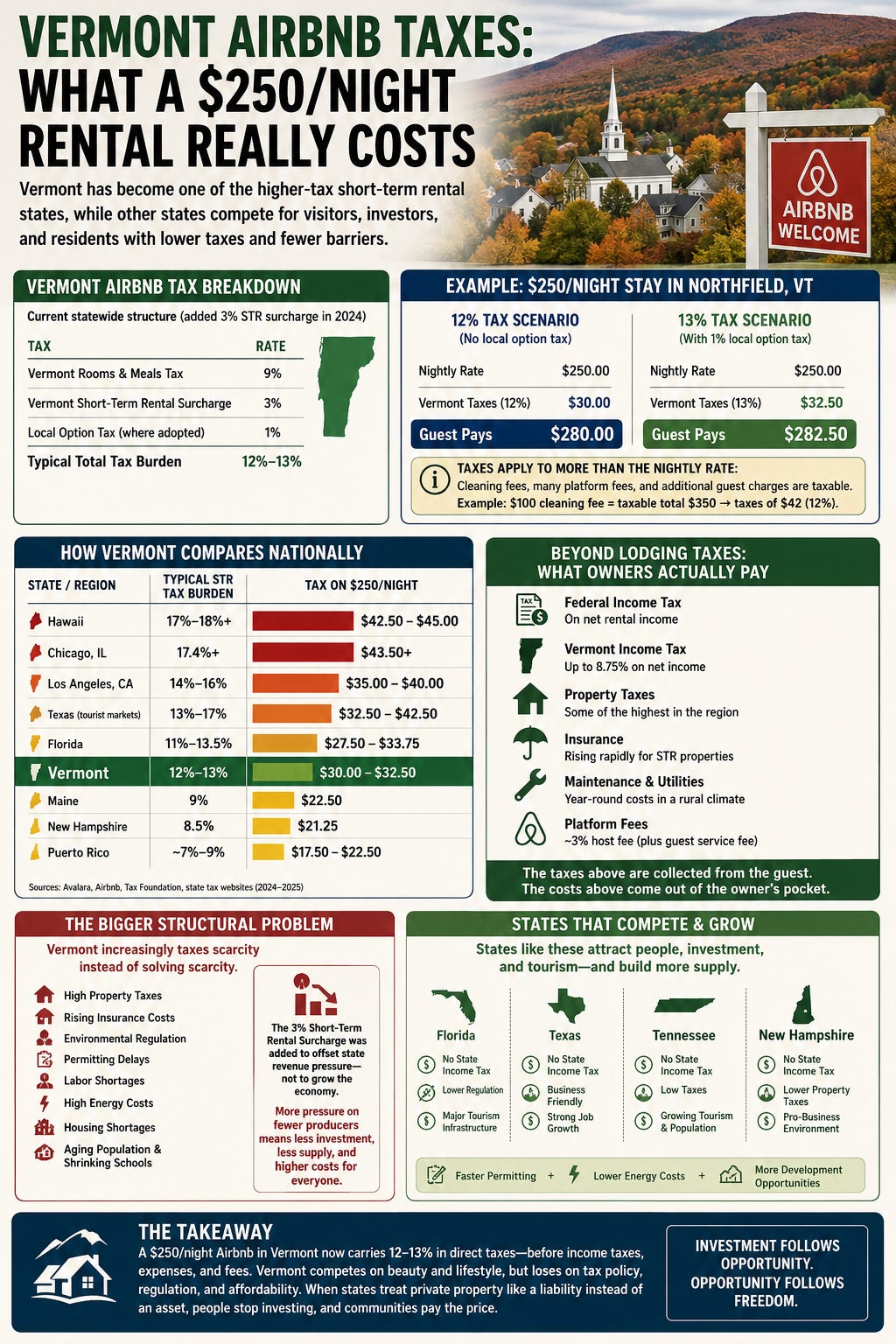
Vermont has quietly become one of the higher-tax states for short-term rentals in the country. What used to be a relatively simple tourism economy has now become more complex, with layered taxes, surcharges, fees, and increasing regulation aimed directly at Airbnb and short-term rental owners.
A simple $250/night Airbnb in places like Northfield now carries roughly 12–13% in direct lodging taxes before the owner even pays income taxes on the profit.
Vermont Airbnb Tax Breakdown
Current statewide structure:
Tax Rate Vermont Rooms & Meals Tax 9% Vermont Short-Term Rental Surcharge 3% Local Option Tax (where adopted) 1%
In many Vermont towns, the total tax burden lies between 12–13%.
For a $250/night stay:
Item Amount Nightly Rate $250.00 Vermont Taxes (12%) $30.00 Guest Pays $280.00
If a town adds a 1% local option tax:
Item Amount Total Taxes (13%) $32.50 Guest Pays $282.50
The taxes also apply to:
cleaning fees,
many platform fees,
and additional guest charges.
A $100 cleaning fee pushes the taxable booking total to $350, meaning taxes rise to about $42 on a single stay.
Then the owner still pays:
federal income tax,
Vermont income tax,
property taxes,
insurance,
maintenance,
utilities,
and platform fees.
How Vermont Compares Nationally
State/Region Typical STR Tax Burden Hawaii 17–18%+ Chicago 17.4%+ Los Angeles 14–16% Texas tourist markets 13–17% Florida 11–13.5% Vermont 12–13% Maine 9% New Hampshire 8.5% Puerto Rico ~7–9%
Vermont is no longer a “low-tax rural tourism state.” It now competes closer to large urban tourist jurisdictions while offering far less tourism infrastructure and far fewer economic advantages.
The Bigger Structural Problem
The issue is not just the lodging tax itself.
The problem is cumulative pressure:
high property taxes,
rising insurance costs,
environmental regulation,
permitting delays,
labor shortages,
utility costs,
and increasingly hostile attitudes toward property owners and small operators.
At the same time, competing states are aggressively attracting:
remote workers,
retirees,
tourism investment,
small business owners,
and construction capital.
States like:
Florida
Texas
Tennessee
New Hampshire
Often combine:
no state income tax,
faster permitting,
lower regulation,
lower energy costs,
and more development-friendly policies.
Meanwhile, Vermont increasingly taxes scarcity instead of solving scarcity.
The state added the 3% short-term rental surcharge while simultaneously struggling with:
housing shortages,
declining demographics,
shrinking school enrollment,
rising healthcare costs,
and a stagnant private-sector growth environment.
The result is a state that increasingly depends on extracting more revenue from a smaller pool of productive residents, property owners, and visitors.
For many Vermonters, the calculation is becoming simple:
“If the state treats private property like a liability instead of an asset, eventually people stop investing in it.”