For years, Vermont has been told that rising property values are a sign of success.
If that were true, Vermont should be thriving.
Instead, many communities are aging, young families continue to leave, employers struggle to find workers, housing remains scarce, and the cost of living continues to rise faster than many people’s incomes.
The problem is that property values and economic prosperity are not the same thing.
A house assessed at $140,000 ten years ago may now be assessed at $400,000 or $500,000. The owner did not suddenly receive a higher paycheck. A retiree did not receive a larger pension. A farmer did not suddenly double production. A small business owner did not automatically earn more revenue. The value of the asset changed on paper, but the ability to pay often did not.
Act 68 and Vermont’s statewide reassessment effort are bringing this issue into focus. Across Vermont, homeowners are reporting dramatic increases in assessed value. Properties in Winhall, Cambridge, Holland, Danville, Royalton, Essex, Barre City, and other communities are seeing assessments increase by 50 percent, 100 percent, 200 percent, and in some cases, more than 300 percent. Some property owners are already reporting significant increases in tax liability. Others have not yet received the full impact of those changes. The concern is not whether reassessments are occurring. The concern is whether Vermont has adequate protections in place when they occur.
As part of this effort, VT4VT is collecting reassessment and property tax data directly from Vermont property owners.
The purpose of the survey is not to oppose reassessments. The purpose is to document what is actually happening across Vermont and compare assessment increases with resulting tax bills.
Property owners are encouraged to submit their previous assessment, current assessment, previous tax bill, current tax bill, municipality, and any additional information they believe is relevant.
The more data collected, the clearer the picture becomes.
If your property has been reassessed, your tax bill has changed, or you have received a reassessment notice, please take a few minutes to complete the survey.
The results are being used to identify trends, measure the real-world impact of Act 68, and help shape future discussions regarding taxpayer protections, affordability, housing, working lands, and the LAND Act framework.
Many people argue that reassessments alone do not increase taxes. In theory, that can be true. In practice, Vermont’s system is tied heavily to assessed value, particularly through the education tax. As assessments rise, homeowners become increasingly exposed to future tax liability. The result is that many Vermonters are watching the value of their property increase far faster than their income.
This is occurring at a time when households are already under pressure. Fuel costs remain high. Electricity costs continue to increase. Insurance costs continue to increase. Food costs continue to increase. Vehicle costs continue to increase. Health care costs continue to increase. Inflation has touched nearly every aspect of daily life. For a family approaching retirement, the issue is not whether a house could theoretically sell for more money than it did ten years ago. The issue is whether they can afford to stay there.
Most people spend decades paying off a mortgage. They expect housing costs to become more manageable as they age. By the time a homeowner retires, the mortgage should be disappearing, not being replaced by rapidly increasing tax burdens. A person who spent thirty years paying for a home should not face greater financial uncertainty at retirement than they faced when they first purchased it.
That problem extends well beyond reassessments.
For decades, Vermont has largely responded to problems after they arrive. Housing becomes scarce, and new programs are created. Property taxes rise, and relief programs are added. Businesses leave, and incentives are offered to attract new investment. Farms disappear, and preservation efforts expand. The underlying pressures remain.
The reassessment issue is exposing those pressures all at once.
A property owner whose assessment increased from $150,000 to $500,000 may be no more capable of paying higher taxes today than they were ten years ago. A retired couple living on a fixed income does not become wealthier because a neighboring property sold for a premium. A farmer does not suddenly earn more because outside buyers have driven up the market value of rural land. Market value may change overnight. Income rarely does.
Vermont should be planning for the next twenty-five years, not simply reacting to the next crisis. The question is not whether property values can continue increasing. The question is what kind of state those increases are creating. A state where productive farms remain in operation, forests remain productive, businesses invest, housing is created, and families can afford to stay is very different from a state where property ownership increasingly concentrates into fewer hands while the people who built the community struggle to remain.
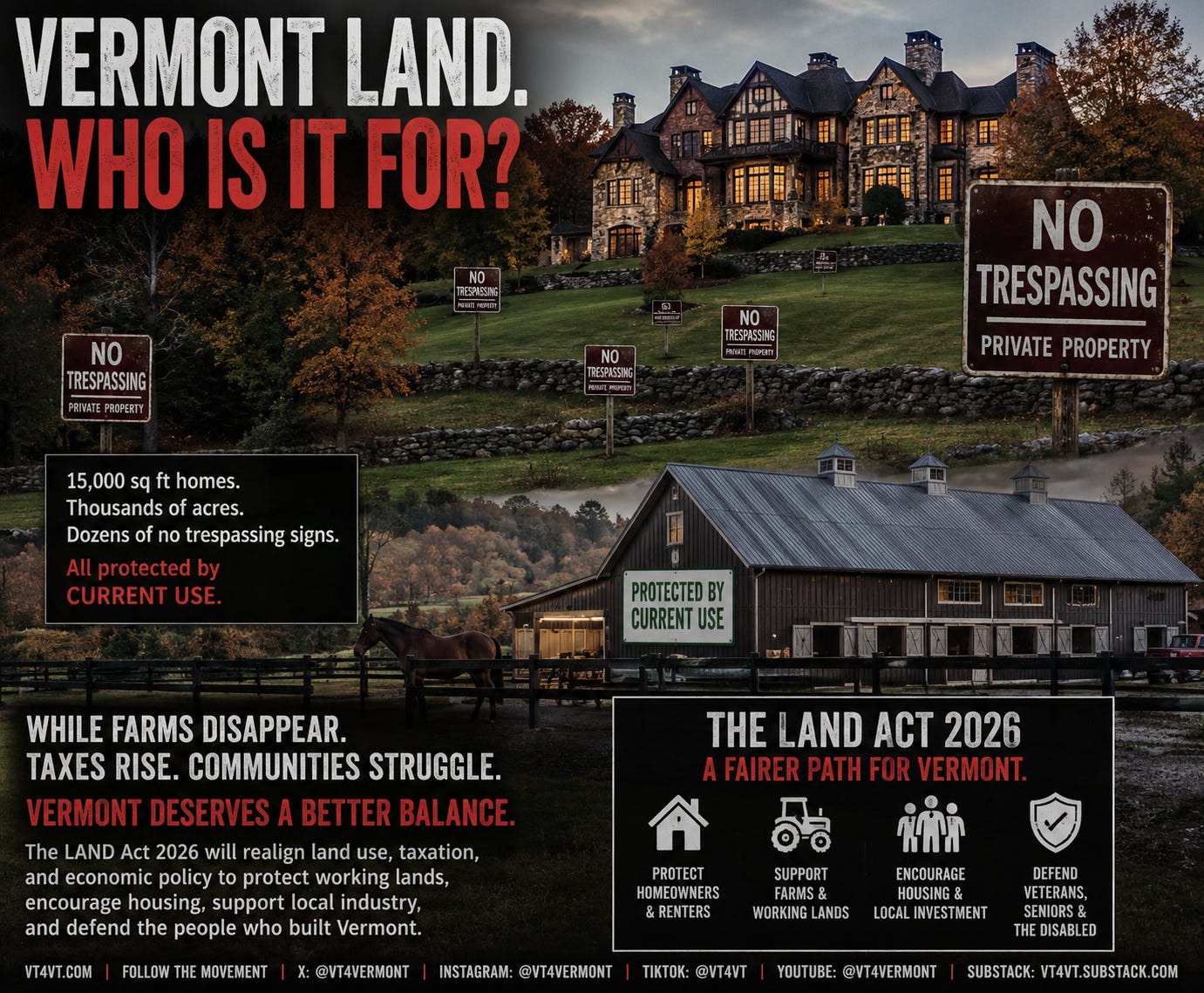
The purpose of the LAND Act is to begin addressing those issues before the consequences become permanent. The proposal starts from a simple premise: stability should be rewarded. A resident who remains in the same home for decades should receive greater protection than a recent purchaser. A long-term tenant who contributes to a community year after year should receive recognition through the tax system. A family farm that remains productive should receive greater protection than land held solely for speculation or isolation. Housing creation should be encouraged where it adds long-term residential opportunity. Investment should be welcomed when it strengthens Vermont’s economy rather than simply inflating asset prices.
The proposal does not seek to stop reassessments. It does not seek to stop growth. It does not seek to punish success. It seeks to reconnect taxation with affordability and public policy with long-term outcomes.
Vermont’s future depends on more than the price of real estate. It depends on whether working families, retirees, farmers, renters, business owners, veterans, and young people can afford to remain here. If they cannot, rising assessments will become little more than a transfer of property from those who built Vermont to those who can afford to buy it after they leave.
The LAND Act is an attempt to change that direction before it becomes irreversible.
Sources:
Act 68 of 2023 established Vermont’s statewide reassessment requirements and property tax reforms.
Source:
https://legislature.vermont.gov/Documents/2024/Docs/ACTS/ACT068/ACT068%20As%20Enacted.pdf
Assessment examples referenced in this article are drawn from property owner submissions provided to the VT4VT Vermont Reassessment Survey during 2026.
The LAND Act 2026 remains a working draft and has not been introduced in the Vermont General Assembly.
I will be publishing my concepts for the “LAND Act 2026” framework shortly.
If you would like to participate please contact me directly vt4vermont@gmail.com
The proposal is still evolving, but the objective remains the same: protect homeowners, renters, farmers, working lands, veterans, retirees, small businesses, and long-term Vermont residents from policies that increasingly disconnect property values from the ability to pay.
The LAND Act is not about stopping growth. It is about creating a path forward that encourages housing, productive land use, economic opportunity, and long-term stability while preserving the people and communities that make Vermont what it is.
Follow the discussion and future releases:
X (Twitter): @vt4vermont
Instagram: @vt4vermont
TikTok: @vt4VT
YouTube:
https://www.youtube.com/@Vt4vermont
Substack:

Additional survey data, supporting research, draft language, and revisions will be published as they become available.


