There is a problem with the way Vermont talks about nonhomestead property. A nonhomestead property can certainly be a multimillion-dollar vacation estate, but it can also be a hunting camp your grandfather bought for $300 in the 1960s, a cabin without year-round water, a woodlot, inherited family land, a small rental property, or the house someone bought hoping to retire to someday.
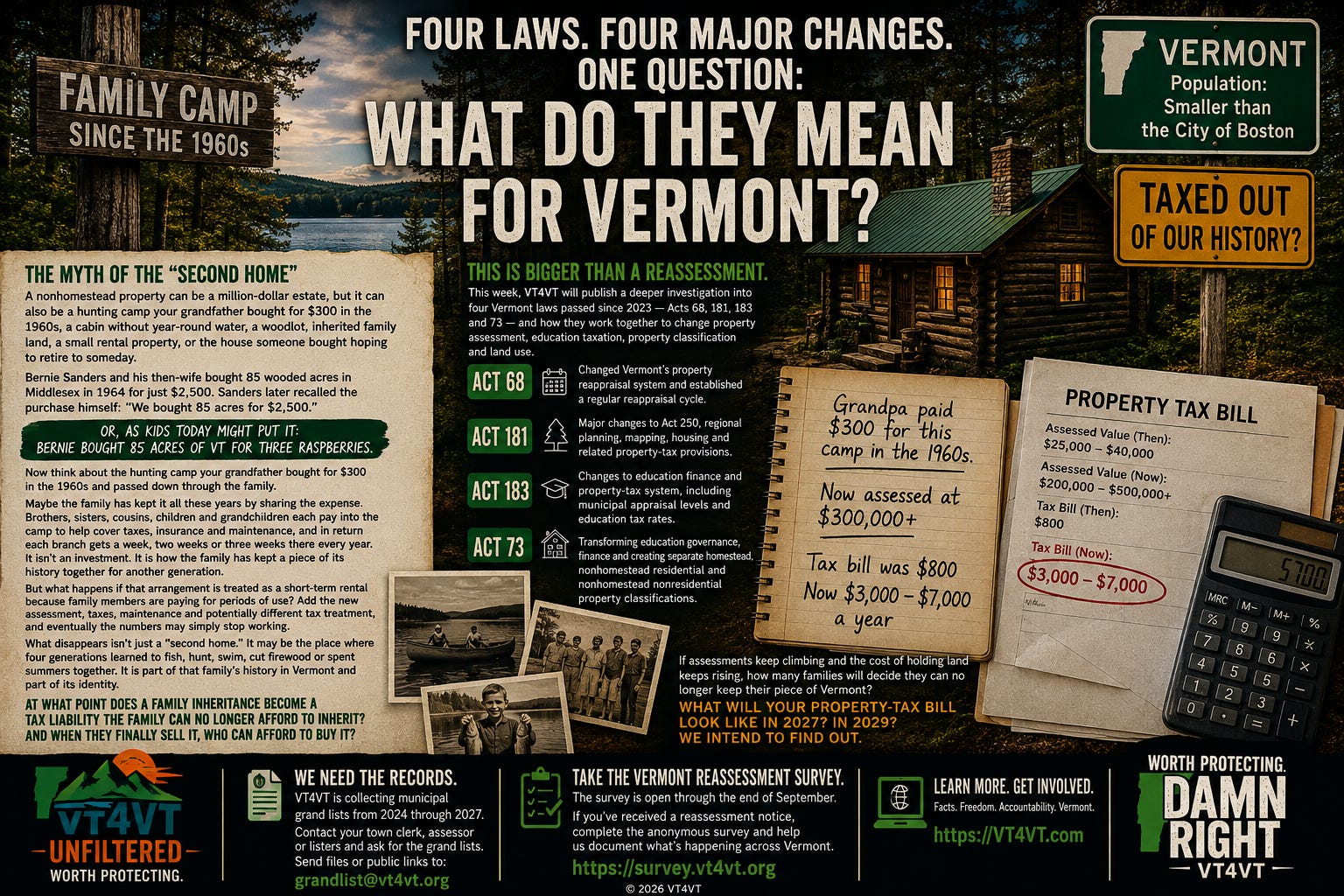
For some historical perspective, Bernie Sanders and his then-wife bought 85 wooded acres in Middlesex in 1964 for just $2,500. Sanders later recalled the purchase himself: “We bought 85 acres for $2,500.”
Source:
https://www.politico.com/magazine/story/2019/05/24/bernie-sanders-millionaires-226982/
Or, as kids today might put it: Bernie bought 85 acres of Vermont for three raspberries.
Now think about the hunting camp your grandfather bought for $300 in the 1960s and passed down through the family. It may have been assessed at $25,000 or $40,000 with an $800 tax bill for years. What happens when reassessment puts it at $200,000, $300,000 or $500,000, and the tax bill becomes $3,000, $5,000 or $7,000? Then Vermont creates a separate tax classification for nonhomestead residential property, giving the Legislature another lever over what that camp could cost to keep.
Maybe the family has kept it all these years by sharing the expense. Brothers, sisters, cousins, children and grandchildren each pay into the camp to help cover the property taxes, insurance and maintenance, and in return each branch of the family gets a week, two weeks or three weeks there every year. It isn’t an investment. It is how the family has managed to keep a piece of its history together for another generation.
But what happens if that arrangement is treated as a short-term rental because family members are paying for periods of use? Add the new assessment, taxes, maintenance and potentially different tax treatment, and eventually the numbers may simply stop working.
What disappears isn’t just a “second home.” It may be the place where four generations learned to fish, hunt, swim, cut firewood or spent summers together. It is part of that family’s history in Vermont and part of its identity.
That is why reducing this debate to “second homes,” “short-term rentals” and “the rich” is so misleading. Behind those labels are generational Vermonters, families who have summered here for generations, hunters and campers, retirees, small landlords, farmers, business owners, and people who have spent decades living, working or returning to the same piece of Vermont.
At what point does a family inheritance become a tax liability the family can no longer afford to inherit? And when they finally sell it, who can afford to buy it?
This Is Bigger Than a Reassessment
VT4VT is publishing a deeper investigation into four Vermont laws passed since 2023 — Acts 68, 181, 183 and 73 — and how they work together to change property assessment, education taxation, property classification and land use.
These aren’t simply proposals being kicked around by candidates. They are laws. Different provisions take effect at different times and their ultimate effects still have to be measured, but the statutory framework has already been enacted.
Act 68, passed in 2023, changed Vermont’s property reappraisal system and established a regular reappraisal cycle.
https://legislature.vermont.gov/bill/status/2024/H.480
Act 181, passed in 2024, made extensive changes to Vermont land-use law, Act 250, regional planning and mapping, housing and related property-tax provisions.
https://legislature.vermont.gov/Documents/2024/Docs/ACTS/ACT181/ACT181%20Act%20Summary.pdf
Act 183, also passed in 2024, changed Vermont’s education-finance and property-tax system, including the mechanism involving municipal appraisal levels and education property-tax rates.
https://legislature.vermont.gov/bill/status/2024/H.887
Act 73, passed in 2025, transformed major portions of Vermont’s education-governance and finance system and created the framework for separate homestead, nonhomestead residential and nonhomestead nonresidential property classifications.
https://legislature.vermont.gov/bill/status/2026/H.454
That matters because Vermont has a population smaller than the City of Boston, yet we continue creating increasingly complicated systems governing how property is valued, classified, taxed and used. If assessments continue climbing, property classifications permit increasingly different tax treatment, land-use restrictions change what owners can do with their property, and the cost of simply holding land continues rising, how many families will eventually decide they can no longer afford to keep their piece of Vermont?
That question extends beyond camps and second homes. What happens to farms, small businesses and rental properties? What is happening to utility assessments, and if utility property taxes rise substantially, where does that cost ultimately go? What happens when an $800 tax bill becomes $3,000, $5,000 or $7,000 while the property itself hasn’t become any more capable of producing the money necessary to pay it?
And what will your property-tax bill look like in 2027? What about 2029?
These are questions we intend to answer with public records.
Four laws. Four major changes to Vermont property. One question: what do they mean for your economic future in Vermont?
We Need the Grand Lists
To answer that question, we need the records.
VT4VT is collecting municipal grand lists from 2024 through 2027. We need the grand lists from before and after reassessment so we can measure what actually changed, which classes of property were affected and ultimately where the tax burden moved.
Finding these records isn’t always as simple as going to a town website. In some municipalities it takes 15 minutes; in others it can take hours. Contact your town clerk, assessor or listers and ask for your town’s 2024, 2025, 2026 and, when available, 2027 grand lists.
Send the files, public links or information about where they can be obtained to:
VT4VT:
https://VT4VT.com
The Vermont Reassessment Survey Is Still Open
The Vermont Reassessment Survey remains open through the end of September.
If you’ve received a reassessment notice, complete the anonymous survey. Survey responses help us identify trends and towns that warrant further investigation. We then compare those trends against grand lists, tax rates, tax bills and other public records.
Vermont Reassessment Survey and Grand list submission:
VT4VT:
https://VT4VT.com
Sources & Public Records
Vermont General Assembly — Act 68 (H.480), An act relating to property valuation and reappraisals:
https://legislature.vermont.gov/bill/status/2024/H.480
Vermont General Assembly — Act 181 (H.687), An act relating to community resilience and biodiversity protection through land use:
https://legislature.vermont.gov/Documents/2024/Docs/ACTS/ACT181/ACT181%20Act%20Summary.pdf
Vermont General Assembly — Act 183 (H.887), An act relating to homestead property tax yields, nonhomestead rates, and policy changes to education finance and taxation:
https://legislature.vermont.gov/bill/status/2024/H.887
Vermont General Assembly — Act 73 (H.454), An act relating to transforming Vermont’s education governance, quality, and finance systems:
https://legislature.vermont.gov/bill/status/2026/H.454
Montgomery Assessor/Listers — municipal property-tax, CLA and reappraisal information:
https://montgomeryvt.us/g/office/listers
Politico Magazine — “Bernie Sanders Has a Secret”:
https://www.politico.com/magazine/story/2019/05/24/bernie-sanders-millionaires-226982/
VT4VT Vermont Reassessment Survey:
https://survey.vt4vt.org
VT4VT:
https://VT4VT.com
Worth Protecting.
Damn Right.