Vermont is heading toward a financial breaking point and most people still do not understand what is happening.
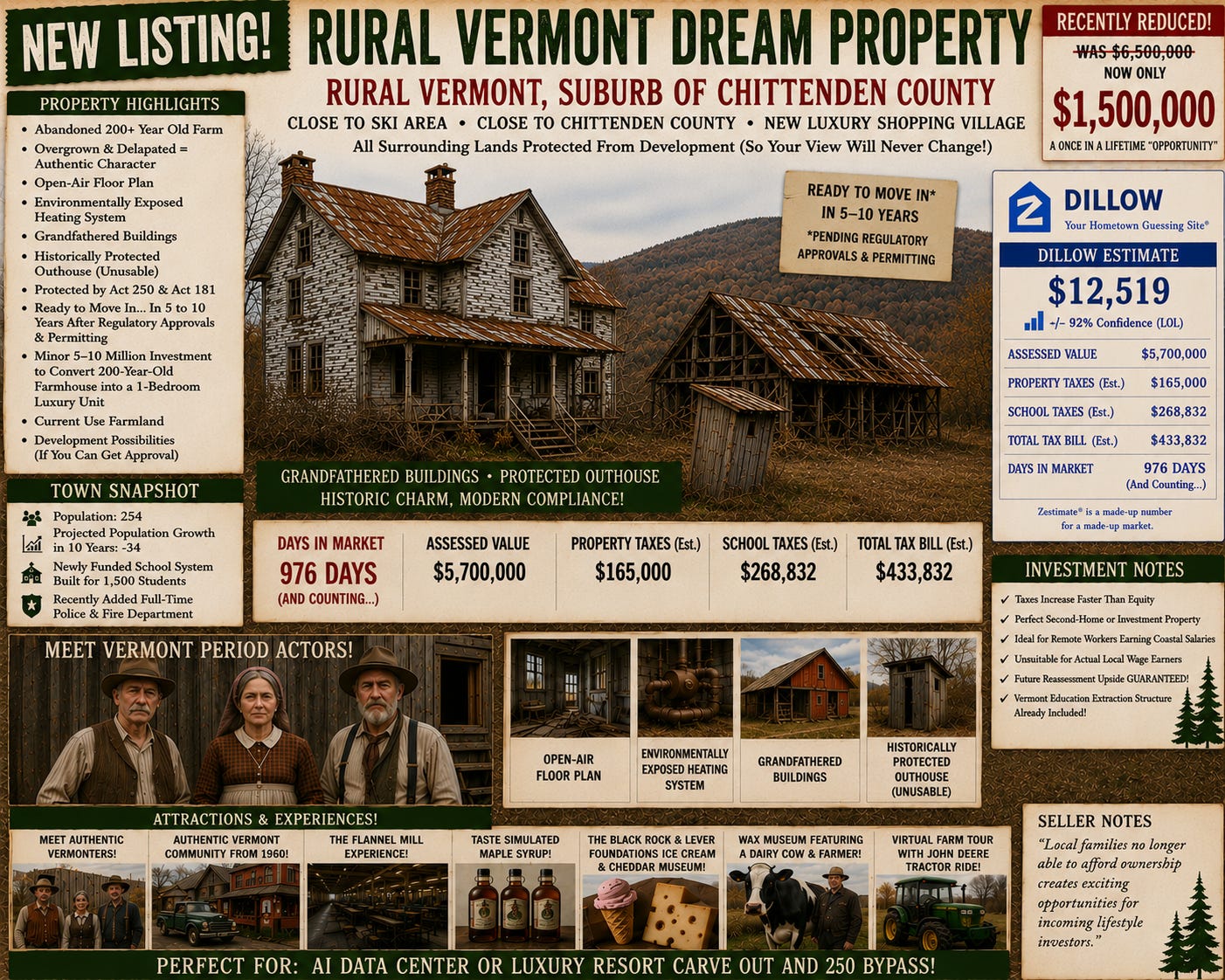
This is not just about:
- expensive groceries
- high fuel prices
- labor shortages
- housing costs
- Act 250
- Act 181
- permit delays
- or rising building costs
Those are all serious problems.
But the real emergency is the collision between:
- statewide reassessment
- inflated post-COVID property values
- and Vermont’s centralized education tax structure.
For decades many rural Vermont properties carried relatively modest assessments.
An old farmhouse might have been assessed at:
- $53,000
- $70,000
- or $120,000
not because it was worthless, but because assessments often lagged behind actual market activity for years.
Then COVID happened.
People fled cities.
Cash buyers arrived.
Remote workers flooded into rural areas.
Second-home purchases exploded.
Suddenly properties ordinary Vermonters viewed as:
- family farms
- hunting camps
- old homesteads
- or modest rural homes
were selling for:
- $350,000
- $500,000
- $900,000
- sometimes more.
That distorted Vermont’s market far beyond what local wages support.
Now the state has effectively forced towns into market-value reassessment systems tied to the statewide education tax structure through:
- CLA equalization
- reassessment modernization
- and policies advanced after Acts 60, 68, and 183.
And that is where the panic starts.
Because an old farmhouse assessed at $53,000 suddenly becoming “worth” $500,000 does not mean the owner suddenly became wealthy.
It means the state found a dramatically larger taxable asset.
The owner may have lived there for:
- 40 years
- 50 years
- maybe generations.
No mansion was built.
No luxury expansion happened.
No major development occurred.
The market changed around them.
Meanwhile Vermont still maintains statewide education tax structures averaging roughly:
- $15–$17 per $1,000 of assessed value when fully applied across homestead and equalized valuation systems.
That may not sound extreme until you apply it to dramatically inflated valuations.
A home in Barre reportedly jumped from roughly:
- $4,400 annually
to
- nearly $11,000.
And many Vermonters fear that is only the beginning.
The core issue is this:
If the statewide taxable property base explodes upward because reassessment pushes rural and commercial property toward post-COVID market values, then education tax rates should mathematically collapse downward if the system is truly revenue neutral.
Instead, many Vermonters believe the opposite will happen:
- reassessments rise
- spending continues increasing
- and the state absorbs the windfall into permanent government expansion.
Current statewide equalized property values are generally estimated somewhere around:
- $120–$150 billion.
But if rural land, farms, undeveloped acreage, commercial property, and residential property all move toward modern market pricing simultaneously, Vermont’s effective taxable base could potentially move toward:
- $300–$500 billion
- perhaps even higher over time.
Now apply the current education tax structure.
At:
- $15 per $1,000
the system could theoretically generate:
- $4.5 billion annually on a $300B base
- $6 billion annually on a $400B base
- $7.5 billion annually on a $500B base
At:
- $17 per $1,000
the numbers become:
- $5.1 billion
- $6.8 billion
- $8.5 billion annually
That is why people keep using the word:
windfall.
Because Vermont’s actual education obligations are nowhere near those numbers.
And that is the disconnect terrifying rural Vermont.
The policies people have debated for decades were the water slowly heating in the pot.
What people are feeling now is:
the water boiling.
People tolerated:
- regulation
- slow permitting
- centralized planning
- stagnant wages
- housing shortages
- infrastructure limitations
- and incremental tax increases
for years.
But when an ordinary rural property suddenly jumps from:
- $70,000 assessed value
to
- $500,000 market value
while education tax structures remain high, the system stops feeling theoretical.
That is when people panic.
Because once:
- taxes explode
- rents follow
- farms fail
- retirees cannot survive fixed-income costs
- and small businesses collapse
you do not simply reverse the damage later.
Property transfers.
Communities change.
Families leave.
And if you think this only impacts homeowners, you are wrong.
Landlords pass costs to renters.
Businesses raise prices.
Young families leave.
Communities hollow out.
The people most insulated from systems like this are:
- wealthy out-of-state buyers
- institutional investors
- second-home owners
- and people wealthy enough to hire attorneys and tax specialists.
Ordinary Vermonters do not have that luxury.
I never agreed with the structure of this centralized system to begin with.
Towns and cities should primarily manage and fund their own schools locally, with the state stepping in to support communities that genuinely need assistance.
That preserves:
- local accountability
- local control
- local identity
- and the purpose of towns and municipalities themselves.
Instead Vermont created a hybrid system where:
- towns still vote budgets
- but the state largely controls collection and redistribution.
So people feel like they still have local authority while the financial structure increasingly operates statewide.
And now with market-value reassessment applied across the entire state, Vermont is effectively treating:
- Barre like Shelburne
- Rutland like Burlington
- rural towns like luxury markets
under the same statewide extraction structure.
The rest of Vermont is not a suburb of Chittenden County.
At some point you have to ask:
if towns no longer truly control their own economic destiny, taxation structure, or educational financing, then what is the actual purpose of municipal independence anymore?
That is why more and more people are beginning to talk about:
- injunctions
- emergency legal action
- taxpayer resistance
- and outside scrutiny before this spirals completely out of control.
Because once government normalizes collecting revenue from inflated market values, many Vermonters do not believe it will ever voluntarily reduce that revenue stream later.
This is no longer just a policy disagreement.
This is a state of emergency. #VT4VT