By VT4VT
I wrote the first version of this article in May. At the time, the argument was largely about frustration: taxes, housing, regulation, Montpelier and the growing number of Vermonters wondering whether they can afford to remain here.
Several months of digging through grand lists, reassessments, education tax rates, legislation, municipal records and housing reports have changed the way I would make that argument today.
The frustration remains. What has changed is my understanding of what has to come next.
How I Got Here
I found the Act 181 protest site online roughly a week after the first major protest had already taken place. The same day I found it, the group changed its name to Rural Vermont Rising. That did not stop anything for me. I started posting, following the discussion and trying to understand what had happened and why so many rural Vermonters were concerned about the direction of land-use policy.
It was not long before I was at the State House protesting alone in person but in solidarity online with a much larger community. I met House members, talked with concerned citizens and, for a while, became known as “the Act 250 guy.” I found that funny, but it also made something clear: if I was going to criticize these policies publicly, I needed to understand them well enough to defend the argument with records, legislation and numbers.
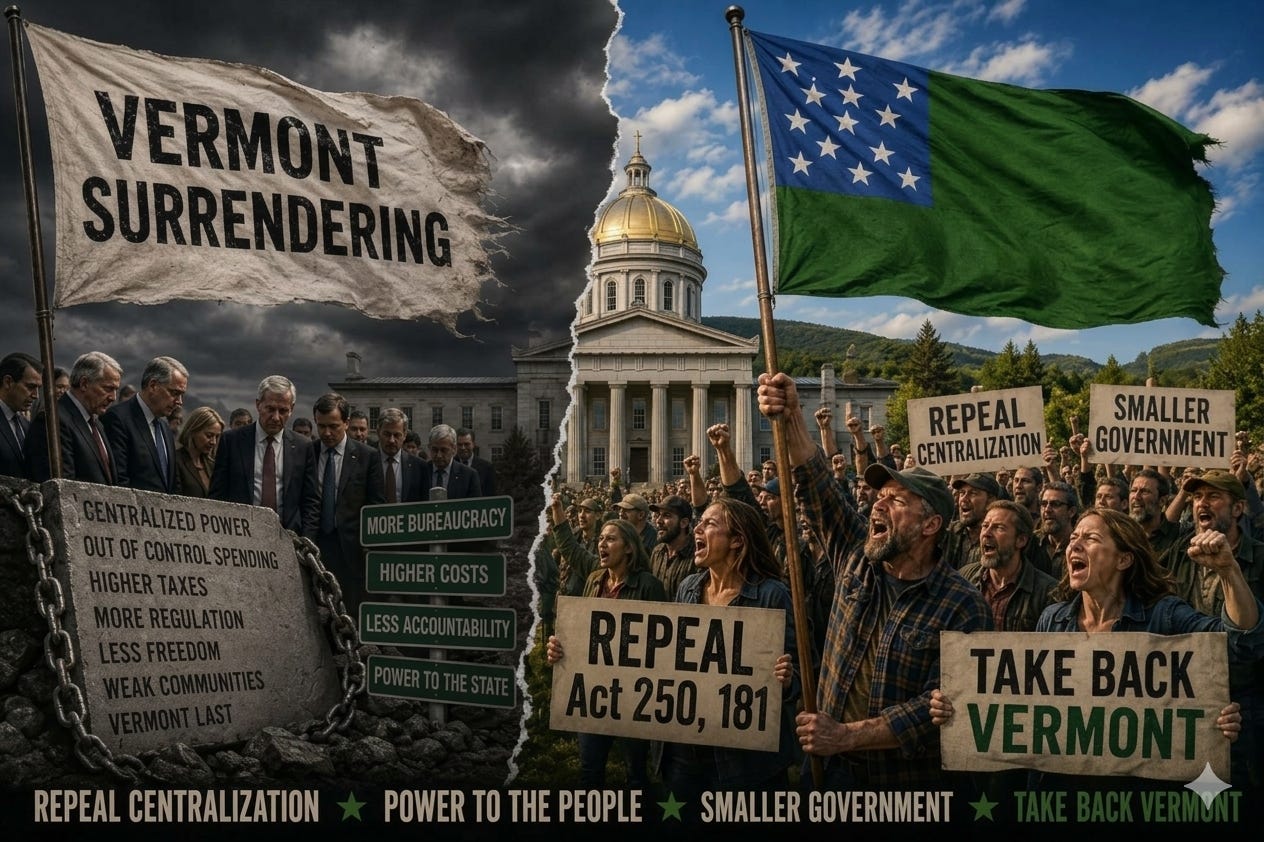
That pushed me deeper into the laws. What I found was not one isolated bill, but a series of separate changes moving through Vermont government at roughly the same time: Act 68 on property valuation and reappraisal, Act 121 on wetlands and river corridors, Act 181 on land use and Act 250, Act 73 on education governance and property taxation, and the continuing reach of Act 250 itself. Each law has its own stated purpose and should be judged on its own provisions, but taken together they have convinced me that Vermont is moving toward greater state control over land, development, assessment and taxation.
I believe these are connected efforts to centralize authority, restrict the practical use of private property and impose a level of taxation that has become excessive. I also believe Vermont has moved far enough in that direction that we need to revisit the language of our own Constitution, particularly Chapter I, Article 9.
Article 9 says that every member of society has a right to be protected in the enjoyment of “life, liberty, and property” and is therefore obligated to contribute that member’s proportion toward the expense of that protection. It also says that before a tax is raised, its purpose ought to appear to the Legislature to be of more service to the community than the money would be if it were not collected. That is unusually direct constitutional language about both property and taxation.
I am not claiming that Article 9 automatically makes any particular Vermont tax unconstitutional. That is a legal question that requires analysis of Vermont case law and the specific tax at issue. My argument is that Vermont has reached a point where the constitutional language deserves to be taken seriously again. When property owners are subjected simultaneously to reassessment, statewide education taxation, land-use permitting, wetland restrictions, development restrictions and increasingly centralized decision-making, it is reasonable to ask whether government is still protecting the enjoyment of property while requiring only a proportionate contribution for legitimate public purposes.
That is the question that now concerns me: not simply whether Vermonters still hold deeds, but whether ownership continues to carry meaningful control over the property being taxed.
I do not see the current direction as land freedom. I see a continuing transfer of practical authority away from the property owner and toward the State, accompanied by a tax structure that I believe increasingly treats privately owned Vermont real estate as a revenue base first and private property second.
That conclusion did not come from the first protest alone. It developed as I read more legislation, examined grand lists and tax data, followed municipal decisions and spent more time talking with Vermonters affected by these policies. It was not long after those first trips to the State House that I launched VT4VT across as many platforms as I could, and the project has grown from commentary into a broader effort to collect records, analyze the numbers and document what government is actually doing.
The original version of this article reflected what I knew in May. I know more now. That is why I have rewritten it.
October is also different from the protest I missed. There is advance notice now. There is organization. There is time to read the laws, collect the records, understand what changed and arrive prepared. There is lead time, mass and direction. Thank you Rural Vermont Rising Organizers.

Do We Surrender and Run—or Stay and Fight?
Vermont will not change because we complain about it. It will change only if Vermonters participate in governing it.
Vermont’s problems will not be solved simply because enough people become angry about them. Elections matter, but an election is only one point in a much larger governing process. Decisions are being made throughout the year in legislative committees, school boards, selectboards, planning commissions, municipal offices and state agencies.
If Vermonters want different results, more Vermonters have to participate in that process.
Start With What We Can Document
Vermont does have a housing problem. We do not need political rhetoric to establish that.
The Vermont Housing Finance Agency’s 2025–2029 Housing Needs Assessment estimates that Vermont needs approximately 24,000 to 36,000 additional year-round homes between 2025 and 2029. The report estimates a statewide rental vacancy rate of about 3 percent and says more than half of Vermont renters—roughly 34,000 households—spend more than 30 percent of their income on housing. About 17,000 renter households spend more than half their income on housing.
Those are not numbers produced by VT4VT. They come from Vermont’s statewide housing research.
Property taxation presents a different problem, but one that also requires understanding the underlying numbers.
For FY2027, the Legislature established a statewide non-homestead education property tax rate of $1.643 per $100 of value and a homestead property yield of $9,401. Those numbers are only the beginning of the calculation. The final education rate applied in a municipality can depend on school spending, the Common Level of Appraisal and the statewide adjustment. The Department of Taxes explains that the CLA is used to equalize education taxation among municipalities whose grand lists may be at different percentages of fair market value.
A taxpayer trying to understand a final property-tax bill may therefore encounter a reappraisal, a new assessed value, municipal tax rates, education rates, CLA, the statewide adjustment, homestead or non-homestead classification and, for some households, property-tax credits.
That complexity is one reason VT4VT began collecting the underlying records instead of relying on anecdotes.
Land-use policy has been changing as well. Act 181, enacted in 2024 as H.687, substantially revised Vermont’s land-use system. Among its provisions, the law established a process for tiered, location-based Act 250 jurisdiction, renamed the Natural Resources Board as the Land Use Review Board and added an Act 250 criterion addressing fragmentation of forest blocks and habitat connectors.
There are legitimate political disagreements about these policies. Some Vermonters support them. Others believe they have made government too centralized, expensive or restrictive.
Before arguing about whether a policy is good or bad, however, we ought to establish what the law actually says, what government actually spent, what a town actually assessed and what taxpayers actually paid.
That has increasingly become the purpose of VT4VT.
Government Happens Between Elections
Voting is essential, but most government does not happen inside a voting booth.
A school budget exists before voters see it on a ballot. A bill has usually gone through months of drafting, testimony, amendments and committee votes before legislators take a final roll call. Municipal plans are developed before they begin shaping future land-use decisions.
The same principle applies locally.
Vermont planning commissions prepare municipal plans and make recommendations concerning land development, conservation and preservation. Depending on the municipality’s structure, they can also have responsibilities involving site plans and subdivisions. Vermont law also gives citizens mechanisms for placing certain questions before voters at town meeting through the petition process.
That leaves Vermonters with considerably more opportunity to participate in government than casting a ballot every two years.
It can mean attending a school-board or selectboard meeting before the budget is finished, reading a bill while it is still in committee, submitting testimony, examining a grand list, requesting a public record or asking a legislator to explain a vote. It can mean serving on a planning commission or running for local office.
None of that is particularly dramatic. Much of it is tedious.
It is also where government happens.
VT4VT Has Changed Too
VVT4VT began with frustration and opinion. It has become a research project uncovering the records.
Grand lists, tax bills, budgets, legislation and recorded votes allow us to test claims instead of repeating them. If reassessments shift the tax burden, we can measure it. If spending rises, we can trace it. If a law changes development or taxation, we can identify the provision and follow the result.
That standard applies to us too. If the records support our argument, we publish them. If they do not, we correct the argument.
VT4VT can advocate, but the evidence comes first.
My Position
What follows is my opinion. It is not a conclusion produced by a grand list, housing report or Department of Taxes spreadsheet.
I believe Vermont should move toward smaller state government, greater municipal control, simpler taxation and a regulatory environment that makes it easier to build businesses, housing and personal wealth here.
I believe Vermont should examine how much authority has migrated away from towns and local communities and determine whether some of those decisions belong closer to the people directly affected by them.
I believe Act 250 and Vermont’s broader land-use structure deserve fundamental reconsideration rather than continually adding new provisions to an already complicated regulatory system.
My long-term objective would go considerably further. I would like Vermont to develop a tax structure that ultimately eliminates both the personal income tax and the traditional property-tax system.
That last sentence is easy to write. Turning it into credible policy is much harder.
Government requires revenue. Schools, roads, public safety and other services still have to be paid for. Eliminating one source of revenue without explaining what replaces it is not a tax plan.
If VT4VT is going to advocate for fundamental tax reform, then we have an obligation to do the difficult part: build the model, identify the revenue, calculate who pays, determine who benefits and publish the numbers.
Anything less is another slogan.
Accountability Requires Records
Citizens have every right to make government officials defend their decisions.
That can happen at a legislative hearing, town meeting, public forum or selectboard meeting. It can happen through newspapers, radio, podcasts and independent media. It can happen when a farmer brings financial records showing the actual cost of a policy, when a builder explains why a project cannot be constructed, or when a business owner shows what taxes, utilities and payroll are doing to the company’s bottom line.
The strongest challenge is usually the one accompanied by documentation.
If a tax increased, bring the bill. If an assessment changed, bring the grand list. If spending increased, bring the budget. If a legislator voted for something, bring the roll call. If a regulation prevents a project from moving forward, identify the regulation.
Then ask for an explanation.
Government accountability does not require violence, destruction or intimidation. It requires citizens who understand the system well enough to question it and who are persistent enough to keep asking when an answer does not match the record.
Build From the Town Up
There is a contradiction in demanding greater local control while ignoring local government.
Selectboards, school boards, planning commissions and municipal offices all depend on people willing to serve. Budgets, grand lists, agendas and plans are public, but often receive little attention until the consequences show up in a tax bill or development decision.
Ignoring those institutions does not remove their power. Someone else will attend the meeting, submit testimony, serve on the board and help shape the outcome.
That is one of the biggest changes in how I now look at Vermont government. I am no longer focused only on the decisions coming out of the system. I am paying much more attention to how those decisions get made.
So: Run or Stay?
I understand why some Vermonters are considering leaving. For some families, that may be a financial decision driven by taxes, housing, employment, energy costs or retirement income.
For those of us staying, the question is different. Complaining from the sidelines changes very little. Local government, legislative hearings, budgets and public records require people willing to participate, serve, testify and run for office.
VT4VT’s role is to document what is happening. We can compare grand lists, publish tax rates, examine budgets, read legislation and track votes so Vermonters can judge the record for themselves.
If we want more responsibility returned to Vermont’s citizens and towns, we have to accept some responsibility ourselves.
Showing up matters. Showing up informed matters more.
Sources and Public Records
Vermont Housing Finance Agency — Vermont Housing Needs Assessment 2025–2029
https://vhfa.org/sites/default/files/publications/VT-HNA-2025.pdf
The assessment documents Vermont’s housing supply, vacancy rates, renter cost burden and projected need for 24,000 to 36,000 additional year-round homes.
Vermont Agency of Commerce and Community Development — 2025–2029 Housing Needs Assessment release
https://accd.vermont.gov/press-releases/department-housing-and-community-development-releases-latest-vermont-five-year
The state summary identifies the projected 24,000-to-36,000-home requirement and renter affordability findings.
Vermont Department of Taxes — FY2027 Education Tax Rate Calculations
https://tax.vermont.gov/property/education-property-tax-rates/faqs
The Department explains the FY2027 statewide nonhomestead rate, homestead property yield, CLA, statewide adjustment and town-level education-tax calculation.
Vermont Department of Taxes — FY2027 Education Property Tax Rates
https://tax.vermont.gov/ed-rates
Official FY2027 municipal education-property-tax rates, CLA figures, statewide adjustment and final homestead and nonhomestead rates.
Vermont Department of Taxes — Equalization Study
https://tax.vermont.gov/municipalities/reports/equalization-study
Official explanation and municipal data for Vermont’s Common Level of Appraisal, Coefficient of Dispersion and Equalized Education Property Value.
Vermont Legislature — H.687 / Act 181
https://legislature.vermont.gov/bill/status/2024/H.0687
Official legislative history, enacted legislation and supporting documents for Act 181 of 2024.
Vermont Secretary of State — Local Office Descriptions
https://sos.vermont.gov/elections/election-info-resources/candidates/local-office-descriptions
Official descriptions of Vermont municipal offices, including planning commissions and their responsibilities.
Vermont Secretary of State — Petitioning Your Local Government
https://sos.vermont.gov/elections/election-info-resources/town-meeting-local-elections/local-petitions
Official guidance concerning citizen petitions and placing qualifying articles before voters at annual or special town meetings.
Help Build the Vermont Record
VT4VT is building an independent database of Vermont property taxes, reassessments, grand lists, legislation, municipal records and public-policy information.
Read the research and use the Vermont Property Tax Calculator at VT4VT.com.
Vermonters can also complete the anonymous Vermont Reassessment Survey and submit municipal grand lists, reassessment notices, tax information and other public records that can help expand the database.
Survey responses are used to identify statewide and municipal trends. Individual survey responses are not matched to individual taxpayers. Public-record analysis is kept separate from anonymous survey data.
VT4VT is a program of Fort Aldrich Incorporated, a 501(c)(3) nonprofit organization.
