Vermont has spent years describing housing as a central answer to its demographic and economic problems: workers need homes, more homes will attract workers, and more workers will expand the tax base needed to support the state.
But Vermont asked a more fundamental question a decade ago.
Vermont Already Asked Why People Leave
In 2016, a legislative study examined why young Vermonters leave and what might encourage people to relocate here. The Legislature commissioned the work and received a straightforward answer: the relationship between salaries and the cost of living strongly influenced where people chose to live.
The study also identified economic opportunity. Larger economic centers offered young workers not simply a job, but choices among employers and careers. The Answer…
JOBS.
Not just any job, good-paying jobs, opportunity, and somewhere to advance. Not flipping burgers and higher minimum wage, not that there is anything wrong with that, but, that won’t keep people here and it isn’t economic opportunity, neither is a $9 latte served by a barista. This wasn’t rocket science. Vermont could have asked young people why they were leaving.
And economic opportunity definitely did not mean building more houses when there were not enough jobs — or enough people earning the money to buy them.
Vermont’s housing market did not explode because the state suddenly created thousands of good jobs and ran out of houses for the workers. COVID changed the market. People left New York and other cities for places like Vermont. They could pay more, outbid local buyers, build, remodel and spend money.
What they did not bring was lasting economic opportunity after the final paint job dried.
That may not have been obvious in 2016. What was obvious was that the economic opportunity young Vermonters were looking for was not here.
Vermont knew this in 2016.
Over the following decade, state government adopted policies affecting taxation, land use, regulation, energy, housing and the cost of doing business. Some were signed by the governor; others were enacted over his objections. In several cases, lawmakers proceeded after receiving warnings about potential costs and economic effects.
The Private Economy Belongs in the Housing Debate
U.S. Bureau of Labor Statistics data show that in the third quarter of 2025, Vermont private establishments lost 19,658 jobs through contractions and closures while openings and expansions produced 16,739. The result was a net loss of 2,919 private-sector jobs in one quarter. Vermont’s gross job-loss rate was 7.8 percent, compared with 5.7 percent nationally.
Those figures do not establish that any particular Vermont law caused those losses. They do show why the health of the productive economy belongs in the housing discussion.
The House Did Not Disappear. The Children Did.
Vermont Public reported in 2026 that Vermont would have needed nearly 22,000 additional homes between 2015 and 2024 simply to accommodate shrinking household sizes, even without population growth.
One example involved a three-bedroom Burlington home once occupied by a couple and their two children. The marriage ended, the children grew up, and both left Vermont “to pursue opportunities elsewhere.” Eventually, one person remained in the house.
Vermont’s Housing Needs Assessment documents the broader mismatch. Sixty-eight percent of owner households contain only one or two people, while 74 percent of owner-occupied homes have three or more bedrooms. Vermont has 66,467 homes with at least four bedrooms but only 14,679 households large enough to technically require that much space under the report’s standard.
That is a housing problem, but it also points back to the economic question Vermont asked in 2016.
If Vermont’s children leave for opportunities elsewhere while their parents remain in the family home, constructing another house does not address why they left. It addresses what happened afterward.
Housing Supports an Economy. It Does Not Replace One.
Building five houses beside five existing $500,000 houses does not automatically produce ten $250,000 houses. Nor does construction itself create five businesses, five productive households or five long-term careers. The eventual cost of those homes will still reflect land, construction, financing, taxes, regulation and market conditions.
People build lives where they believe they can find opportunity.
That was essentially what Vermont’s own research told policymakers a decade ago.
The Question Vermont Should Be Measuring
The Legislature asked why people leave. It received an answer. The measurable question now is whether the policies adopted during the following decade improved or worsened the economic conditions identified in that study.
That question belongs at the center of Vermont’s housing debate.
Government can subsidize construction, change zoning and establish housing targets. But increasing the number of bedrooms cannot, by itself, create the diverse economy necessary to retain the people Vermont already raises.
Vermont asked the right question in 2016: why do people leave, and what would make them stay?
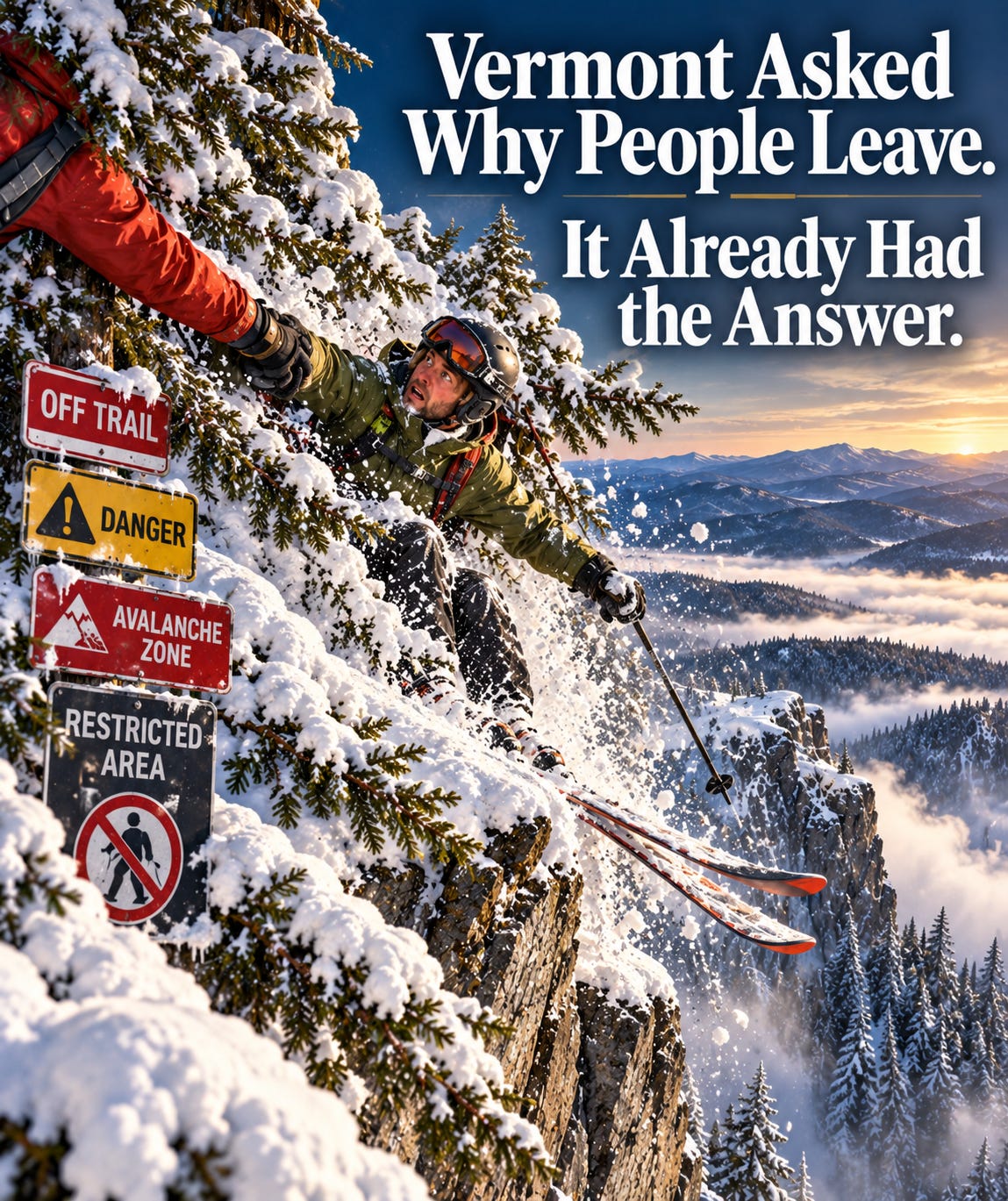
Over A Cliff
Vermont is no longer simply heading in the wrong direction. It went off the trail, ignored the warning signs, crossed into restricted terrain and kept going onto the far side of the mountain, a place so dangerous that almost no one would choose to ski there in the first place. Along the way, policymakers had reports, studies and economic warnings in front of them, many of them paid for by the same taxpayers now living with the consequences. Those warnings were not hidden. They were commissioned, published and available before many of these decisions were made.
The Vermont Legislature and Government is dragging us with them, Just picture this: Vermont bushwhacking through snow-covered pines with a cliff directly ahead. The skis are already over the edge, the snow is spraying forward, and the momentum is still carrying the state in the same direction. The people making these decisions are not simply risking an abstract policy failure. They are putting Vermont families, businesses, farms and communities in danger of becoming increasingly unaffordable and economically unsustainable.
At this point, the answer is not another study, another subsidy, another zoning rewrite, another layer of regulation or another promise that the same approach will eventually work. Vermont needs to stop immediately, JUST STOP! Take a breath, get its bearings, examine the warnings it already paid for, and reverse course, because we are awake, we are aware, and we are not going to take it.
We are at the point where someone needs to put out an arm and catch Vermont before it punches through the last line of pines and goes over the cliff.
That moment is now.
Vermont General Assembly — Employee Relocation Tax Credit Study Committee, Report of the Employee Relocation Tax Credit Study Committee (2016)
https://legislature.vermont.gov/committee/detail/2016/32/Reports
Vermont Housing Finance Agency — Vermont Housing Needs Assessment 2025–2029
https://vhfa.org/sites/default/files/publications/VT-HNA-2025.pdf
Vermont Public — Carly Berlin, “Why Vermont’s housing shortage can’t be explained by population size alone,” August 25, 2026
https://www.vermontpublic.org/local-news/2026-08-25/vermonts-housing-shortage-cant-be-explained-population-size-alone
U.S. Bureau of Labor Statistics — Business Employment Dynamics in Vermont — Third Quarter 2025
https://www.bls.gov/regions/northeast/news-release/businessemploymentdynamics_vermont.htm
Related VT4VT Research
VT4VT — Vermont Property Tax Research, Grand List Analysis, Reassessments and Public Policy
https://VT4VT.com
Vermont Property Tax Affordability Survey
https://survey.vt4vt.com/s/004-property-tax-affordabiltiy/
Is Vermont Affordable? — Focus on Education
https://survey.vt4vt.com/s/is-vermont-affordable-focus-on-education/
Vermonters can also submit municipal grand lists, reassessment notices, tax bills and other public records to VT4VT to help expand the independent statewide database documenting Vermont property taxes, reassessments and public policy.
Support VT4VT
VT4VT is a program of Fort Aldrich Incorporated, a registered 501(c)(3) nonprofit organization. Contributions supporting VT4VT research, public-record analysis, data tools and civic education may be made through:
VT4VT
https://VT4VT.com
VT4VT on Substack
Follow VT4VT
YouTube: https://www.youtube.com/@Vt4vermont
X: https://x.com/vt4vermont
Instagram: https://www.instagram.com/vt4vermont
TikTok: https://www.tiktok.com/@vt4vt
Quora: https://vermonteesforvermontvt4vt.quora.com/
