Vermont has changed the rules governing property, and it has done it through several major laws in just a few years. Reassessments are changing property values, the education-property-tax calculation has changed, new property classifications are coming into play, and Vermont has rewritten major portions of its land-use system.
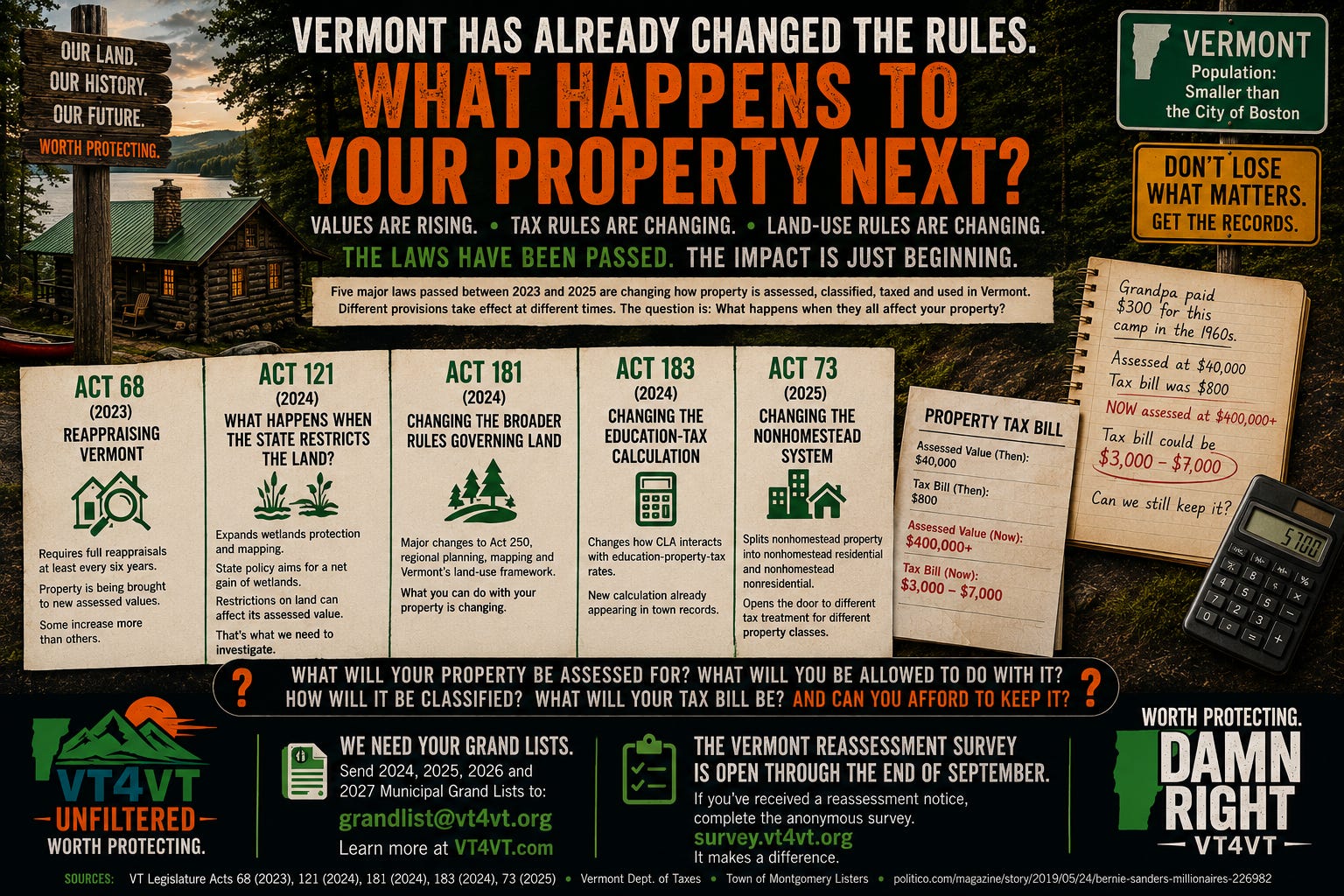
These aren’t proposals. The laws have already passed.
Act 68 changed the reappraisal system. Act 121 expanded Vermont’s wetlands protection and mapping system. Act 181 changed major parts of Vermont’s land-use framework. Act 183 changed the education-property-tax calculation. Act 73 created new property classifications.
These aren’t proposals being debated for some distant future. They are laws.
Different provisions take effect at different times, and that distinction matters. We don’t yet know what every Vermonter’s final tax bill will be or how every provision will ultimately affect individual properties.
But the framework has changed.
The question now is what happens when these laws begin interacting with the same piece of Vermont property.
Act 68: Reappraising Vermont
Act 68 changed Vermont’s reappraisal system. Beginning in 2025, municipalities generally must conduct full reappraisals at least every six years unless the Department of Taxes approves a longer period. The first municipalities under the new schedule are expected to complete their reappraisals by April 1, 2027.
That means Vermont is entering a period when property across the state will be brought to new assessed values.
We have already seen how dramatic that can be in New Haven. The town’s homestead grand list increased from approximately $208 million in 2024 to nearly $475 million in 2026.
That does not mean everyone’s tax bill increased by 128 percent. What it does mean is that the values used to distribute the tax burden changed dramatically. Some properties increased much more than others, which is why we need to follow the assessments all the way through to the final tax bills.
Act 68:
https://legislature.vermont.gov/bill/status/2024/H.480
Act 121: What Happens When the State Restricts the Land?
Act 121 adds another piece that deserves much more attention in the property-tax discussion.
Passed in 2024, Act 121 changed Vermont law governing wetlands, river corridors and dam safety. It requires the Agency of Natural Resources to update Vermont’s Significant Wetlands Inventory at least annually beginning in 2026 and requires High Quality Wetlands Inventory Plus mapping throughout Vermont by January 1, 2030. The statewide mapping is required to include ground truthing.
The law also establishes a state policy of protecting, regulating and restoring wetlands with the goal of achieving a net gain of wetlands acreage. For certain permitted activities affecting more than 5,000 square feet of wetlands, the rules require compensation through restoration, enhancement or creation of wetlands, with a minimum 2-to-1 restoration ratio for permanently filled or drained wetlands.
That alone makes Act 121 relevant to Vermont property owners.
But its legislative history makes it particularly relevant to our investigation.
During consideration of S.213, which became Act 121, the Legislature specifically called Jill Remick, Director of Property Valuation and Review at the Vermont Department of Taxes, to testify about “Property Valuation.”
In subsequent written comments, Remick explained that restrictions on property can affect its assessed value. Discussing floodplain-management land and easements, she told lawmakers that appraisal practices already recognize circumstances in which restrictions or partial rights reduce value.
That raises an important question as Vermont simultaneously reassesses property and expands its mapping and regulation of wetlands and other sensitive land:
Are Vermont’s new assessments accounting for restrictions on how that property can actually be used?
If a parcel contains substantial wetlands, floodplain, conservation easements or other restrictions, we should be able to look at the appraisal and determine whether those limitations were reflected in the property’s assessed value.
That isn’t an argument that every newly mapped wetland automatically reduces an assessment. Act 121 doesn’t say that.
It’s a question we can answer with the records.
Act 121:
https://legislature.vermont.gov/bill/status/2024/S.213
Act 121 as enacted:
https://legislature.vermont.gov/Documents/2024/Docs/ACTS/ACT121/ACT121%20As%20Enacted.pdf
Act 181: Changing the Broader Rules Governing Land
Act 181 changed another part of the equation.
The law made major changes to Act 250 administration, regional planning, mapping and Vermont’s tiered land-use framework.
That means Vermont property owners can face two different questions at the same time: What does the State say my property is worth for taxation, and what am I actually allowed to do with it?
Act 121 makes that question even more important.
If additional wetlands or other regulated areas are identified on a property, or if land-use rules otherwise restrict its development potential, does the property’s assessment reflect those limitations?
That’s something VT4VT can test rather than speculate about.
Act 181:
https://legislature.vermont.gov/bill/status/2024/H.687
Act 183: Changing the Education-Tax Calculation
While Vermont was changing reappraisal and land-use policy, it also changed the education-property-tax calculation.
Act 183 changed how the Common Level of Appraisal interacts with education-property-tax rates. Beginning with the 2025-2026 property-tax year, a municipality’s CLA is compared with a statewide adjustment rather than simply being applied on its own.
We can already see that calculation in Montgomery’s records. Its December 2024 equalization results reported a CLA of 63.88 percent, while its tax records show an adjustment factor of approximately 88.28 percent.
So property values are changing while the mechanism used to translate municipal appraisal levels into education-property-tax rates is changing as well.
Act 183:
https://legislature.vermont.gov/bill/status/2024/H.887
Act 73: Changing the Nonhomestead System
Act 73 changes another major part of the equation by separating the old nonhomestead category into nonhomestead residential and nonhomestead nonresidential property.
That distinction matters because a multimillion-dollar vacation estate isn’t the only property Vermont calls nonhomestead.
A nonhomestead property can be a family camp, seasonal home, hunting cabin, inherited property, rental, business, open land or other property that isn’t someone’s declared Vermont homestead.
The creation of the new classifications does not, by itself, tell us what every future tax rate will be. But creating separate classifications creates the mechanism through which those categories can receive different tax treatment.
That’s why we need to watch what happens next.
Act 73:
https://legislature.vermont.gov/bill/status/2026/H.454
hoping to retire to someday.
For some historical perspective, Bernie Sanders and his then-wife bought 85 wooded acres in Middlesex in 1964 for just $2,500. Sanders later recalled the purchase himself: “We bought 85 acres for $2,500.”
Or, as kids today might put it: Bernie bought 85 acres of Vermont for three raspberries.
There Is Another Connection We Need to Investigate
Jill Remick’s Act 121 testimony contains another detail that deserves attention.
While discussing S.213 in 2024, Property Valuation and Review was simultaneously working on the major reappraisal and property-tax-category study required by Act 68.
Remick also referenced new State work involving utility valuation.
That caught our attention because the New Haven grand lists show substantial changes involving some utility property.
We don’t yet know whether those changes are connected to the State’s utility-valuation work. We shouldn’t claim that they are until we have the records.
But now we know where to look.
We need to determine what Vermont changed in utility valuation, when it changed, which properties were affected and whether similar assessment changes appear in other municipalities.
If utility property-tax obligations rise substantially, the next question is whether any of those costs eventually reach Vermont customers through regulated electric or telecommunications rates.
Again, that’s something we can investigate with records rather than assume.
What Happens When All Five Laws Reach the Same Property?
This is where the story becomes bigger than any individual Act.
A property can receive a new assessment under Vermont’s reappraisal system while the education-tax calculation has changed. The property may fall into one of the new classifications established under Act 73. Act 181 may affect the broader land-use framework surrounding it. Act 121 is simultaneously producing more detailed information about wetlands while expanding Vermont’s wetlands policy.
None of those facts alone tells us what someone’s 2027 tax bill will be.
Together, however, they give us a very clear research question:
What happens to the value, use and tax burden of actual Vermont properties as these laws are implemented?
Where Have the Businesses Gone? What Happens to the Utilities?
The same questions extend beyond homes and camps.
Our New Haven grand-list analysis raised another issue that deserves investigation: substantial changes in the assessed values of some utility property. We need grand lists from more municipalities to determine whether what we found in New Haven is unusual or part of a broader pattern.
If utility assessments and property-tax liabilities rise substantially, what happens next? Does any of that increased cost eventually reach customers through electric or telecommunications rates? We don’t have enough records yet to answer that, which is exactly why we’re collecting them.
Businesses deserve the same examination. We need to know how commercial assessments are changing and what Act 73’s new classifications ultimately mean for their education-property-tax burden.
What Will Your Tax Bill Be in 2027?
This is the question behind the entire investigation.
What happens when your property is reassessed under the new system, the education-tax calculation has changed, your property falls into one of the new classifications, and Vermont has simultaneously changed the rules governing land use?
What will your property-tax bill look like in 2027? What will it look like in 2029?
And can you still afford to own the property when it arrives?
Those questions can’t be answered from a reassessment notice alone. We need the old assessment, the new assessment, the municipal and education tax rates and finally the actual tax bill.
Lets look at what the cost of educating students looks like now.
Vermont’s FY2027 statewide Education Fund proposal compared with FY2026:
FY2027 proposed total Education Fund uses: $2.565 billion
FY2026 preliminary total: $2.4325 billion
Increase: $132.5 million
Percentage increase: approximately 5.45%
The narrower “education payment” to school districts rises from $1.9911 billion to $2.1047 billion—an increase of $113.6 million, or 5.7%.
These are the January 2026 proposal/outlook figures. The later House proposal reduced the FY2027 education payment to approximately $2.0754 billion after incorporating adopted local school budgets.
January Education Fund Outlook
Remember the 13 Percent
Vermonters should also remember the recent education-property-tax debate, when projected increases were reduced through surplus funds and other legislative adjustments.
That matters because reducing what taxpayers see in one year doesn’t necessarily eliminate the spending and cost pressures underneath it. We need to know what happens when those temporary resources are no longer available.
That’s why VT4VT isn’t looking at a single tax year. We’re building the record across several years.
These Laws Aren’t Campaign Proposals
Much of the current discussion can make it sound as though Vermont is still considering whether to make major changes to its property-tax and land-use systems.
It already has.
Acts 68, 121, 181, 183 and 73 are laws. There are still implementation decisions to make, future tax rates to establish and provisions that haven’t fully taken effect, but the underlying statutory changes have already been enacted.
The question isn’t whether these laws exist. The question is what happens when they begin working together on actual Vermont properties.
This Is Why We Need Your Grand Lists
VT4VT is collecting Vermont municipal grand lists from 2024 through 2027 because those records let us compare what happened before and after reassessment and determine where the tax burden actually moved.
Unfortunately, these records aren’t all sitting on one state website waiting to be downloaded. Some towns publish them online and others don’t. Finding one municipality’s records can take anywhere from 15 minutes to two hours.
We need your help.
Contact your town clerk, assessor or listers and request the 2024, 2025, 2026 and, when available, 2027 grand lists. Send the files or public links to:
grandlist@vt4vt.org
https://VT4VT.com
The Vermont Reassessment Survey Is Still Open
The Vermont Reassessment Survey remains open through the end of September.
If you’ve received a reassessment notice, complete the anonymous survey. The survey helps identify patterns across Vermont, and the grand lists allow us to investigate those patterns against public records.
Vermont Reassessment Survey:
https://survey.vt4vt.org
VT4VT:
https://VT4VT.com
Four major laws have changed Vermont’s property-tax, education-finance and land-use framework since 2023. We now need the public records to document what those changes actually mean for homeowners, camps, farms, businesses, utilities and the families trying to keep property that may have been theirs for generations.
What will your property be worth? How will it be classified? What will your tax bill be? And can you afford to keep it?
That’s what we’re going to find out.
Sources
Vermont General Assembly — Act 68 / H.480:
https://legislature.vermont.gov/bill/status/2024/H.480
Act 121 — S.213:
https://legislature.vermont.gov/bill/status/2024/S.213
Act 121 — As Enacted:
https://legislature.vermont.gov/Documents/2024/Docs/ACTS/ACT121/ACT121%20As%20Enacted.pdf
Vermont General Assembly — Act 181 / H.687:
https://legislature.vermont.gov/bill/status/2024/H.687
Vermont General Assembly — Act 183 / H.887:
https://legislature.vermont.gov/bill/status/2024/H.887
Vermont General Assembly — Act 73 / H.454:
https://legislature.vermont.gov/bill/status/2026/H.454
Montgomery Assessor/Listers:
https://montgomeryvt.us/g/office/listers
Politico — Bernie Sanders land-purchase background:
https://www.politico.com/magazine/story/2019/05/24/bernie-sanders-millionaires-226982/
Vermont Department of Taxes — Listers and Assessors:
https://tax.vermont.gov/tags/listers-and-assessors
January Education Fund Outlook
Vermont Reassessment Survey:
https://survey.vt4vt.org
VT4VT:
https://VT4VT.com
Worth Protecting.
Damn Right.