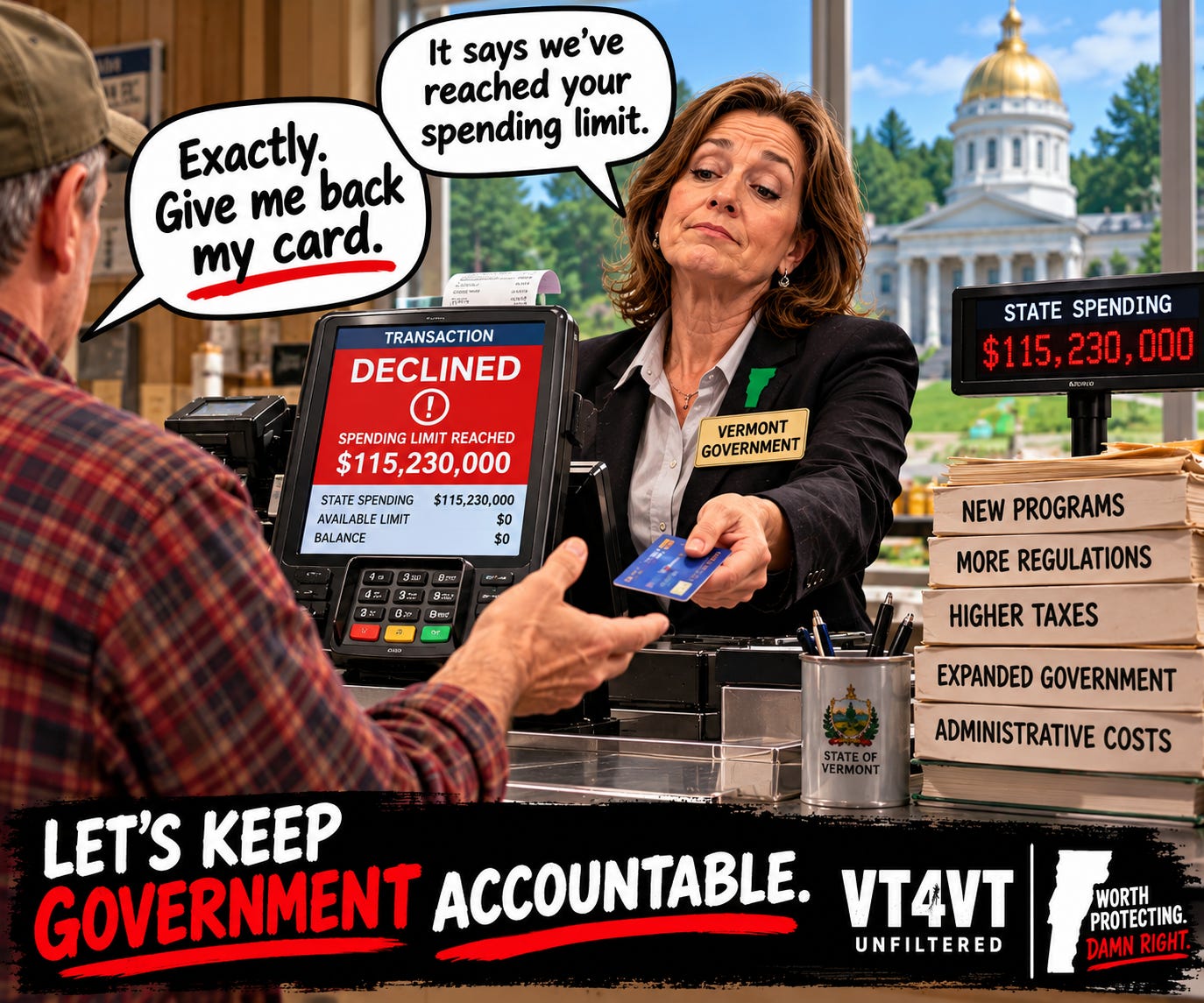
The metaphor is simple: Vermont government has the credit card. Vermonters are paying the bill.
At some point, the card gets declined.
Vermont’s affordability debate cannot be separated from government spending, education costs, property taxes and the growing collection of programs that taxpayers are expected to finance. The state’s own budget documents show how quickly the numbers have grown.
The Governor’s proposed FY2026 budget put total state-funded appropriations at about $5.85 billion, compared with approximately $4.93 billion in FY2022. Within that total, Education Fund appropriations increased from approximately $1.86 billion to $2.42 billion over the same period. Vermont Legislature
Those costs eventually reach Vermonters.
For FY2027, the Legislature established a statewide non-homestead education property tax rate of $1.643 per $100 of value before the adjustments applied to individual towns. Homestead rates depend on school spending and the state’s education-finance formula. Vermont Tax
Meanwhile, Vermont is moving through another major statewide property-reassessment cycle. Towns completing reappraisals in 2026 are assigned a 100 percent Common Level of Appraisal under Act 164. The Department of Taxes’ current rate table identifies municipalities including Addison, Bakersfield, Barre City, New Haven and Newfane as having completed 2026 reappraisals. Vermont Tax
VT4VT’s public-record research is beginning to show what is happening underneath those statewide numbers.
In New Haven, the homestead grand list examined by VT4VT increased from roughly $208 million in 2024 to $475 million in 2026 — approximately 128 percent.
In Colchester, VT4VT’s analysis of the town’s as-billed grand lists found something equally revealing. Even though tax rates declined following reassessment, the amount generated by the state education tax increased from approximately $41.1 million to $50.5 million — about $9.3 million, or 23 percent. Municipal taxes generated increased another approximately $1.1 million.
A reassessment by itself does not necessarily increase a homeowner’s tax bill. The Vermont Department of Taxes explicitly demonstrates how a higher assessment can be offset by a lower tax rate. Vermont Tax The question VT4VT is investigating is different: after the new assessments and new rates are applied, who actually pays more, who pays less, and how much additional money is collected?
That requires grand lists, tax rates and actual tax bills—not slogans.
The taxpayer in our illustration has finally reached across the counter and asked Vermont government for the credit card back.
“It says we’ve reached your spending limit.”
“Exactly. Give me back my card.”
Government cannot make Vermont affordable by continually asking Vermonters to finance more government.
Let’s keep government accountable.VT4VT Surveys This Week
Is Vermont Affordable?
Can Vermonters still afford to live here?
This anonymous survey looks at the real financial pressure facing Vermont households, including housing costs, taxes, utilities, everyday expenses, and whether people are considering leaving Vermont because of affordability.
Your responses help VT4VT document what Vermonters are experiencing and identify trends that deserve deeper public-record research.
Take the survey:
https://survey.vt4vt.com/s/003-leaving/
Property Tax Affordability Survey
How are Vermont property taxes affecting your household?
This anonymous survey focuses specifically on property taxes, reassessments, rising property values, tax bills, and whether Vermont homeowners believe their current property-tax burden is sustainable.
The results will help VT4VT compare taxpayer experiences with municipal grand lists, tax rates, reassessment data, and other public records as we continue building the FY2027 Vermont Property Tax database.
Take the survey:
https://survey.vt4vt.com/s/004-property-tax-affordabiltiy/
VT4VT.com
Worth Protecting.
Damn Right.
Help Build the VT4VT Database
VT4VT is building an independent statewide database documenting Vermont property taxes, reassessments, Grand Lists, legislation, housing policy and government decisions.
Complete the anonymous Vermont Reassessment Survey:
Vermont Reassessment Survey
Submit your municipality’s Grand List:
Submit a Grand List
Vermonters can also help by sharing reassessment notices, final property-tax bills, municipal records and sourced research. Survey responses are used to identify statewide trends and are not presented as identifiable individual taxpayer records.
Read the complete investigation and VT4VT town reports at:
VT4VT Newsstand
VT4VT.com
Support Independent Vermont Research
VT4VT keeps these stories, public-record investigations and research available to Vermonters.
VT4VT is a program of Fort Aldrich Incorporated, a 501(c)(3) nonprofit organization. Support helps pay for public-record collection, data analysis, research and the tools being built to document Vermont property taxes and public policy.
Readers can support the work through a paid VT4VT Substack subscription or through the VT4VT donation option at VT4VT.com.
Checks or money orders may also be made payable to:
Fort Aldrich Incorporated
P.O. Box 302
Northfield, VT 05663
Write VT4VT in the memo if you want the contribution directed to the VT4VT program.
Can’t donate? Submit records, Grand Lists, reassessment information or sourced research. Building the database is part of the work.
YouTube: @Vt4vermont
Substack: VT4VT Substack
X: @vt4vermont
Instagram: @vt4vermont
TikTok: @vt4vt
