Over the past several weeks, property owners from across Vermont have been submitting reassessment notices and property tax information through the VT4VT Vermont Reassessment Survey.
The purpose of the survey has always been simple: collect real-world data from Vermont property owners and compare what is actually happening on the ground against what we are being told should happen.
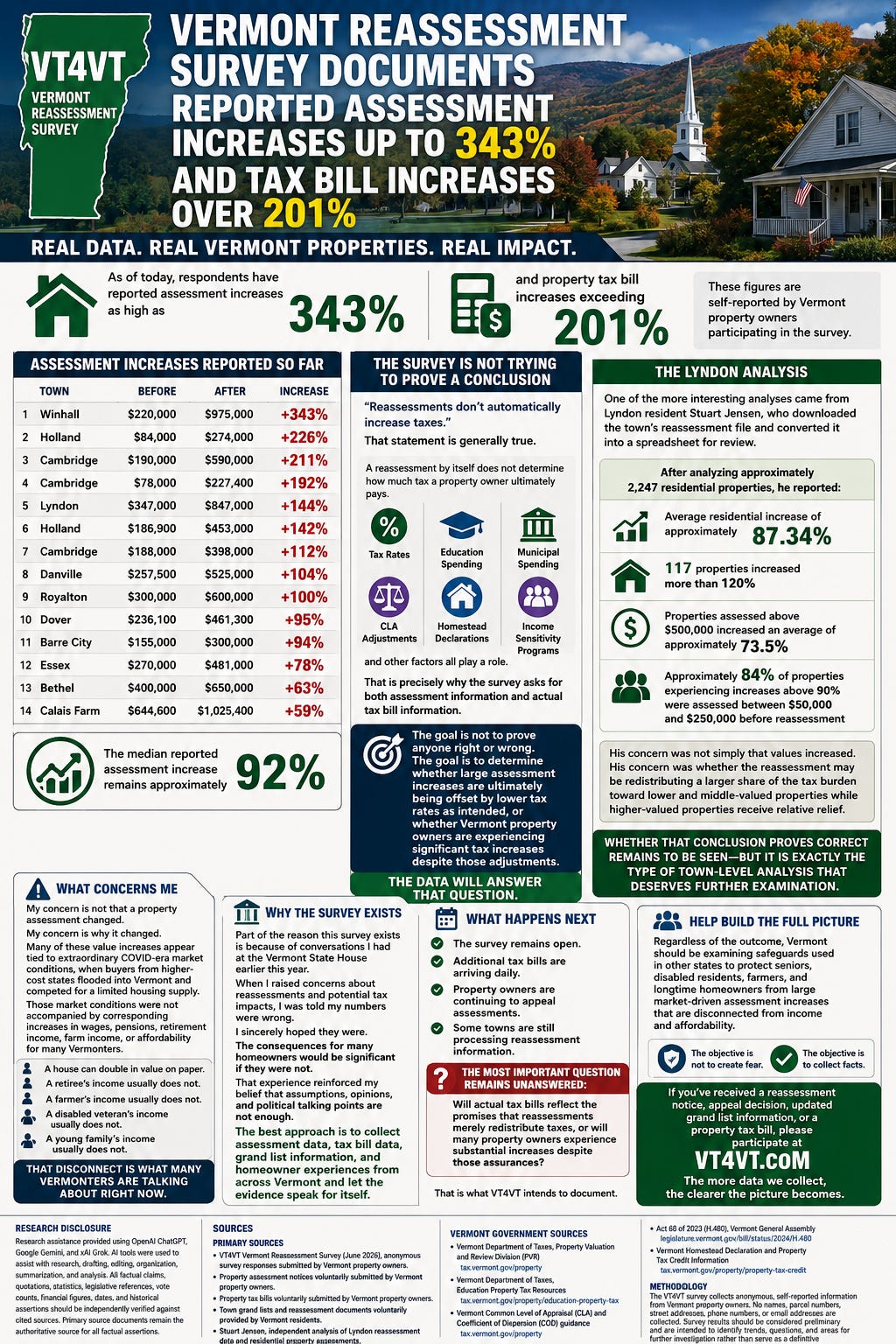
As of today, respondents have reported assessment increases as high as 343% and property tax bill increases exceeding 201%.
These figures are self-reported by Vermont property owners participating in the survey.
Among the assessment increases reported so far:
- Winhall: $220,000 → $975,000 (+343%)
- Holland: $84,000 → $274,000 (+226%)
- Cambridge: $190,000 → $590,000 (+211%)
- Cambridge: $78,000 → $227,400 (+192%)
- Lyndon: $347,000 → $847,000 (+144%)
- Holland: $186,900 → $453,000 (+142%)
- Cambridge: $188,000 → $398,000 (+112%)
- Danville: $257,500 → $525,000 (+104%)
- Royalton: $300,000 → $600,000 (+100%)
- Dover: $236,100 → $461,300 (+95%)
- Barre City: $155,000 → $300,000 (+94%)
- Essex: $270,000 → $481,000 (+78%)
- Bethel: $400,000 → $650,000 (+63%)
- Calais Farm: $644,600 → $1,025,400 (+59%)
The median reported assessment increase remains approximately 92%.
The Survey Is Not Trying To Prove A Conclusion
One of the most common responses I receive is:
"Reassessments don't automatically increase taxes."
That statement is generally true.
A reassessment by itself does not determine how much tax a property owner ultimately pays.
Tax rates, education spending, municipal spending, Common Level of Appraisal (CLA) adjustments, homestead declarations, income sensitivity programs, and other factors all play a role. That is precisely why the survey asks for both assessment information and actual tax bill information.
The goal is not to prove anyone right or wrong.
The goal is to determine whether large assessment increases are ultimately being offset by lower tax rates as intended, or whether Vermont property owners are experiencing significant tax increases despite those adjustments.
The data will answer that question.
What Concerns Me
My concern is not that a property assessment changed.
My concern is why it changed.
Many of these value increases appear tied to extraordinary COVID-era market conditions, when buyers from higher-cost states flooded into Vermont and competed for a limited housing supply.
Those market conditions were not accompanied by corresponding increases in wages, pensions, retirement income, farm income, or affordability for many Vermonters.
A house can double in value on paper.
A retiree's income usually does not.
A farmer's income usually does not.
A disabled veteran's income usually does not.
A young family's income usually does not.
That disconnect is what many Vermonters are talking about right now.
The Lyndon Analysis
One of the more interesting analyses came from Lyndon resident Stuart Jensen, who downloaded the town's reassessment file and converted it into a spreadsheet for review.
After analyzing approximately 2,247 residential properties, he reported:
Average residential increase of approximately 87.34%
117 properties increased more than 120%
Properties assessed above $500,000 increased an average of approximately 73.5%
Approximately 84% of properties experiencing increases above 90% were assessed between $50,000 and $250,000 before reassessment
His concern was not simply that values increased.
His concern was whether the reassessment may be redistributing a larger share of the tax burden toward lower and middle-valued properties while higher-valued properties receive relative relief. Whether that conclusion proves correct remains to be seen. But it is exactly the type of town-level analysis that deserves further examination.
Why The Survey Exists
Part of the reason this survey exists is because of conversations I had at the Vermont State House earlier this year. When I raised concerns about reassessments and potential tax impacts, I was told my numbers were wrong. I sincerely hoped they were.
The consequences for many homeowners would be significant if they were not.
That experience reinforced my belief that assumptions, opinions, and political talking points are not enough. The best approach is to collect assessment data, tax bill data, grand list information, and homeowner experiences from across Vermont and let the evidence speak for itself.
What Happens Next
The survey remains open.
Additional tax bills are arriving daily.
Property owners are continuing to appeal assessments.
Some towns are still processing reassessment information.
The most important question remains unanswered: Will actual tax bills reflect the promises that reassessments merely redistribute taxes, or will many property owners experience substantial increases despite those assurances?
That is what VT4VT intends to document.
Regardless of the outcome, Vermont should be examining safeguards used in other states to protect seniors, disabled residents, farmers, and longtime homeowners from large market-driven assessment increases that are disconnected from income and affordability.
The objective is not to create fear.
The objective is to collect facts.
If you've received a reassessment notice, appeal decision, updated grand list information, or a property tax bill, please participate at VT4VT.com. The more data we collect, the clearer the picture becomes.
--
Research Disclosure
Research assistance provided using OpenAI ChatGPT, Google Gemini, and xAI Grok. AI tools were used to assist with research, drafting, editing, organization, summarization, and analysis. All factual claims, quotations, statistics, legislative references, vote counts, financial figures, dates, and historical assertions should be independently verified against cited sources. Primary source documents remain the authoritative source for all factual assertions.
Sources
Primary Sources
- VT4VT Vermont Reassessment Survey (June 2026), anonymous survey responses submitted by Vermont property owners.
- Property assessment notices voluntarily submitted by Vermont property owners.
- Property tax bills voluntarily submitted by Vermont property owners.
- Town grand lists and reassessment documents voluntarily provided by Vermont residents.
- Stuart Jensen, independent analysis of Lyndon reassessment data and residential property assessments.
Vermont Government Sources
- Vermont Department of Taxes, Property Valuation and Review Division (PVR)
https://tax.vermont.gov/property
- Vermont Department of Taxes, Education Property Tax Resources
https://tax.vermont.gov/property/education-property-tax
- Vermont Common Level of Appraisal (CLA) and Coefficient of Dispersion (COD) guidance
https://tax.vermont.gov/property
- Act 68 of 2023 (H.480), Vermont General Assembly
https://legislature.vermont.gov/bill/status/2024/H.480
- Vermont Homestead Declaration and Property Tax Credit Information
https://tax.vermont.gov/property/property-tax-credit
Methodology
The VT4VT survey collects anonymous, self-reported information from Vermont property owners. No names, parcel numbers, street addresses, phone numbers, or email addresses are collected. Assessment and tax bill figures are reported directly by participants and have not been independently audited unless specifically stated. Survey results should be considered preliminary and are intended to identify trends, questions, and areas for further investigation rather than serve as a definitive statewide assessment.