Over the summer of 2026, something changed in Vermont’s housing debate.
Vermont had been talking about housing shortages and affordability for years. The familiar argument was that Vermont had not built enough housing, permitting was too difficult, vacancy rates were too low, and workers could not find places they could afford to live.
Then the conversation began expanding.
Short-term rentals appeared. Second homes appeared. Seasonal homes appeared. Empty nesters appeared. Household size appeared. Spare bedrooms appeared.
Individually, each story can be read as another attempt to understand Vermont’s housing problem. Put the stories in chronological order, however, and they present a question worth investigating: How did Vermont get from “we need more housing” to examining how Vermonters are using the housing that already exists?
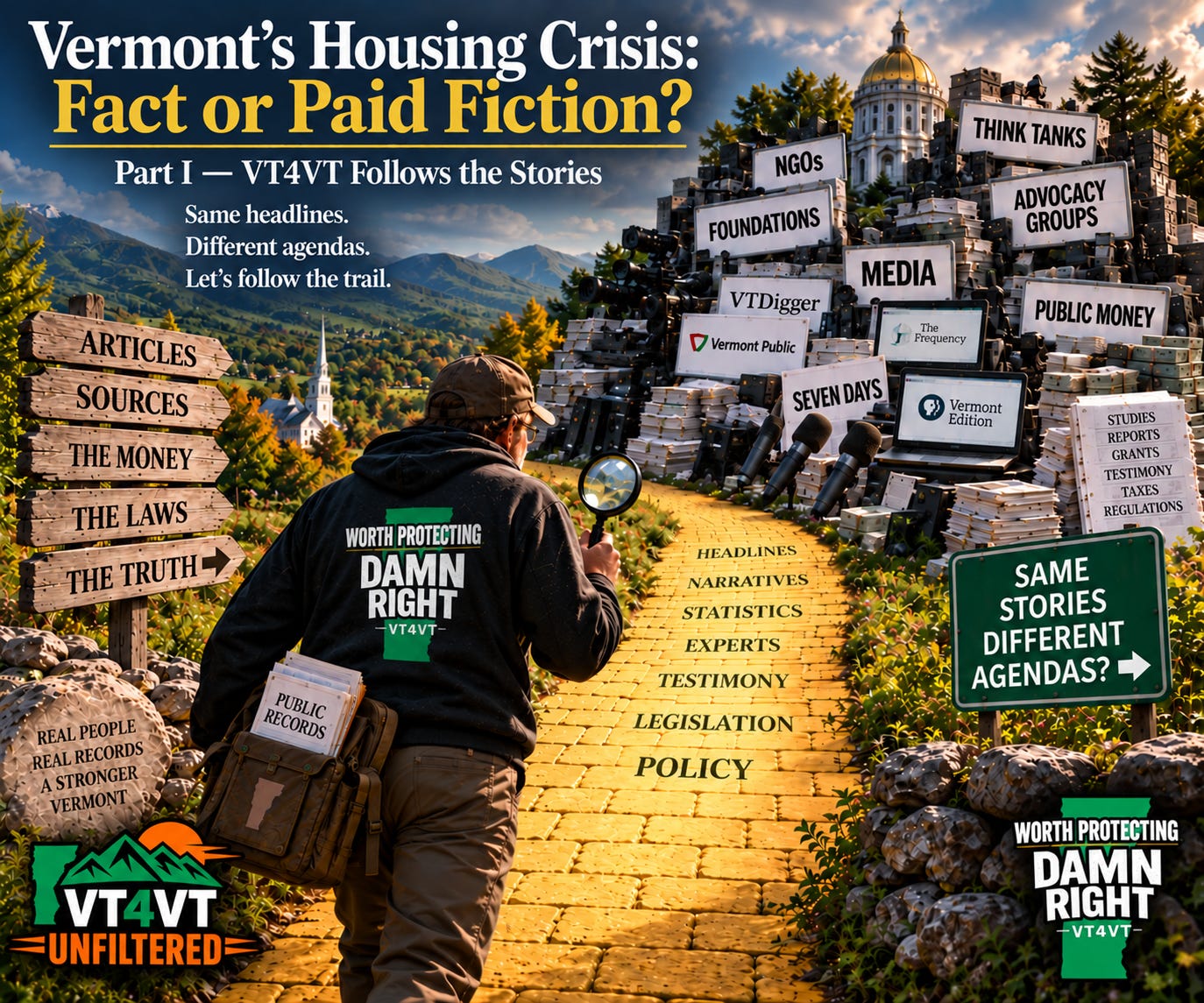
VT4VT decided to follow the stories.
This is the first part of a larger investigation. We will follow the stories, then their sources and funding, then the laws, taxes and public money, and finally go backward through the historical record to determine when Vermont’s current housing problem actually began and how its definition changed.
The headline asks whether what Vermonters are being told is fact or paid fiction. The answer cannot come from the headline. It has to come from the records.
June 23 — Better Housing, Not Just More Housing
On June 23, John Bossange, president of Better (not Bigger) Vermont, published a VTDigger commentary titled “Vermont needs better housing, not just more of it.”
Bossange did not deny that Vermont had an affordability problem. He wrote that few would deny a shortage of lower- and moderately-priced housing. But he challenged the idea that simply constructing more units was the answer.
He criticized where new housing was being built, what it looked like, its effect on Vermont’s landscape and infrastructure, and whether new construction was actually serving Vermont families rather than wealthy second-home and out-of-state buyers.
The housing argument was already becoming more complicated than a simple unit count.
That same day, a solicitation later reposted online sought Vermont empty nesters living in houses that might now be larger than they needed. It asked whether people were living in homes that had once fit their families but no longer matched their household size.
At that point, the question was not only how many homes Vermont had built. The size of existing homes and the number of people occupying them had entered the discussion.
June 30 — The Pushback Begins
A week later, Mickey Nowak responded to Bossange in VTDigger with “Vermont has bigger fish to fry than housing aesthetics.”
Nowak challenged Bossange’s concern about the appearance and location of new development and argued that Vermont had more pressing problems.
This was still an argument primarily about what Vermont should build and how it should build it.
That did not last long.
July 8 — “Hoarding”
On July 8, Steven Farnham published a letter under a much more provocative headline:
“Vermont doesn’t have a housing shortage. It has a hoarding problem.”
Farnham argued that vacant second homes and short-term rentals, rather than an absolute lack of houses, were driving the problem. He described Vermont’s housing as “mal-distributed” and pointed toward homes purchased during the pandemic that were subsequently vacant or used as short-term rentals.
Whether that argument is supported statewide is something we will examine later.
For purposes of following the stories, however, the change was clear.
The argument was no longer simply about Vermont failing to build enough houses.
Who owned the houses and how they were using them had entered the debate.
July 22 — Short-Term Rentals
Two weeks later, Seven Days published “Vermont Towns Try Different Ways to Regulate Short-Term Rentals.”
The original print headline was even more direct:
“Housing Crunch | Short-term rentals are eating into the housing stock of some Vermont towns.”
The article examined communities including Stowe, Burlington and Woodstock and described municipalities considering different approaches to regulating short-term rentals.
Seven Days disclosed that its short-term-rental figures came from the Vermont Housing Finance Agency, which in turn uses data from AirDNA to estimate active listings on platforms such as Airbnb and Vrbo.
That methodology counts entire homes listed for short-term rental during the reporting period, not individual rooms inside occupied houses. Municipal registries can produce different numbers because definitions and registration requirements vary.
Those details become relevant later in this investigation.
For now, another category of privately owned property had moved squarely into Vermont’s housing-crisis discussion.
July 31 — Who Owns the Homes?
On July 31, Bossange returned, this time with Jerry Ward, in another VTDigger commentary:
“Vermont is not for sale.”
Their argument had moved well beyond the design of new housing.
They wrote that Vermont’s housing crisis was not fundamentally about scarcity but about who owns the homes Vermont already has, criticizing investors and speculators and challenging housing projections based on anticipated population growth.
In a little over a month, the public argument had traveled from what new houses should look like to who should own Vermont’s existing houses.
Then the tax discussion arrived.
August 3 — Second Homes Become a Tax Question
On August 3, Vermont Public reporter Carly Berlin published “Vermont Democrats turn to second home taxes as a matter of principle — and cash.”
The article reported that all five Democratic candidates then competing for governor and lieutenant governor supported raising taxes on second homes in some form. Republican Gov. Phil Scott and Lt. Gov. John Rodgers opposed adding new taxes and argued for controlling education spending and expanding the tax base.
Berlin’s reporting also exposed a problem that runs throughout the second-home debate:
Nobody seemed to have one number for how many second homes Vermont actually has.
Census estimates placed Vermont at just under 50,000 seasonal homes, about 14% of the housing stock.
A Vermont Housing Finance Agency analysis of municipal property-tax data identified approximately 14,500 seasonal homes that generally would not be suitable for year-round habitation.
A preliminary Vermont Department of Taxes analysis flagged roughly 70,000 properties that could potentially fall within a proposed second-home category, although the analysis was incomplete.
Those aren’t three estimates of precisely the same thing. They use different definitions and datasets.
Yet all three numbers can easily become “second homes” once they enter political conversation.
Berlin also reported that Vermont already had taxes directed at this area. A tax on second-home sales enacted in 2024 had applied to roughly 7,300 transactions over two years and generated about $28 million in preliminary revenue. A 3% surcharge on short-term-rental stays had also been enacted.
Housing was no longer simply a construction question.
It was becoming a classification and taxation question.
August 5 — One Crisis, or Several?
Two days later, Bryan Sell published “Vermont’s housing crisis isn’t one problem: it’s three.”
Sell argued that Vermont communities were dealing with different combinations of problems: conversion of housing into short-term rentals, an aging workforce unable to support a large construction expansion, and long-term depopulation.
His argument challenged a statewide one-size-fits-all solution.
A short-term-rental problem in a ski town is not necessarily the housing problem facing another Vermont community. Building housing in a town losing population for decades does not necessarily solve anything there. Even within a single town, different neighborhoods can experience different pressures.
That raises a question that will return throughout this series:
When Vermont says it has a housing crisis, are we always talking about the same crisis?
August 12 — The Counterargument Gets Louder
By August 12, the disagreement was becoming difficult to miss.
Matt Swenson published “Vermont doesn’t have a housing shortage. It has an affordability problem.”
He argued that increasing rental vacancy and newly constructed units in Vermont’s largest rental market had not made available housing affordable to working Vermonters. His argument was not that supply is irrelevant, but that supply alone no longer explained what people were experiencing.
That same day, Donna Brown published “Part-time Vermonters aren’t the enemy.”
Brown described her family as long-time part-time Vermonters and challenged the idea that vacation-home owners like her caused the housing problem. She also raised another issue that will become relevant later in this series: members of her extended family had moved to Vermont decades earlier, but none of their eight adult children remained in the state.
Housing was being discussed as the reason people could not stay in Vermont.
Brown was asking whether Vermont had sufficiently examined why they left.
August 20 — Housing, Jobs and Part-Time Vermonters
On August 20, two more competing arguments appeared.
Tray DuClos published “Vermont’s housing shortage is the real obstacle to growth.”
He connected housing availability to Vermont’s ability to support workers and economic expansion and pointed to zoning restrictions as one cause.
Lew Holzman responded to the developing second-home debate with “Don’t punish Vermonters who split their time here.”
Holzman questioned how Vermont would distinguish among different kinds of part-time residents and asked whether attracting more businesses should receive greater attention.
By this point, Vermont’s housing discussion included construction, affordability, zoning, workforce, economic growth, short-term rentals, second homes, part-time residents and taxation.
Five days later, another element moved to the center of the discussion.
August 25 — The People Inside the Houses
On August 25, Vermont Public and VTDigger published Carly Berlin’s “Why Vermont’s housing shortage can’t be explained by population size alone.”
The article began with a Burlington homeowner whose family circumstances had changed. A house that once held a family of four was now occupied by one person.
Berlin reported that roughly 70% of Vermont households consist of only one or two people and that Vermont’s average household size has fallen to approximately 2.2 people.
The Vermont Housing Finance Agency analysis cited in the story estimated that Vermont needed to add nearly 22,000 homes between 2015 and 2024 simply to account for declining household size within the existing population.
The theory is not difficult to understand.
If four people once occupy one house and later form three or four separate households, the same number of people can require more housing units. An aging population, divorce, children leaving home and more people living independently can therefore increase housing demand without equivalent population growth.
Those demographic changes are real.
But the story also moved Vermont’s housing conversation into different territory.
The question was no longer only how many homes existed.
The number of people living inside them was now part of the explanation.
August 26 — Spare Bedrooms
The next morning, Vermont Public’s daily news podcast, The Frequency, asked:
“Could one solution to the state’s housing crunch lie in that spare bedroom?”
Its episode was titled “How spare bedrooms fit into Vermont’s housing crisis.”
A demographic statistic about declining household size had now become a discussion about unused bedrooms inside existing Vermont homes.
Two days later, on August 28, Vermont This Week featured the issue under “Population size alone doesn’t explain Vermont’s housing shortage.”
Then, on August 31, Vermont Edition devoted a 35-minute program to “Household sizes are shrinking in Vermont, burdening the housing market,” featuring Berlin and Vermont Housing Finance Agency executive director Maura Collins.
In less than a week, household size moved through a reported news story, a daily-news podcast, a statewide public-affairs program and a Vermont Edition discussion.
The underlying demographic change is documented. Vermont households have become smaller over decades.
The policy question is different:
When does the number of people living inside a privately owned home become part of the state’s explanation for a housing shortage?
Nobody had seized anyone’s spare bedroom. Nobody had proposed assigning another family to an empty room.
But the conversation had moved.
Vermont was no longer talking only about what it had failed to build. It was increasingly talking about how existing homes were occupied.
August 30 — Short-Term Rentals Push Back
Between those broadcasts, another constituency entered the argument.
On August 30, Jenny Dewar published “Short-term rentals are vital to Vermont’s economy.”
Dewar identified herself as a board member of the Vermont Short-Term Rental Alliance. She argued that short-term rentals support local businesses and workers, generate property and meals-and-rooms taxes, and represent only a small portion of Vermont’s housing stock.
Whether those claims withstand examination is a question for the source material.
But her response demonstrated that the people whose properties were increasingly being discussed as part of the housing problem were now pushing back publicly.
September 7 — Affordability Returns
On September 7, Walter Carpenter published “We chose this housing crisis.”
Carpenter agreed that housing was obstructing growth but focused on the relationship between wages and rents. His argument was that Vermont had created an economy in which people increasingly could not afford to live where they worked.
That brought the conversation back toward something Vermont had been discussing long before the summer of 2026:
affordability.
The difference was that affordability was now sharing the stage with second homes, STRs, household size, spare bedrooms, zoning, development, workforce shortages and property taxation.
September 11 — What Is a Seasonal Home, Anyway?
Then WCAX asked a deceptively simple question:
“What qualifies as a seasonal home in Vermont?”
The answer complicated the numbers being used throughout the debate.
WCAX reported that Vermont had nearly 50,000 homes defined as seasonally vacant, approximately 14% of the state’s housing stock.
But Housing Commissioner Alex Farrell explained that many seasonal properties are not capable of supporting year-round habitation because they may lack insulation, water, sewer capacity or other infrastructure necessary for full-time occupancy.
Farrell also said something else worth recording.
The role of seasonal housing in Vermont’s housing stock, he said, “really hasn’t changed.”
According to Farrell, seasonal housing actually represents a smaller share of Vermont’s housing stock than it did in 1990.
His explanation for why seasonal homes receive more attention today was not that Vermont suddenly acquired tens of thousands of them.
It was that Vermont stopped building enough housing.
That brings us almost full circle.
So What Exactly Is the Crisis?
In less than three months, Vermonters encountered several explanations.
Vermont needs more homes. Vermont needs different homes. Vermont needs more affordable homes. Zoning prevents homes from being built. Short-term rentals remove homes from the year-round market. Second homes consume housing capacity. Smaller households require more housing units. Spare bedrooms represent existing capacity that is not housing another household. Seasonal homes may be contributing to scarcity, although many are not suitable for year-round occupancy and seasonal housing itself has existed at substantial levels in Vermont for decades.
ome of those explanations can simultaneously be true. Some may describe statewide conditions while others apply primarily to particular towns or housing markets. Some are measurements drawn from public records, while others are estimates, models or political arguments. In several cases, the explanations directly contradict one another.
Reading the headlines alone cannot tell us which is which, so VT4VT went underneath them. We followed the original statistics, reports, organizations, funding, testimony and public records to see where these claims came from and what the underlying evidence actually establishes.
So VT4VT went underneath them.
Where did the statistics originate? Who conducted the research? Who commissioned it? Who funded the organizations producing it? Which organizations supplied experts to reporters and lawmakers? Which groups are advocating for particular housing policies? Was any of the journalism itself supported through outside funding? Which of these arguments subsequently appeared before legislative committees?
Funding does not automatically make research wrong, and disagreement does not automatically make it right.
But when research, advocacy, journalism and public policy begin using the same numbers and language, Vermonters deserve to know where those ideas originated and who paid to develop or promote them.
That is where we go next.
Part II — VT4VT Follows the Sources and Money
Fact or Paid Fiction?
We’re following the records.
Help Us Build the Record
VT4VT is collecting information from Vermonters as part of the FY2027 Vermont Property Tax Cycle. If your property has been reassessed, complete the anonymous Vermont Reassessment Survey. We are also collecting municipal grand lists, reassessment notices, tax-rate information and final property-tax bills so survey trends can be compared with public records.
If you have access to your municipality’s grand list, send us the document or a link to where it is published. The more towns we can document, the better we can determine what is happening across Vermont rather than relying on individual examples.
Support Independent Vermont Research
VT4VT keeps these stories, public-record investigations and research free for everyone.
VT4VT is part of Fort Aldrich Incorporated, a 501(c)(3) nonprofit organization.
If you find this work valuable, support VT4VT with a paid subscription through Substack or make a tax-deductible donation through VT4VT Donate. Your support helps fund public-record collection, data analysis, research and the tools we are building for Vermonters.
You can also support the work by mailing a check or money order payable to:
Fort Aldrich Incorporated
P.O. Box 302
Northfield, VT 05663
Please note VT4VT in the memo on your payment if you would like your contribution directed to the VT4VT program.
Keep the stories free. Support the research. Make a donation to the cause.
Can’t donate? Help investigate. Submit public records, grand lists, reassessment information or sourced research and help us build the most comprehensive independent Vermont property-tax and public-policy database possible.
VT4VT.com
Worth Protecting.
Damn Right.
Sources — Part I
John Bossange — “Vermont needs better housing, not just more of it” — VTDigger — June 23, 2026
https://vtdigger.org/2026/06/23/opinion-vermont-needs-better-housing-not-just-more-of-it/
“Is your home the wrong size for you? Help Vermont Public explore the state’s changing housing needs” — contemporaneous Reddit post — June 23, 2026
The post solicits empty nesters living in houses larger than they need and growing families unable to find larger homes, and directs respondents to Vermont Public reporter Carly Berlin. We have not located a corresponding original Vermont Public webpage, so this should continue to be identified specifically as the contemporaneous Reddit post rather than a Vermont Public article.
https://www.reddit.com/r/vermont/comments/1udqkxe/is_your_home_the_wrong_size_for_you_help_vermont/
Mickey Nowak — “Vermont has bigger fish to fry than housing aesthetics” — VTDigger — June 30, 2026
https://vtdigger.org/2026/06/30/opinion-vermont-has-bigger-fish-to-fry-than-housing-aesthetics/
Steven Farnham — “Vermont doesn’t have a housing shortage. It has a hoarding problem.” — VTDigger — July 8, 2026
https://vtdigger.org/2026/07/08/opinion-vermont-doesnt-have-a-housing-shortage-it-has-a-hoarding-problem/
Aaron Calvin and Hannah Bassett — “Vermont Towns Try Different Ways to Regulate Short-Term Rentals” — Seven Days — July 22, 2026
The original print headline was “Housing Crunch | Short-term rentals are eating into the housing stock of some Vermont towns.” Seven Days says its STR figures came from VHFA using AirDNA data and counted entire homes rather than rooms in occupied homes.
https://www.sevendaysvt.com/news/housingcrisis/vermont-towns-try-different-ways-to-regulate-short-term-rentals/
John Bossange and Jerry Ward — “Vermont is not for sale” — VTDigger — July 31, 2026
https://vtdigger.org/2026/07/31/opinion-vermont-is-not-for-sale/
Carly Berlin — “Vermont Democrats turn to second home taxes as a matter of principle — and cash” — Vermont Public — August 3, 2026
This is the original Vermont Public page containing the competing Census, VHFA and preliminary Department of Taxes estimates discussed in Part I.
https://www.vermontpublic.org/local-news/2026-08-03/vermont-democrats-second-home-taxes-principle-cash
Bryan Sell — “Vermont’s housing crisis isn’t one problem: it’s three” — VTDigger — August 5, 2026
https://vtdigger.org/2026/08/05/opinion-vermonts-housing-crisis-isnt-one-problem-its-three/
Matt Swenson — “Vermont doesn’t have a housing shortage. It has an affordability problem.” — VTDigger — August 12, 2026
https://vtdigger.org/2026/08/12/opinion-vermont-doesnt-have-a-housing-shortage-it-has-an-affordability-problem/
Donna Brown — “Part-time Vermonters aren’t the enemy” — VTDigger — August 12, 2026
https://vtdigger.org/2026/08/12/opinion-part-time-vermonters-arent-the-enemy/
Tray DuClos — “Vermont’s housing shortage is the real obstacle to growth” — VTDigger — August 20, 2026
https://vtdigger.org/2026/08/20/opinion-vermonts-housing-shortage-is-the-real-obstacle-to-growth/
Lew Holzman — “Don’t punish Vermonters who split their time here” — VTDigger — August 20, 2026
https://vtdigger.org/2026/08/20/opinion-dont-punish-vermonters-who-split-their-time-here/
Carly Berlin — “Why Vermont’s housing shortage can’t be explained by population size alone” — Vermont Public — August 25, 2026
https://www.vermontpublic.org/local-news/2026-08-25/vermonts-housing-shortage-cant-be-explained-population-size-alone
Vermont Public — “How spare bedrooms fit into Vermont’s housing crisis” — The Frequency — August 26, 2026
https://www.vermontpublic.org/podcast/the-frequency-daily-vermont-news/2026-08-26/how-spare-bedrooms-fit-into-vermonts-housing-crisis
Vermont This Week — “Population size alone doesn’t explain Vermont’s housing shortage” — August 28, 2026
https://www.pbs.org/video/august-28-2026-udsaqy/
Jenny Dewar — “Short-term rentals are vital to Vermont’s economy” — VTDigger — August 30, 2026
VTDigger identifies Dewar as a board member of the Vermont Short-Term Rental Alliance.
https://vtdigger.org/2026/08/30/opinion-short-term-rentals-are-vital-to-vermonts-economy/
Mikaela Lefrak and Jon Ehrens — “Household sizes are shrinking in Vermont, burdening the housing market” — Vermont Edition — August 31, 2026
Guests included Carly Berlin and Vermont Housing Finance Agency executive director Maura Collins.
https://www.vermontpublic.org/show/vermont-edition/2026-08-31/household-sizes-are-shrinking-in-vermont-burdening-the-housing-market
Walter Carpenter — “We chose this housing crisis” — VTDigger — September 7, 2026
https://vtdigger.org/2026/09/07/opinion-we-chose-this-housing-crisis/
Michael Buchanan — “What qualifies as a seasonal home in Vermont? New tax raises questions” — WCAX — September 11, 2026
The URL is dated September 12, but WCAX lists the story as published September 11, 2026 at 10:01 p.m. EDT.
https://www.wcax.com/2026/09/12/what-qualifies-seasonal-home-vermont-new-tax-raises-questions/
