This is my opinionated response to a Windsor, Vermont candidate's article. I believe the article is emotionally compelling, but its conclusions are based on assumptions that don't reflect Vermont's economic realities. Regardless of where you fall on the political spectrum, these ideas influence the people voting alongside us. If we want to change Vermont's direction, we have to persuade our neighbors with facts, evidence, and common sense. Otherwise, we'll continue down the same path of rising costs and declining affordability.
It describes younger and lower-income Vermonters watching wealthier people enjoy the state while they work behind counters, serve food, clean properties, and struggle to afford housing themselves.
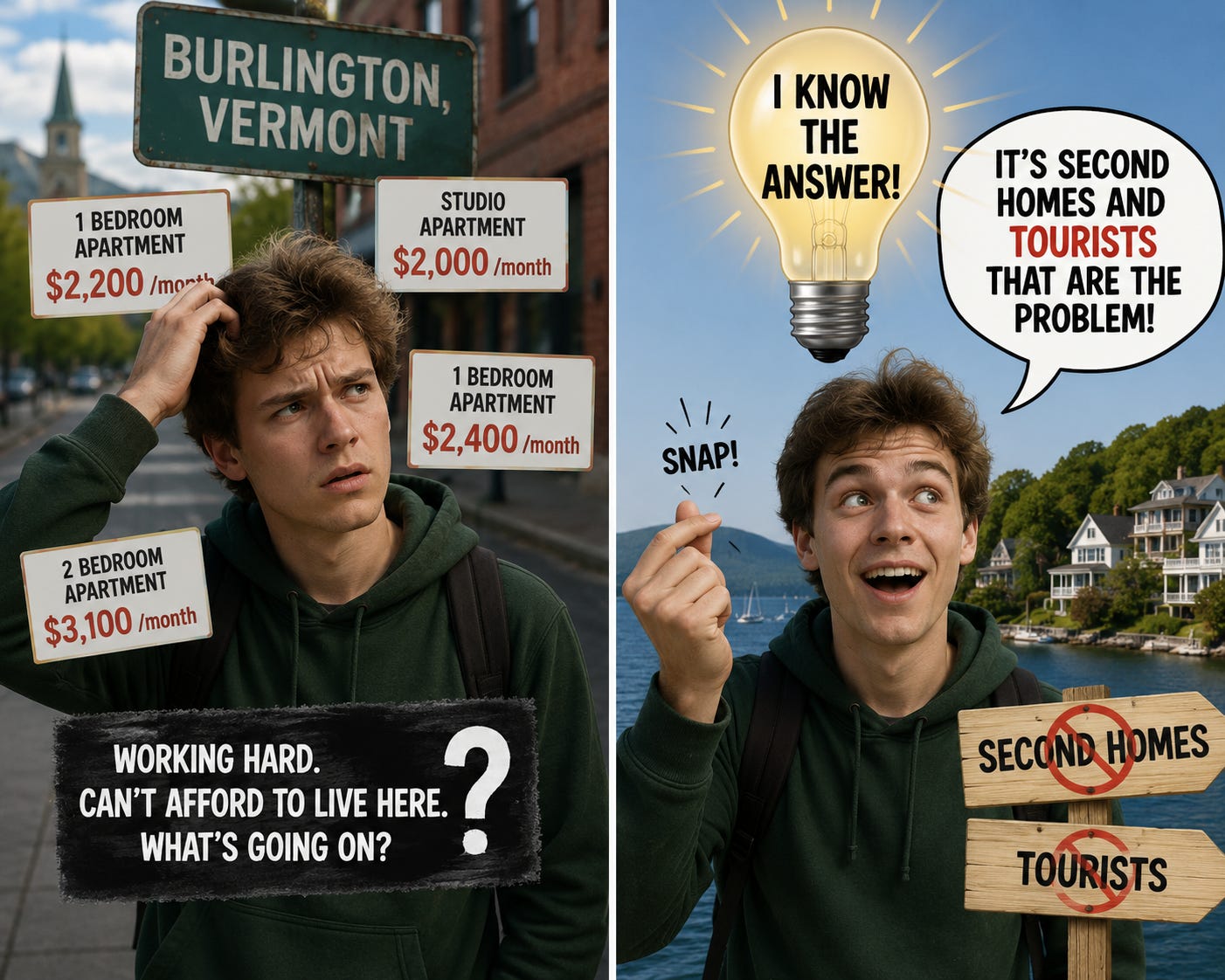
That frustration is real.
The economic conclusions drawn from it are not.
This is increasingly how policy is made in Vermont. A politician identifies someone who is struggling—a recent college graduate, a restaurant worker, a gas-station employee, a renter, or a young family—and promises to make life more affordable by regulating somebody else.
The landlord is blamed.
The second-home owner is blamed.
The tourist is blamed.
The short-term rental is blamed.
The outside investor is blamed.
The proposed solution is always some combination of more restrictions, higher taxes, tighter controls, public subsidies, and greater government management of property.
It sounds compassionate.
It rarely survives contact with arithmetic.
The Promise of Cheap Housing That Does Not Exist
The underlying promise is that if Vermont could somehow free up enough second homes, vacation properties, and short-term rentals, ordinary Vermonters would once again be able to rent apartments for prices that disappeared decades ago.
That is fantasy.
A two-bedroom condominium in Stowe is not going to become an $800 apartment because the State restricts short-term rentals. A restored farmhouse in a rural town is not automatically workforce housing. A seasonal camp is not a substitute for an apartment near employment. A ski property does not become affordable merely because politicians change who may occupy it.
Even if a property moves from short-term rental use to the long-term market, its underlying costs do not disappear.
The acquisition price remains.
The mortgage remains.
The property taxes remain.
The insurance remains.
The heating costs remain.
The maintenance remains.
The cost of repairs remains.
The regulatory burden remains.
A government order can change the legal use of a property. It cannot repeal mathematics.
Housing Costs Are Supported by Income
Housing is expensive in major economic centers because those places also contain high-paying employment.
Boston housing is extraordinarily expensive, but the regional economy includes technology, finance, medicine, engineering, higher education, biotechnology, law, and large corporate employers. A qualified person in the right field can plausibly earn a substantial salary within several years of entering the workforce.
That does not make Boston affordable. It means the housing market is attached to a large employment and income base.
Rural Vermont does not have that economy.
A young person graduating from high school in rural Vermont has a far lower likelihood of earning $100,000 by age 26 than a similarly situated person entering a high-paying industry in a major metropolitan area. Many Vermont jobs remain concentrated in hospitality, retail, healthcare support, education, government, construction, and small business.
The central problem is therefore not simply the price of housing.
It is the relationship among housing prices, wages, employment, taxation, and opportunity.
Vermont politicians repeatedly discuss housing while avoiding the harder question:
What jobs will allow people to pay for it?
Building housing without creating economic opportunity does not solve affordability. It creates additional units that residents still cannot afford without subsidies, roommates, public assistance, or outside income.
Housing Follows Opportunity
Vermont’s political establishment increasingly treats housing construction as though it creates an economy.
The normal sequence runs in the opposite direction.
Businesses invest.
Jobs are created.
Wages rise.
Workers relocate.
Household demand grows.
Housing is built.
Vermont’s strategy often appears to be:
Build tens of thousands of units, subsidize them, declare them necessary, and assume employers, workers, and economic growth will follow.
That is not a housing strategy. It is a speculative population policy.
The State has cited an upper housing-production target of more than 41,000 additional homes by 2030. That number is not a direct count of 41,000 Vermont families currently standing without housing.
It is a planning target based on assumptions about future household growth, desired vacancy rates, replacement units, homelessness, and projected demand.
The government establishes the target, fails to meet the target, and then points to that failure as evidence of an emergency.
That is a self-reinforcing political argument.
It does not prove that building the projected number of units will produce affordable communities or sustainable demand.
A Second Home Is Not Automatically a Lost Home
Second homes are regularly presented as housing removed from Vermonters.
Sometimes that is true in a specific market. A short-term rental located in a tight residential neighborhood may compete with a potential long-term rental.
But Vermont policymakers routinely take that narrow possibility and apply it to the entire state.
A second home in a remote rural town may exist precisely because there is insufficient local employment to support year-round demand. The property may be a camp, an old farmhouse, a ski property, a seasonal residence, or a building that required extensive rehabilitation.
Removing the seasonal buyer does not create a local family capable of purchasing and maintaining it.
In many cases, outside investment is the reason the building still exists.
Vermont is filled with old structures requiring roofs, foundations, heating systems, insulation, wiring, plumbing, septic work, and constant maintenance. A person purchasing one of those properties may inject hundreds of thousands of dollars into the local economy before spending a single night there.
That work supports electricians, plumbers, carpenters, painters, roofers, masons, excavators, HVAC technicians, landscapers, snowplow operators, cleaners, engineers, surveyors, property managers, hardware stores, lumberyards, and local suppliers.
These are Vermont jobs.
A town with a large number of second homes may also receive substantial property-tax revenue from owners who use fewer year-round public services. Those owners do not generally send children to the local school system. They do not use municipal services at the same rate as full-time households. Yet they still support the tax base and maintain local property.
That does not mean every second home is economically beneficial.
It means the argument is more complicated than “outsider owns house, Vermonter loses house.”
Tourism Supports More Than Hotels
Tourism is also treated as though it merely allows wealthy visitors to consume Vermont while local people serve them.
That framing ignores how much of Vermont’s rural economy depends on outside discretionary spending.
Visitors pay for lodging, meals, recreation, retail goods, transportation, repairs, guides, equipment, and services. Seasonal homeowners pay contractors, cleaners, landscapers, plumbers, electricians, roofers, and property managers.
Visitors also support Vermont agriculture.
They come looking for Vermont beef, dairy, cheese, maple syrup, vegetables, beer, baked goods, and meals associated with local farms. Restaurants advertise partnerships with Vermont producers because customers value that connection.
Walk through a successful Vermont farmers market and look at the parking lot. Many customers are visitors and seasonal residents. They are not there because the products are inexpensive. They are there because local food is part of the Vermont experience.
Many working Vermonters cannot routinely spend premium prices on artisan products, specialty meats, farm-to-table meals, or a small organic sandwich costing well into the double digits.
Visitors with discretionary income can.
Their spending helps sustain farms and producers that Vermont’s small year-round population may not be able to support alone.
Driving those customers away will not turn hospitality workers into engineers or bring manufacturers into rural towns. In many communities, the money and jobs will simply disappear.
The Cost of Creating Rental Housing
The article also reflects a recurring assumption that landlords determine rent largely through greed.
That avoids the actual cost structure.
Take an older Vermont property being converted into three apartments. The project may require structural repairs, fire separation, new electrical systems, plumbing, insulation, heating, parking, wastewater expansion, water-system improvements, professional design, and permitting.
The rehabilitation can easily cost several hundred thousand dollars.
A $600,000 loan at approximately 6.5 percent over 30 years produces a principal-and-interest payment of roughly $3,800 per month. Add $12,000 to $15,000 annually in property taxes, and the monthly carrying cost approaches $4,800 to $5,050 before insurance, maintenance, vacancies, utilities, legal expenses, snow removal, reserves, and any return to the owner.
Three units would therefore need to generate roughly $1,600 to $1,700 each just to cover the mortgage and property taxes, before insurance, maintenance, utilities, vacancies, repairs, legal expenses, and reserves are considered.
A lawmaker may denounce $1,800 rent, and a tenant may genuinely be unable to afford it, but neither fact changes what it costs to create and operate the unit. Property taxes, regulatory expenses, financing costs, and the risk of prolonged nonpayment or property damage are all eventually built into rent. Government cannot keep increasing the cost and risk of providing housing and then condemn the provider because the finished product is expensive.
The Politics of Manufactured Villains
This is the political bait. Struggling people are told that someone else possesses the thing they need. Renters are told that landlords are withholding affordable apartments. Younger Vermonters are told that second-home owners took their houses. Workers are told that tourists are exploiting them, and voters are told that outside investors are hollowing out their communities. Government then promises to restore affordability by taking greater control of property.
The argument is emotionally satisfying because it creates a clear villain. It is economically dangerous because it conceals the actual causes of the problem. Vermont housing is expensive because property, construction, financing, utilities, taxes, regulation, and maintenance are expensive, while wages and employment opportunities remain weak. Eliminating one category of property owner does not eliminate any of those costs.
Amanda Janoo and Selective Decentralization
The same contradiction appears in the political movement represented by gubernatorial candidate Amanda Janoo.
Janoo speaks about local democracy, community power, and opposition to excessive centralization. Yet much of her broader policy framework relies on greater statewide coordination, public administration, economic planning, healthcare restructuring, housing intervention, and redistribution.
She may oppose forced school consolidation. She may object to centralized land-use decisions under Act 181.
But opposing specific centralized decisions while proposing centralized systems elsewhere is not principled decentralization.
It is selective centralization.
The position is effectively:
Centralized authority is dangerous when it produces outcomes I oppose, but necessary when it advances policies I support.
That is not an alternative to Vermont’s current political structure. It is another effort to control it.
Vermont already concentrates enormous power in state agencies, administrative formulas, appointed officials, regional planning bodies, unelected boards, and centralized funding systems.
Changing who operates that machinery does not reduce centralization.
It changes the operator.
Sympathy Is Not an Economic Policy
Dylan Morse’s article is not unusual.
It represents a common political style in Vermont: begin with genuine hardship, assign blame to a politically convenient group, and propose greater government intervention without calculating the resulting costs.
The recent graduate struggling with rent deserves an honest explanation.
The gas-station employee deserves an honest explanation.
The hospitality worker living with roommates deserves an honest explanation.
They should not be told that an $800 apartment is waiting to be released if Vermont can only drive away enough second-home owners and tourists.
That apartment does not exist, will never exist, has never existed. Just because housing seems less affordable now doesn’t mean the older generation paid two raspberries for this house in the 40s 50s 60s …. until now. Honestly it was 5 raspberries in the 90s but don’t’ tell them. That was only because the real estate market collapsed. I could offer solutions like remove equity firms ability to own single family through 3 family homes in the state of Vermont, but that’s a different article.
The cost of the property, taxes, financing, maintenance, insurance, and regulation will not permit it to exist without subsidy or someone else absorbing the loss.
The honest answer is harder.
Vermont needs stronger wages.
It needs real employers from economic opportunity outside government and subsidized sectors like NGOs working in the state, productive investment, lower ownership costs (property-tax restraint, low or no permit fees (end act 250/181/121), this comes from housing where jobs and infrastructure can support it.
Most importantly, Vermont needs candidates who understand that compassion does not suspend economics.
Dylan’s article may sound persuasive to someone who is suffering.
That is precisely why it is dangerous, and why this mentality landed us here. I once had a boss who said “if we keep going in this direction were going to get where we are going, and that is where we are right now.
It offers the struggling person a villain instead of an explanation and a political promise instead of a workable solution.
Vermont has had enough of that kind of politics, no thank you Dylan.

Mark Aldrich, Founder
VT4VT.com
Worth Protecting.
Damn Right.