Long before Brigham v. State, Act 60, statewide education property taxes, statewide reassessment, or Vermont’s modern land-use laws, Vermont underwent an earlier transformation in the relationship between its towns and state government.
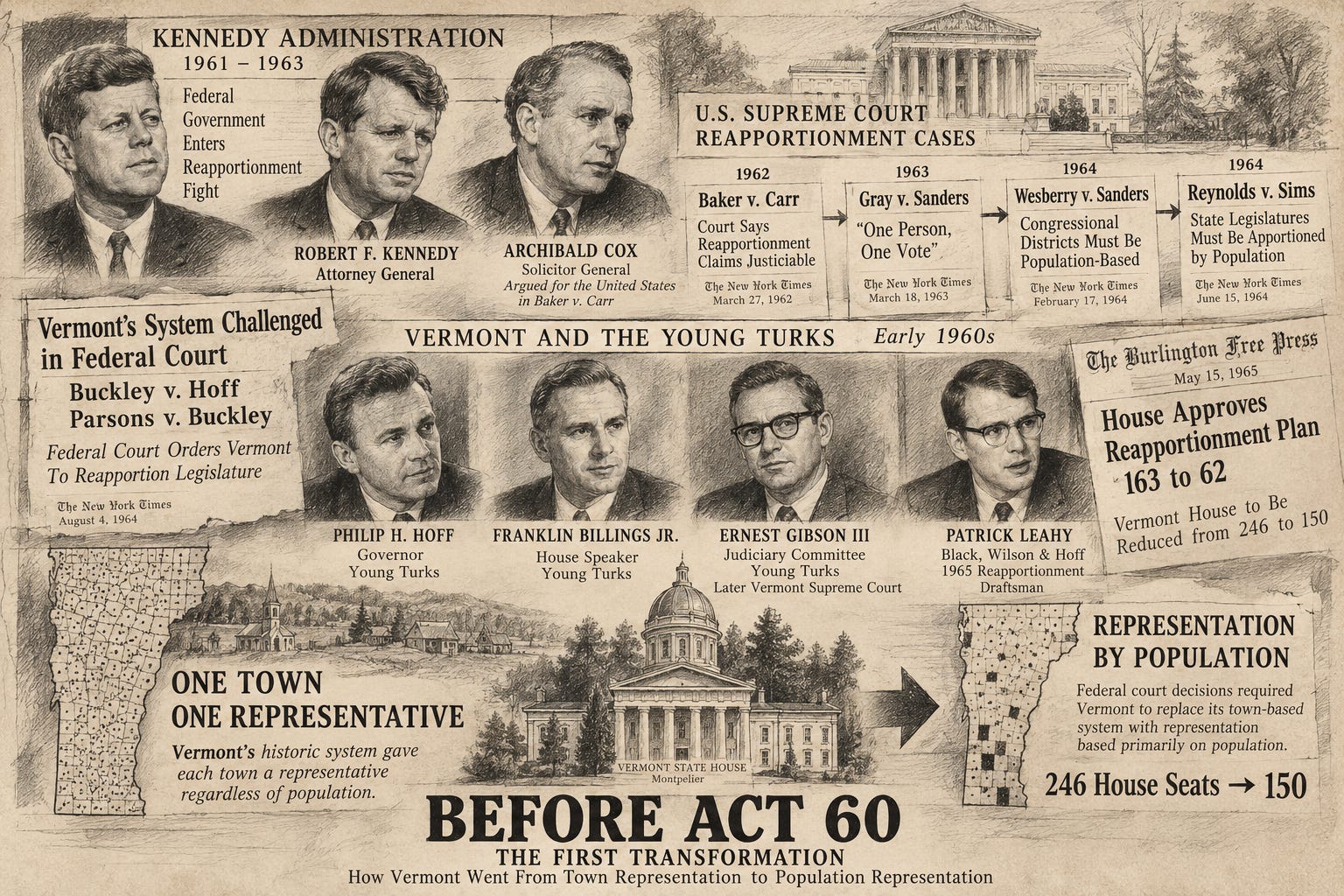
For generations, representation in the Vermont House was based primarily on towns, not population. Beginning in 1777, Vermont’s Constitution provided for representation from individual municipalities. After 1785, each town effectively had one representative in the House regardless of its population. The Vermont Senate, created in 1836, used a different county-based system. Vermont SOS
By 1963, the differences were enormous. Stratton had 38 residents and one representative. Burlington had 35,531 residents and one representative. A House majority could be assembled from towns containing only about 9 percent of Vermont’s population. The 22 largest municipalities contained more than half the state’s population but elected only 22 of the House’s 246 members. Vermont SOS
The federal court that eventually struck down the system put the disparity another way: Burlington’s single representative represented more people than the representatives of Vermont’s 107 smallest towns combined. Justia Law
Vermont had maintained that basic structure for generations.
In the 1960s, federal constitutional law changed it.
Baker v. Carr Opens the Federal Courthouse
The first major case in the sequence came from Tennessee.
In Baker v. Carr, decided March 26, 1962, the United States Supreme Court held that a constitutional challenge to legislative apportionment presented a justiciable question that federal courts could hear under the Equal Protection Clause. The decision did not itself establish the final population formula that Vermont would eventually face, but it opened federal courts to challenges against state legislative apportionment systems. Justia Law
The Kennedy administration participated directly.
Archibald Cox, President John F. Kennedy’s Solicitor General, appeared for the United States as amicus curiae and urged reversal. The Supreme Court’s record identifies Cox along with Assistant Attorney General Burke Marshall and other Justice Department attorneys on the federal government’s brief. Pressbooks
Cox had been more than a career government attorney. The Justice Department’s official biography says he had been an adviser and speechwriter for John F. Kennedy before taking leave from Harvard Law School in 1961 to become Kennedy’s Solicitor General. DOJ specifically identifies Baker v. Carr among the cases in which Cox participated. Department of Justice
The federal government was therefore an active participant in the litigation that opened state legislative apportionment to federal constitutional review.
Georgia and “One Person, One Vote”
The next major decision came from Georgia.
In Gray v. Sanders in 1963, the Supreme Court considered Georgia’s county-unit system for statewide elections. The system gave political weight to geographic units rather than simply treating each statewide vote identically.
The Court struck it down.
Justice William O. Douglas’s opinion supplied the phrase that became synonymous with the reapportionment revolution:
“one person, one vote.”
Gray concerned Georgia’s county-unit system, not Vermont’s Legislature, but it became part of the developing constitutional doctrine of equal voting power. Digital Library of Georgia
Another Georgia case followed.
In Wesberry v. Sanders, decided February 17, 1964, the Supreme Court held that congressional districts within a state had to contain populations as nearly equal as practicable. New Georgia Encyclopedia
Then came the decision that reached directly into state legislatures.
Reynolds v. Sims
On June 15, 1964, the Supreme Court decided Reynolds v. Sims.
The Alabama case addressed representation in a bicameral state legislature. The Court held that the Equal Protection Clause required the seats in both chambers of a state legislature to be apportioned substantially on a population basis. The Court rejected the argument that states could structure one legislative chamber along the geographic model of the United States Senate. FindLaw Caselaw
The Court wrote that legislators represent people rather than geographic areas and that a citizen’s voting power could not constitutionally depend substantially on where that citizen lived. FindLaw Caselaw
Vermont’s House was built around the principle now under constitutional attack.
One town.
One representative.
Whether the town contained 38 residents or 35,531.
Vermont Goes to Federal Court
The Vermont litigation was Buckley v. Hoff.
The “Hoff” was Philip H. Hoff, Vermont’s Democratic governor.
On August 3, 1964, a three-judge panel of the United States District Court for the District of Vermont concluded that both chambers of the Vermont General Assembly were malapportioned under the federal constitutional standards then emerging from the Supreme Court. Justia Law
The court documented the numbers.
Vermont had a population of 389,881.
The House had 246 representatives.
Ten of Vermont’s largest municipalities contained 132,790 people—more than one-third of Vermont’s population—but together elected only ten House members.
Twenty-two of Vermont’s largest municipalities contained 195,692 people, more than half the state population, but elected only 22 members of the 246-member House.
Meanwhile, 124 towns containing less than 12 percent of Vermont’s population elected a majority of the House. Justia Law
The old Vermont system could not survive the new federal standard.
The Supreme Court subsequently acted in Parsons v. Buckley, 379 U.S. 359, in January 1965. Vermont’s own Secretary of State history records that the General Assembly was ordered to reapportion itself by July. ChanRobles
Vermont had to construct a new Legislature.
The people who would do it were already changing Vermont politics.
The Young Turks
In the 1961–62 Legislature, an informal group of younger legislators had begun working together across party lines.
They called themselves the Young Turks.
The Vermont Historical Society identifies the group as:
Franklin Billings Jr. (R-Woodstock)
Philip Hoff (D-Burlington)
Richard Mallary (R-Fairlee)
John Downs (R-St. Johnsbury)
Ernest Gibson III (R-Brattleboro)
Sanborn Partridge (R-Proctor)
Byron Hathorn (R-Hartford)
Anthony Farrell Jr. (D-Norwich)
Stanton Lazarus (D-Middlebury)
William Jay Smith (D-Pownal). Vermont Historical Society
Franklin Billings later described how the group operated. They initially met socially, but their meetings developed into discussions of legislation and coordinated decisions about who would speak and when. Vermont Folklife
The 1962 election changed their position inside Vermont government.
Philip Hoff was elected governor.
Franklin Billings became Speaker of the House.
Billings then placed members of the Young Turks into important committee leadership positions. Richard Mallary became chairman of Appropriations, John Downs chaired Ways and Means, Sanborn Partridge chaired Education, and Ernest Gibson III chaired Judiciary. Mallary later recalled that virtually every member of the group became a committee chair, vice chair or Speaker. Vermont Folklife
Billings also remembered another initiative from that period: what he described as the first organized effort at education funding equalization in the state. Vermont Folklife
That effort predates Brigham and Act 60 by more than three decades.
Philip Hoff, Franklin Billings and Reapportionment
The federal order put reapportionment directly in front of this new political leadership.
Former Gov. Tom Salmon later recalled that Hoff and Billings summoned moderate Republicans and Democrats and urged them to reach agreement rather than leave Vermont in violation of the federal order. Salmon described the eventual reapportionment effort as bipartisan. Vermont Folklife
Historian Howard Ball’s account describes Hoff and Billings leading a bipartisan coalition that accepted Vermont’s obligation to comply with the federal order. Speaker Billings appointed a 25-member Blue Ribbon Legislative Reapportionment Committee, chaired by conservative Republican Emory “Em” Hebard of Glover. Over approximately four months, the committee considered numerous proposals before producing a plan that changed representation from town equality to population equality. Vermont Historical Society
The political resistance was substantial.
Some legislators feared small towns would lose their independent voices. Others opposed what they viewed as federal judicial interference in Vermont government. Vermont SOS
Rep. Frank Hutchins represented 113 people in Stannard. During the debate, he reportedly cried while urging his colleagues not to forget his town. Stratton Rep. Vivian Tuttle represented only 38 residents but voted for the reapportionment legislation that would end Stratton’s guaranteed individual House seat. Vermont SOS
The final plan passed 163–62. It reduced the House from 246 members to 150. Vermont Historical Society
Gov. Hoff signed the House reapportionment measure as Act 98 on June 17, 1965. Act 96 addressed the Senate, while Act 97 established the continuing reapportionment process. A special election under the new system followed in November 1965. Vermont SOS
Vermont’s Legislature commemorated the transformation fifty years later, describing Act 98 as ending each organized municipality’s guarantee of its own representative. Vermont General Assembly
Ernest Gibson III
One member of the Young Turks deserves particular attention because his name appears again decades later.
Ernest W. Gibson III was a Republican representative from Brattleboro and chairman of House Judiciary during the Young Turks’ rise. Verm\ont Folklife
His political career became a judicial career.
Gibson later served as chairman of the Vermont Public Service Board, became a Superior Court judge and eventually joined the Vermont Supreme Court.
In 1997, Gibson was one of the five Vermont Supreme Court justices participating in Brigham v. State.
The 1960s and 1990s episodes should not be collapsed into a claim that Gibson’s later judicial decision resulted from his earlier political associations. The documented chronology is narrower: a member of the political group involved in Vermont’s 1960s transformation remained in Vermont government long enough to participate in the constitutional education-finance case that preceded another major restructuring three decades later.
Before following Gibson to Brigham, however, another young Vermont lawyer enters the 1965 record.
Patrick Leahy
Patrick Leahy graduated from Georgetown University Law Center in 1964. Finding Aids
Before returning to Vermont, Leahy had an encounter with Attorney General Robert F. Kennedy.
Leahy described it himself decades later in an oral-history interview with then-Rep. Peter Welch.
Kennedy invited four law students to meet with him. Leahy recalled spending approximately an hour and a half with Kennedy, after which Kennedy asked Leahy to join the Department of Justice.
Leahy declined.
He told Welch that he and his wife, Marcelle, were Vermonters and wanted to return home. StoryCorps Archive
Leahy returned to Burlington and joined Black, Wilson and Hoff.
The Hoff was Gov. Philip Hoff. StoryCorps Archive
The young lawyer who had declined Robert Kennedy’s invitation to join the Justice Department was therefore practicing at the firm associated with the governor whose administration was confronting Vermont’s federal reapportionment order.
Then Leahy became directly involved in reapportionment.
Leahy Helps Draft the New System
The Vermont House’s official journal later recorded what happened:
“Speaker Billings had hired two young legislative draftsmen to create a reapportionment plan—one was a young lawyer named Patrick Leahy.”
The same legislative account records the 163–62 vote and says Gov. Hoff watched from the gallery after playing a significant role behind the scenes while allowing Republican Speaker Billings to lead publicly. Vermont General Assembly
Another biographical account identifies Leahy in January 1965 as an assistant to Lewis E. Springer Jr., legislative draftsman for the Vermont General Assembly, giving us an important lead on the drafting operation that should be examined further. Wikipedia
The documented sequence is:
Robert F. Kennedy offered Patrick Leahy a position in the Justice Department. Leahy declined and returned to Vermont. He joined Philip Hoff’s Burlington law firm. He then worked in legislative drafting while Vermont was constructing its response to the federal reapportionment order. Speaker Franklin Billings later identified Leahy as one of two young draftsmen employed to create the reapportionment plan. StoryCorps Archive
The records reviewed by VT4VT have not established that Kennedy’s recruitment of Leahy was connected to Leahy’s subsequent Vermont reapportionment work.
The Kennedy administration nevertheless had its own documented role in the national reapportionment litigation through Solicitor General Archibald Cox and the Justice Department’s participation in Baker v. Carr. Pressbooks
What Changed in Vermont
The structural result can be measured.
Before 1965, Vermont’s House contained 246 representatives. Towns with populations ranging from 38 people to more than 35,000 each elected one representative. Vermont Historical Society
After reapportionment, the House contained 150 representatives elected from population-based districts. Fifty-two of the original 72 new House districts contained two or more towns. Small towns that previously elected their own representative were grouped into larger districts. Vermont Historical Society
The Vermont Secretary of State summarizes the transformation plainly: Act 98 reduced the House from 246 to 150 and created a system of representative districts. Vermont SOS
Hoff himself later said reapportionment had “changed the nature of Vermont” and “changed the nature of the Legislature.” Vermont Folklife
Historian Howard Ball concluded that the change reduced the political force of Vermont’s old localism and shifted legislative power geographically as representation followed population rather than independent towns. Vermont Historical Society
That was the first transformation in the history we are following.
It occurred more than thirty years before Brigham.
The People Did Not Disappear
The careers of several participants continued through Vermont government.
Franklin Billings Jr. went from Speaker of the House to the Vermont Superior Court, then the Vermont Supreme Court, where he became chief justice, and finally the federal bench after President Ronald Reagan nominated him to the U.S. District Court for Vermont in 1984. Federal Judicial Center
Patrick Leahy was appointed Chittenden County State’s Attorney in 1966 and later elected to the United States Senate in 1974. UVM’s archival biography confirms his 1966 appointment and subsequent service on governmental commissions under Governors Hoff, Deane Davis and Thomas Salmon. Finding Aids
Ernest Gibson III moved from the Young Turks and House Judiciary into the judiciary and ultimately the Vermont Supreme Court.
Three decades after the federal courts required Vermont to restructure legislative representation, the Vermont Supreme Court confronted a different constitutional dispute involving Vermont towns.
This time the issue was not how many legislators a town could elect.
It was whether the educational opportunities available to a child could depend upon the taxable property wealth of the community in which that child lived.
The case was Brigham v. State.
And Ernest Gibson III was still there.
What the Public Record Establishes So Far
The record establishes that Vermont’s 1965 reapportionment was part of a national constitutional transformation produced through federal litigation. The Kennedy administration participated in Baker v. Carr through Solicitor General Archibald Cox. Federal courts subsequently found Vermont’s existing legislative system unconstitutional under the developing population-equality standard. Pressbooks
The record also establishes that Hoff, Billings and Gibson belonged to the bipartisan Young Turks; that Hoff and Billings helped assemble support for Vermont’s reapportionment response; that Billings appointed the committee responsible for developing the plan; and that Patrick Leahy participated in the legislative drafting process after returning from Georgetown and joining Hoff’s Burlington law firm. Vermont Folklife
Leahy’s own oral history establishes that Robert Kennedy had previously invited him to join the Justice Department and that Leahy declined because he wanted to return to Vermont. StoryCorps Archive
Those records document relationships and chronology. They do not, on the evidence located so far, establish a coordinated Kennedy-administration effort to direct Vermont’s reapportionment legislation, nor do they establish that the Young Turks’ 1960s work caused the Brigham decision three decades later.
The next public-record question is narrower: who were the remaining lawyers, legislators and institutional actors involved in Vermont’s reapportionment litigation and drafting, and where do they appear later in Vermont’s education-finance history?
That record takes us toward Brigham, Act 60 and the next transformation.
Sources
Vermont Secretary of State — A History of Legislative Apportionment
https://sos.vermont.gov/vsara/learn/general-assembly/legislative-apportionment/history
Vermont Historical Society — Howard Ball, “From ‘One Town, One [or Two] Vote[s]’ to ‘One Person, One Vote’: The Impact of Reapportionment on Vermont, 1777–1992”
https://vermonthistory.org/journal/misc/ReapportionmentOnVermont.pdf
Vermont Historical Society — Young Turks Reunion Papers, 1964–2000
https://vermonthistory.org/documents/findaid/YoungTurks.pdf
Vermont Folklife — Under the Golden Dome, Program 2: The Young Turks
https://www.vtfolklife.org/big-bucket-media-fieldwork/program-2-the-young-turks
Vermont Folklife — Under the Golden Dome, Program 3: Philip Hoff and Reapportionment
https://www.vtfolklife.org/big-bucket-media-fieldwork/program-3-philip-hoff-and-reapportionment
Vermont General Assembly — House Journal, May 14, 2015, historical account of the 1965 reapportionment
https://legislature.vermont.gov/Documents/2016/Docs/JOURNAL/hj150514.pdf
Vermont General Assembly — 50th Anniversary of the 1965 Reapportionment
https://legislature.vermont.gov/Documents/2016/Docs/CALENDAR/hc160121a.pdf
Buckley v. Hoff, 234 F. Supp. 191 (D. Vt. 1964)
https://law.justia.com/cases/federal/district-courts/FSupp/234/191/1671351/
Baker v. Carr, 369 U.S. 186 (1962)
https://supreme.justia.com/cases/federal/us/369/186/
Federal Judicial Center — Baker v. Carr
https://www.fjc.gov/node/7499216
U.S. Department of Justice — Solicitor General Archibald Cox
https://www.justice.gov/osg/bio/archibald-cox
Digital Library of Georgia / New Georgia Encyclopedia — Gray v. Sanders (1963)
https://dlg.usg.edu/record/nge_ngen_gray-v-sanders-1963
New Georgia Encyclopedia — Wesberry v. Sanders (1964)
https://www.georgiaencyclopedia.org/articles/government-politics/wesberry-v-sanders-1964/
Reynolds v. Sims, 377 U.S. 533 (1964)
https://caselaw.findlaw.com/court/us-supreme-court/377/533.html
StoryCorps Archive — Peter Welch and Patrick Leahy
https://archive.storycorps.org/interviews/peter-welch-and-patrick-leahy/
University of Vermont Special Collections — Patrick J. Leahy biographical record
https://scfindingaids.uvm.edu/agents/people/1579
Federal Judicial Center — Franklin S. Billings Jr.
https://www.fjc.gov/history/judges/billings-franklin-s-jr
VT4VT Surveys This Week
Is Vermont Affordable?
Can Vermonters still afford to live here?
This anonymous survey looks at the real financial pressure facing Vermont households, including housing costs, taxes, utilities, everyday expenses, and whether people are considering leaving Vermont because of affordability.
Your responses help VT4VT document what Vermonters are experiencing and identify trends that deserve deeper public-record research.
Take the survey:
https://survey.vt4vt.com/s/003-leaving/
Property Tax Affordability Survey
How are Vermont property taxes affecting your household?
This anonymous survey focuses specifically on property taxes, reassessments, rising property values, tax bills, and whether Vermont homeowners believe their current property-tax burden is sustainable.
The results will help VT4VT compare taxpayer experiences with municipal grand lists, tax rates, reassessment data, and other public records as we continue building the FY2027 Vermont Property Tax database.
Take the survey:
https://survey.vt4vt.com/s/004-property-tax-affordabiltiy/
VT4VT.com
Worth Protecting.
Damn Right.
Help Build the VT4VT Database
VT4VT is building an independent statewide database documenting Vermont property taxes, reassessments, Grand Lists, legislation, housing policy and government decisions.
Complete the anonymous Vermont Reassessment Survey:
Vermont Reassessment Survey
Submit your municipality’s Grand List:
Submit a Grand List
Vermonters can also help by sharing reassessment notices, final property-tax bills, municipal records and sourced research. Survey responses are used to identify statewide trends and are not presented as identifiable individual taxpayer records.
Read the complete investigation and VT4VT town reports at:
VT4VT Newsstand
VT4VT.com
Support Independent Vermont Research
VT4VT keeps these stories, public-record investigations and research available to Vermonters.
VT4VT is a program of Fort Aldrich Incorporated, a 501(c)(3) nonprofit organization. Support helps pay for public-record collection, data analysis, research and the tools being built to document Vermont property taxes and public policy.
Readers can support the work through a paid VT4VT Substack subscription or through the VT4VT donation option at VT4VT.com.
Checks or money orders may also be made payable to:
Fort Aldrich Incorporated
P.O. Box 302
Northfield, VT 05663
Write VT4VT in the memo if you want the contribution directed to the VT4VT program.
Can’t donate? Submit records, Grand Lists, reassessment information or sourced research. Building the database is part of the work.
YouTube: @Vt4vermont
Substack: VT4VT Substack
X: @vt4vermont
Instagram: @vt4vermont
TikTok: @vt4vt
