Property Values Rose. Jobs Didn’t. Wages Didn’t. Taxes Did.
Act 68 of 2023 and Vermont’s Property Tax Shift
Act 68 of 2023 (H.480) was signed by Governor Phil Scott on June 14, 2023. The law established Vermont’s modern property valuation framework and requires municipalities to conduct regular reappraisals on a statewide schedule.
Many Vermont municipalities had not conducted full reappraisals for years or, in some cases, decades prior to Act 68. During that same period, Vermont experienced substantial increases in residential property values, particularly in rural communities during and after the COVID migration period.
The increase in property values was not accompanied by comparable growth in Vermont manufacturing employment, agricultural income, or rural wages. Property values increased. The underlying rural economy often did not increase at the same rate.
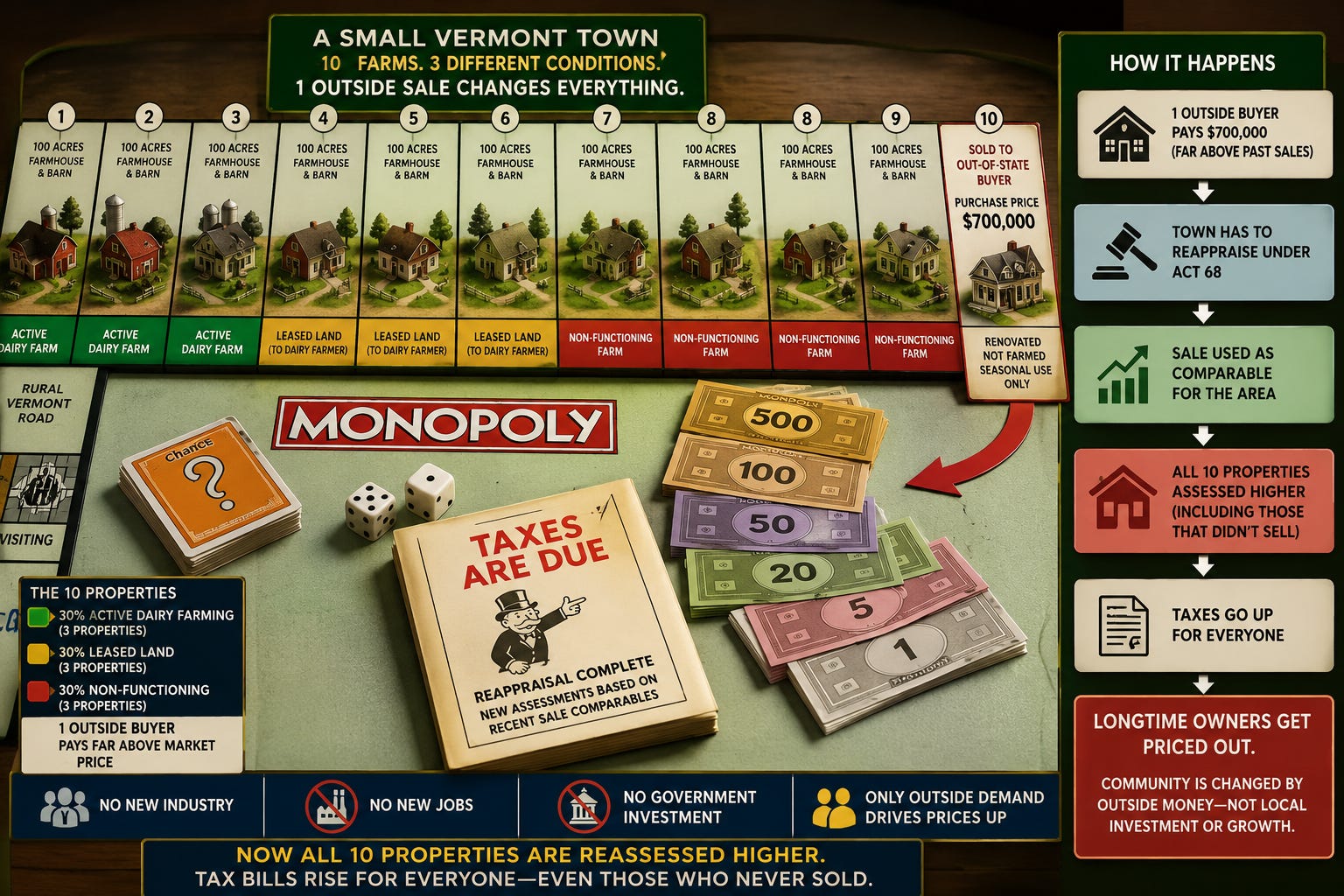
Cause and Effect
During and after COVID, Vermont experienced one of the largest increases in residential property values in its history. Rural communities that had seen little growth for decades suddenly became attractive to buyers from higher-cost states. Properties that might have sold for $150,000 or $200,000 before the pandemic were selling for several times that amount. In many cases, the buyer was not purchasing a working farm, creating jobs, or establishing a business. The buyer was purchasing a residence, a second home, or a seasonal property.
Act 68 of 2023 established Vermont’s statewide reassessment framework and requires municipalities to move property assessments closer to current market value.
The increase in property values did not correspond with comparable increases in Vermont manufacturing employment, agricultural income, or rural wages. A dairy farmer earns milk revenue. A retiree receives a pension or Social Security. A local tradesman earns wages based on work performed. None of those income sources automatically increase because a neighboring property sells for a higher price.
Governor Scott reported that education property taxes increased approximately 40 percent over a five-year period and warned that additional increases would occur without structural reforms to Vermont’s education system.
Vermont Public reported lawmakers debating more than $100 million in property tax relief during 2026 while homeowners continued to face rising bills.
A homeowner whose property was assessed at $150,000 fifteen years ago may now receive an assessment several times higher. The assessment may reflect current market conditions. The homeowner’s income may not. A property owner who never sold, never borrowed against the property, and never realized any financial gain from rising values can still receive a substantially larger tax bill.
One Sale. Ten Farms. No New Jobs.
Ten farms sit on the same rural Vermont road. Each contains approximately 100 acres, a farmhouse, and a barn. Three remain active dairy operations. Three lease land to neighboring dairy farmers. Three are no longer actively farmed. One sits vacant. Most of the farms have been owned by the same families for decades, and the town has not conducted a full reappraisal in years.
No major employer has moved into the area. No manufacturing facility has opened nearby. No commercial development has occurred. Local wages, farm income, and employment remain largely unchanged.
During the COVID migration period, the vacant farm is listed for sale. Before the pandemic, similar farms in the area might have sold for $150,000 to $250,000. Buyers from higher-cost states enter the market. The property receives multiple offers and eventually sells for $700,000.
The new owner renovates the farmhouse, converts the barn into recreational space, and uses the property as a seasonal residence. The owner does not operate a farm, establish a business, or create jobs in the community.
The sale becomes part of the market data used to estimate surrounding property values.
The neighboring farms never sold. Their owners received none of the proceeds from the transaction. They did not receive higher wages, additional farm income, or increased business revenue. The financial gain created by the sale belongs to the seller and the purchaser.
The surrounding market, however, has changed. Comparable sales now reflect higher values than existed before the pandemic. Properties that were never offered for sale may be reassessed using those market conditions.
Act 68 of 2023 requires municipalities to move toward regular reappraisals and assessments that more closely reflect current market values.
The market value of the road increased. The income of the surrounding property owners may not have increased at all. A reassessment converts market appreciation into taxable value, whether the property was sold or not.
Property Tax Protections Used in Other States
Many states have adopted laws designed to protect homeowners from sudden increases in property taxes caused by rapidly rising real estate values. California limits annual assessment increases for many properties until a property is sold or transferred. Florida limits annual homestead assessment increases to 3 percent or inflation, whichever is lower. Michigan limits taxable value growth to inflation or 5 percent. Texas limits annual increases in the taxable value of a homestead to 10 percent plus improvements. Oklahoma limits annual increases for homestead properties to 3 percent.
Other states focus on limiting the amount of tax that can be collected rather than limiting assessments. Massachusetts generally limits annual property tax levy growth unless voters approve an override. Washington limits annual levy growth for taxing authorities without voter approval. Indiana constitutionally limits property tax liability for homestead property.
Several states use a combination of protections. South Carolina limits reassessment increases for many owner-occupied properties over a five-year reassessment cycle. Arizona limits annual increases in the value of limited property. Colorado uses constitutional and statutory mechanisms that adjust residential taxable values when appreciation accelerates.
Although the mechanisms differ, the principle is similar. Market value and household income are different measurements. A property may double in value while the owner’s income remains unchanged. A retired homeowner does not receive a larger pension because neighboring properties sell for more money. A farmer does not receive higher milk prices because real estate values increase. A wage earner does not automatically receive a raise because the housing market becomes more competitive.
Many states responded to that reality by adopting assessment caps, levy caps, tax caps, homestead protections, or combinations of all four.
Vermont’s Current Approach
Vermont currently relies primarily on reassessment and education property tax calculations rather than broad assessment-growth protections for existing homeowners.
Act 68 of 2023 established Vermont’s statewide reassessment framework. The reassessment cycle begins January 1, 2025. The first municipalities are scheduled to complete reappraisals by April 1, 2027.
The policy debate is no longer whether reassessments will occur. The reassessment framework has already been enacted. The debate is whether Vermont should adopt protections similar to those used in other states when rapidly rising market values outpace growth in wages, agricultural income, pensions, and local economic activity.
Research Disclosure
Research assistance provided using OpenAI ChatGPT and Google Gemini.
All factual claims, quotations, statistics, legislative references, vote counts, financial figures, dates, and historical assertions should be independently verified against cited sources.
Primary source documents remain the authoritative source for all factual assertions.
Sources
Act 68 of 2023 (H.480)
https://legislature.vermont.gov/bill/status/2024/H.480
Act 68 of 2023 Summary
https://legislature.vermont.gov/Documents/2024/Docs/ACTS/ACT068/ACT068%20Act%20Summary.pdf
Governor Phil Scott Property Tax Statement
https://governor.vermont.gov/press-release/statement-governor-phil-scott-december-1-tax-letter
Vermont Public Property Tax Relief Article
https://www.vermontpublic.org/local-news/2026-04-30/vermont-lawmakers-divided-over-plan-for-property-tax-relief
Vermont Department of Taxes
https://tax.vermont.gov/property
Vermont Department of Taxes – Valuation and Review
https://tax.vermont.gov/property/valuation-and-review
Vermont Department of Taxes – Common Level of Appraisal (CLA)
https://tax.vermont.gov/property/property-tax-adjustment/cla
Vermont Agency of Commerce and Community Development – Market Data
https://accd.vermont.gov/economic-development/market-data
U.S. Bureau of Labor Statistics – Vermont
https://www.bls.gov/regions/new-england/vermont.htm
USDA National Agricultural Statistics Service – Vermont
https://www.nass.usda.gov/Statistics_by_State/Vermont/
California Proposition 13
https://lao.ca.gov/Publications/Report/3497
Florida Save Our Homes
https://pbcpao.gov/assessment-caps.htm
Michigan Proposal A
https://www.cityofsouthfield.com/departments/assessing/uncapping-residential-property-taxes-overview
Texas Homestead Cap
https://hoodcad.net/homestead-appraisal-cap/
Oklahoma Property Tax Limits
https://www.oklahomacounty.org/Directory.aspx?did=63
Massachusetts Proposition 2½
https://www.mass.gov/guides/proposition-2-12-and-tax-rate-process
Indiana Property Tax Caps
https://www.in.gov/dlgf/understanding-your-tax-bill/tax-bill-101/
Washington Levy Limits
https://dor.wa.gov/forms-publications/publications-subject/tax-topics/property-tax-how-1-property-tax-levy-limit-works
South Carolina Property Tax Limits
https://dor.sc.gov/tax/property
Arizona Property Tax Limits
https://azdor.gov/business/property-tax
Colorado Property Tax Information
https://leg.colorado.gov/agencies/legislative-council-staff/property-tax


